
Cannabis Education
Texas Dispensary Guide: Understanding Medical Cannabis, Hemp Shops, and Austin Searches
Oct
Texas Dispensary Guide: Understanding Medical Cannabis, Hemp Shops, and Austin Searches
Searching for a Texas dispensary can produce a confusing mix of medical cannabis providers, hemp retailers, smoke shops, online menus, and businesses advertising themselves as recreational dispensaries. These results may look similar, but their legal authority and customer requirements can differ considerably.
The first question is therefore about the type of business appearing in your search. Does it operate through Texas’s medical cannabis program? Does it sell consumable hemp products? Is it using cannabis-related language without explaining its licensing status?
As of this review, Texas has not established a legal recreational marijuana dispensary market. The Texas State Law Library identifies recreational marijuana use as illegal under Texas law. A storefront, online listing, or “dispensary” sign does not change that position. Guides at Texas State Law Library
This guide explains how to interpret common dispensary searches, understand medical access, evaluate menus, and distinguish useful information from marketing language.
What Does “Texas Dispensary” Actually Mean?
The word dispensary describes a business in everyday conversation, but it does not establish what that business is authorized to provide.
For educational purposes, it helps to separate three categories.
| Business category | What to establish before relying on its claims |
|---|---|
| Medical cannabis dispensing organization | Whether it has the appropriate Texas medical program authorization |
| Consumable hemp retailer | Whether its registration and individual products comply with applicable hemp requirements |
| Smoke shop or cannabis-branded storefront | What it actually sells and which regulatory framework applies |
A search for weed dispensary in Texas can return any of these categories. Search engines organize results partly around the language businesses use, so appearing for a cannabis keyword does not verify medical licensing.
Likewise, advertisements describing Texas pot dispensaries may use familiar terminology without explaining important distinctions. Readers should look for the legal business name, regulator, licensing category, and customer eligibility requirements.
Clear identification matters more than a familiar green logo, a large review count, or an extensive menu.
Is There a Recreational Dispensary in Texas?
A search for recreational dispensary in Texas should begin with the statewide legal position: Texas does not currently operate a licensed adult-use marijuana retail system.
Businesses may advertise recreational experiences, legal THC, hemp products, or cannabis alternatives. Those descriptions do not create authorization to sell recreational marijuana. Medical program participation and hemp retail compliance each have their own requirements.
The same principle applies to age. Being an adult does not, by itself, establish eligibility to obtain marijuana through Texas’s medical program.
When a website describes itself as a recreational dispensary, useful questions include:
- What specific products does the business offer?
- Which agency regulates those products?
- What license or registration does the business hold?
- Does the website clearly explain customer eligibility?
- When was its legal information last reviewed?
A credible explanation should identify the relevant framework rather than rely on a broad statement that everything on the menu is legal.
For background exploration, visit Zombieshroomsstore.com. Use official regulatory sources to establish legal requirements for a particular product or provider.
How Medical Cannabis Access Works in Texas
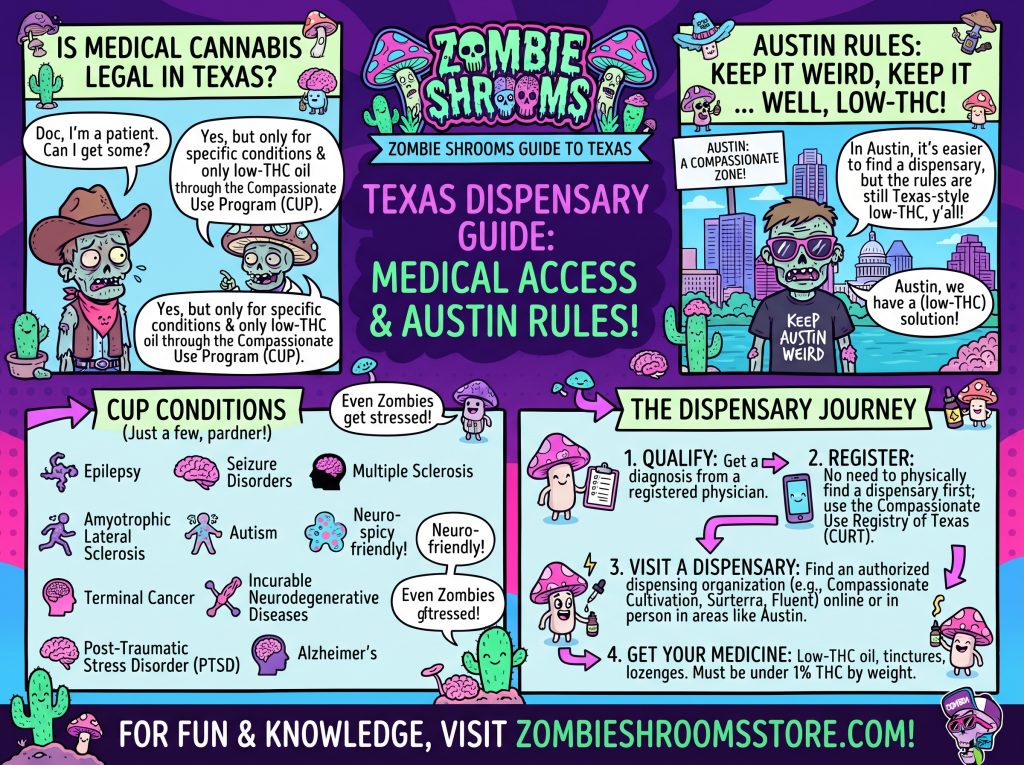
Texas has a medical access pathway through the Compassionate Use Program, often abbreviated CUP or TCUP.
Texas.gov explains that this program allows certain physicians to prescribe low-THC cannabis for medical purposes. It is a regulated medical pathway with eligibility requirements. Texas.gov
The Texas State Law Library’s program guide identifies qualifying conditions that include epilepsy, certain seizure disorders, multiple sclerosis, cancer, post-traumatic stress disorder, conditions causing chronic pain, traumatic brain injury, and several other specified conditions. Its explanation also reflects the current statutory definition of low-THC cannabis as containing no more than 10 milligrams of tetrahydrocannabinols in each dosage unit. Eligibility and treatment decisions still require the appropriate physician assessment. Guides at Texas State Law Library
That terminology deserves attention. Older articles may describe Texas medical cannabis using an earlier percentage limit. An undated blog post can therefore give readers an incomplete picture of the current program.
Understand the Physician’s Role
The medical evaluation is a clinical decision. A qualifying diagnosis does not automatically establish that cannabis is appropriate for every patient with that diagnosis.
A useful consultation should address the person’s medical history, current treatment, relevant concerns, and the proposed treatment plan. Patients should have an opportunity to ask questions and understand the instructions they receive.
Be cautious about websites presenting medical authorization as a guaranteed purchase outcome. Educational content should help readers understand the process without promising approval.
Understand the Registry’s Role
DPS explains that patients must be permanent Texas residents and have a prescription from an approved, qualified physician. The physician enters the prescription into the Compassionate Use Registry of Texas, or CURT. Patients do not separately register with the state or pay a state patient registration fee. DPS also states that an out-of-state prescription cannot simply be filled through the Texas program. Department of Public Safety
For the official patient process, consult the Texas DPS Compassionate Use Program patient FAQs.
Interpreting “Medical Marijuanas Dispensary in Texas Near Me”
People typing “medical marijuanas dispensary in Texas near me” are usually trying to answer a practical question: which legitimate medical provider serves their area?
The useful starting point is authorization. Distance becomes meaningful after the provider’s status is established.
A nearby result might be a physician’s office, a hemp shop, a dispensing location, or a business with a similar name. A map listing may also show an administrative address rather than a patient service location.
When reviewing a provider, establish:
- Its legal business name.
- Its role in the medical program.
- Whether the listed address serves patients.
- Whether appointments or advance arrangements are required.
- Whether its published information is current.
Do not assume that a newly announced business is already authorized to dispense. DPS has expressly stated that conditional licenses do not permit applicants to cultivate, manufacture, distribute, or sell cannabis before final departmental approval. Department of Public Safety
This distinction is especially useful when reading expansion announcements. Selection, conditional approval, final authorization, and an operating patient location can represent different stages.
Austin Texas Weed Dispensary Searches: What to Look For
An Austin Texas weed dispensary search can display many businesses using overlapping language. The best way to assess a result is to identify its business category before interpreting its menu.
Austin-related branding does not establish statewide legal permission. A business can have a professional website, attractive packaging, and positive customer reviews while still requiring closer examination of what it sells and how it is regulated.
Does “Recreational Dispensary Austin Texas” Mean Adult-Use Marijuana?
The phrase recreational dispensary Austin Texas reflects a common search expectation, but it does not describe an established Texas adult-use licensing category.
Readers should look beyond the headline. If a website uses that wording, its explanation should clearly state whether the products are hemp-derived, part of the medical program, or something else.
Avoid treating a city’s reputation, local political debate, or a social media claim as a substitute for applicable law. Changes in enforcement practices also require careful interpretation; they do not automatically establish a licensed retail market.
Comparing Dispensaries in Austin
When researching dispensaries in Austin, compare the quality of their disclosures.
A useful website should explain its identity, service category, product information, and customer requirements in plain language. It should also provide a way to ask questions about discrepancies.
For a weed dispensary Austin listing, check whether the website and map profile agree on the business name and address. Conflicting information is a reason to investigate further.
Reviews can help describe customer service experiences. They are less useful for proving licensing, product composition, or current legal compliance.
Hemp Shops and Medical Dispensaries Follow Different Frameworks
Texas’s consumable hemp market is regulated separately from the medical cannabis program.
The Texas Department of State Health Services describes consumable hemp products as processed or manufactured products containing hemp. Its examples include CBD oils, gummies, infused foods and drinks, and topical products. The agency also publishes licensing, registration, labeling, and enforcement information. Texas DSHS
A hemp registration should therefore be understood within its own scope. It does not establish medical cannabis dispensing authority.
Why Older Hemp Advice Can Mislead Readers
Hemp-related legal information has changed, and older descriptions of delta-8 or other cannabinoids may no longer reflect current Texas requirements.
DSHS states that the Texas schedule affecting delta-8 THC became effective July 31, 2026. The agency explains that only naturally occurring trace amounts from the hemp plant used to manufacture the product are permissible, and that products labeled to contain delta-8 or containing more than trace amounts may be detained and referred to law enforcement. Texas DSHS
This makes broad claims such as “hemp-derived means legal” inadequate. Product composition and the applicable rules matter.
For current agency information, review the Texas DSHS Consumable Hemp Program.
How to Read a Texas 420 Dispensary Menu
A search for Texas 420 dispensary menu may refer to a particular business or simply reflect general shopping terminology. Without identifying the exact operator, it would be misleading to present a verified menu, prices, or current inventory.
An educational menu review should focus on what the listing communicates.
Identify the Product Category
A menu should explain whether an item is a medical program product, a consumable hemp product, an accessory, or another category.
Words such as “premium,” “natural,” and “dispensary quality” do not answer that question. Neither does a strain-style name.
Read Amounts Carefully
Product descriptions can refer to the amount per serving, per dosage unit, or per package. These are different measurements.
For example, a listing that states only a total package amount may leave readers uncertain about the quantity in an individual unit. Clear descriptions should make the measurement understandable without requiring assumptions.
Where a product is prescribed, the patient’s instructions remain essential. A general menu cannot replace an individualized treatment plan.
Match Documentation to the Item
When laboratory documentation is provided, check that it corresponds to the product and batch being described. A report for a different item or an earlier production batch provides limited information about the current listing.
Also examine what the report actually covers. A cannabinoid measurement does not automatically establish that every relevant quality or compliance question has been answered.
A test report is evidence to evaluate within its scope. It is not a universal legal authorization.
You can continue general topic exploration through the Zombieshroomsstore.com homepage, while using regulators and qualified professionals for legal and clinical questions.
What About the Closest Recreational Dispensary to Texas?
The phrase closest recreational dispensary to Texas has no single geographic answer. Texas is large, and a starting point near one border can be hundreds of miles from another.
A responsible answer would need a location, current information about the destination’s retail laws, and verification of a specific business. Naming one store as the closest to the entire state would be unreliable.
There is also an important distinction between a destination’s rules and Texas rules. A business operating lawfully elsewhere does not establish permission to possess its products in Texas. Texas law continues to criminalize unauthorized marijuana possession and delivery. Guides at Texas State Law Library
Educational searches should therefore focus on understanding the relevant jurisdictions. Distance alone does not resolve legality.
Avoid websites that combine travel suggestions with assurances that products can automatically be brought home. Such assurances need a sound legal basis specific to the circumstances.
Common Dispensary Website Red Flags
Some problems are visible before a reader examines individual products.
A website deserves closer scrutiny when it:
- Uses “licensed” without identifying the license category.
- Promises medical approval before an evaluation.
- Describes every cannabinoid as legal without qualification.
- Displays undated legal explanations.
- Uses laboratory documents that do not match the listed item.
- Treats national cannabis headlines as proof of Texas retail authorization.
These are reasons to ask for clearer information. They do not independently establish that a business has violated the law.
Transparent communication should make it easier to identify the operator, understand the service, and verify the claims. Readers should not have to decode vague branding to discover which regulatory framework applies.
A Better Way to Research a Texas Dispensary
Start with a specific question. “How does Texas medical access work?” produces a more useful research path than a broad search for legal weed.
Next, identify the relevant authority. Medical program questions belong with DPS and qualified program physicians. Consumable hemp questions belong with DSHS and the applicable rules.
Then examine the business information. Confirm that the operator’s claims align with the category it says it serves.
Finally, record the date of the information. A current-looking website can contain older paragraphs, and a recent search-engine crawl does not mean every statement on the page has been updated.
For continued educational exploration, visit Zombieshroomsstore.com. Bring legal questions back to official sources and medical questions to a qualified clinician.
Frequently Asked Questions
1. Is recreational marijuana legal in Texas?
Texas has not established legal recreational marijuana sales. A business calling itself a recreational dispensary does not establish adult-use marijuana authorization. Guides at Texas State Law Library
2. How can someone qualify for medical cannabis in Texas?
The Compassionate Use Program requires an eligible Texas resident to receive an appropriate prescription from a qualified program physician. The physician records the prescription in CURT; qualification involves clinical assessment. Department of Public Safety
3. Are all dispensaries in Austin medical cannabis providers?
The word “dispensary” alone does not identify a business’s authorization. Check whether the operator serves the medical program, sells consumable hemp products, or operates in another category.
4. Does a Texas hemp registration authorize marijuana sales?
A hemp registration concerns the consumable hemp framework. It should not be treated as medical cannabis dispensing authority. Texas regulates medical dispensing organizations through a separate program. Frequently Asked Questions
5. Can Texas medical patients grow or smoke their own cannabis?
DPS states that patients cannot grow their own cannabis under the program and that smoking is excluded from the statutory definition of medical use.