
Psychedelics Education
How Long Do Shrooms Last? A Complete Guide to Psilocybin Duration and Effects
Oct
How Long Do Shrooms Last? A Complete Guide to Psilocybin Duration and Effects
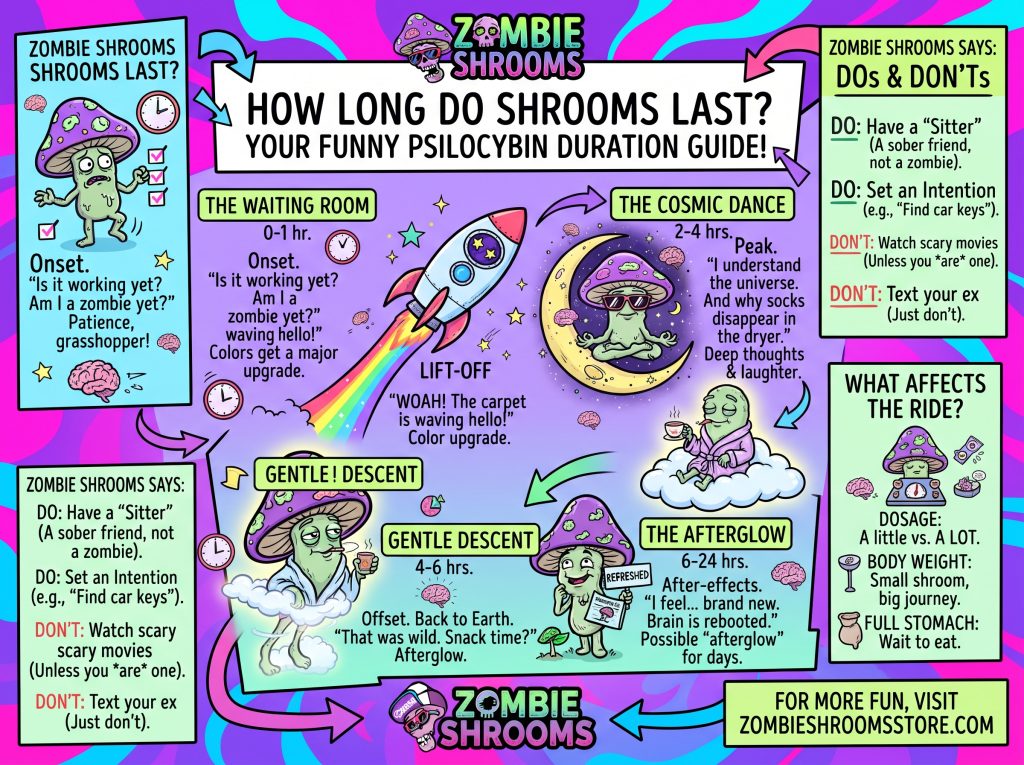
If you have ever asked how long do shrooms last, you are not alone. Interest in psilocybin, the psychoactive compound found in certain mushrooms, has grown sharply across the United States and Canada as researchers, clinicians, and the general public try to understand both its effects and its risks. The short answer is that the acute effects of psilocybin typically begin within 20 to 60 minutes of ingestion and can last anywhere from four to six hours, depending on dose, body chemistry, and how the mushrooms were consumed. The longer answer involves the type of mushroom, the person taking it, and the legal and medical realities that surround these substances in North America.
Psilocybin is a controlled substance in both the United States and Canada. In the U.S., it is classified as a Schedule I drug under federal law, while Canada regulates it under the Controlled Drugs and Substances Act. A small number of jurisdictions have decriminalized personal possession or allowed limited medical or therapeutic access, and some regulated psychedelic products can only be obtained through a physician or approved program. This article is educational and does not encourage illegal use. Instead, it explains duration, appearance, and safety so readers can make informed, lawful decisions. You can explore more informational resources on regulated psychedelic products through trusted educational references that focus on public awareness.
How Long Do Shrooms Last? Understanding the Timeline
The phrase “how long do shrooms last” usually refers to how long the psychoactive experience, often called a “trip,” continues from start to finish. For most people, the full arc runs between four and six hours when the mushrooms are eaten or brewed into tea. Chewing dried mushrooms tends to produce a slower onset because digestion takes time, while tea or lemon-tek methods can bring effects on faster, sometimes within 15 to 30 minutes.
Onset, Peak, and Come-Down Phases
The experience unfolds in recognizable phases. Onset is the first 20 to 60 minutes, when colors may seem brighter and mood may shift subtly. The peak arrives roughly one to two hours after ingestion and is usually the most intense period, lasting two to three hours. The come-down then tapers off over the final one to two hours, though residual feelings of openness or fatigue can linger for the rest of the day.
How Long Do Magic Mushrooms Last Compared to Other Forms
When people ask how long do magic mushrooms last, the answer depends partly on preparation. Fresh mushrooms contain more water and weigh more, so a “dose” by weight differs from dried material. Dried mushrooms are roughly ten times more concentrated by weight. Capsules and chocolates made with mushroom powder may digest at a moderate pace, so onset often falls between the fastest tea method and the slowest whole-mushroom method.
How Long Do Shrooms Stay in Your System?
Duration of effects is different from how long psilocybin stays detectable. The subjective experience ends within hours, but psilocybin and its metabolite psilocin can be detectable in urine for roughly 24 hours and in blood for a shorter window. Hair tests can detect traces for much longer. These detection windows vary by person, dose, and testing method, so no single number fits everyone.
What Affects Psilocybin Duration?
Psilocybin duration is not fixed. Several factors shape how quickly effects begin and how long they last. Dose is the most obvious: a larger amount of psilocybin generally produces a longer and more intense experience. Body weight, metabolism, and liver enzyme activity also play a role, because the body converts psilocybin into psilocin before it acts on serotonin receptors.
Tolerance matters too. People who use psilocybin frequently develop a rapid tolerance, and taking it again within a few days can produce a much weaker effect. Medications, especially antidepressants such as SSRIs, can blunt or alter the experience in unpredictable ways. Because of these variables, two people taking similar amounts of the same mushroom species may report very different timelines.
Cannabis and alcohol are often combined with mushrooms, and this is risky. Both can amplify anxiety, confusion, and impaired judgment. A clear, calm environment and the presence of a sober, trusted person are considered basic safety practices in educational harm-reduction literature.
The Mushrooms Themselves: Psilocybe Cubensis and Relatives
Most recreational and research interest centers on psilocybe cubensis, a species originally described in scientific literature and once known historically as stropharia cubensis. It is the most widely cultivated psilocybin mushroom because it grows relatively easily and produces reliable concentrations of active compounds. Within this species, the golden teacher mushroom is one popular variety, named for its golden-brown caps, though potency varies between batches and growing conditions.
What Do Magic Mushrooms Look Like?
If you want to identify psilocybin mushrooms safely, appearance alone is never enough. What do magic mushrooms look like has a consistent general answer: most psilocybe species have a brownish or golden cap, a slender pale stem, and dark spores. After handling, many develop blue or blue-green bruising, which is caused by oxidation of psilocin. That bruising is a common identifying feature, but it is not proof of anything, because some non-psychoactive mushrooms also bruise.
What Do Psilocybe Mushrooms Look Like in Detail?
To answer what do psilocybe mushrooms look like more precisely, examine the cap, gills, and stem together. Caps are usually convex when young and flatten with age, ranging from caramel to chestnut brown, sometimes with a slight sheen when moist. Gills underneath are dark brown to purplish-black as spores mature, and the stem is typically whitish to yellowish with a fibrous texture. A partial veil may leave a ring on the stem in some species.
What Does Hallucinogenic Mushrooms Look Like Compared to Look-Alikes?
The question what does hallucinogenic mushrooms look like carries a serious warning. Several toxic mushrooms resemble psilocybe species, including some Galerina species that can cause severe poisoning. This is why field identification by beginners is dangerous and why experts use spore prints, habitat, and microscopy rather than a single visual cue. There is no safe shortcut based on appearance alone.
Legal and Medical Context in the U.S. and Canada
Laws shape how people encounter psilocybin far more than biology does. In the United States, psilocybin remains a Schedule I controlled substance federally, though a few states and cities have decriminalized possession or created regulated therapeutic frameworks. In Canada, psilocybin is illegal to possess or sell outside narrow exemptions, but Health Canada has granted limited access for certain medical or end-of-life distress cases and special access programs.
Some regulated psychedelic medications are available only by physician prescription under specific legal pathways. That distinction matters, because unregulated mushrooms sold online or informally carry unknown potency, contamination risk, and legal exposure. Educational material from public health and regulatory sources can help readers understand where legal lines sit in their region. Anyone considering psilocybin for a medical reason should speak with a licensed physician rather than self-medicating.
Because psilocybin affects perception, mood, and judgment, it is not appropriate for everyone. People with a personal or family history of psychosis, bipolar disorder, or severe anxiety may face elevated risk. Pregnant or breastfeeding individuals, and those taking certain psychiatric medications, should treat psilocybin as a serious medical question, not a casual experiment. For more context, see the U.S. National Institute on Drug Abuse overview of psilocybin.
Safety, Risks, and Responsible Awareness
Psilocybin is generally described in clinical literature as having low physiological toxicity, but that does not mean it is risk-free. The main dangers are psychological rather than physical: panic reactions, frightening hallucinations, and dangerous behavior during impaired judgment. Accidents and falls are also possible when perception is distorted, and mixing with other substances raises the risk further.
A second concern is product safety. Mushrooms bought from unregulated sources may be misidentified, laced, or contaminated with mold and pesticides. Because potency varies widely even within the same species, dose is difficult to control. For anyone studying this topic academically, peer-reviewed research summaries on PubMed provide a more reliable foundation than anecdotal forum posts.
Responsible awareness also means respecting the law. Decriminalization in one city does not change federal or national law, and possession can still carry serious consequences. Understanding duration and effects is useful knowledge, but it should never replace professional medical advice or legal guidance.
Frequently Asked Questions
1. How long do shrooms last in the body?
The noticeable effects typically last four to six hours, but psilocybin and psilocin can be detected in urine for about 24 hours. Detection windows vary by dose, metabolism, and the type of test used.
2. Does psilocybin duration change with dose?
Yes. Higher doses generally produce longer and more intense experiences. Even a moderate increase can extend the peak phase and the come-down noticeably.
3. Are golden teacher mushrooms stronger than other varieties?
Not necessarily. The golden teacher mushroom is popular for its moderate and relatively consistent reputation, but potency depends on genetics, growing conditions, and how the material is dried and stored.
4. What do magic mushrooms look like after they bruise?
Bruising usually appears as blue or blue-green discoloration on the stem and cap, caused by oxidation of psilocin. This is a common trait of many psilocybe species but is not a reliable identification method on its own.
5. Can you build a tolerance to psilocybin?
Yes, tolerance develops quickly and can reduce effects within days of repeated use. Most educational sources recommend spacing experiences well apart to avoid diminishing returns.
6. Is psilocybin legal in the United States and Canada?
It remains federally controlled in the U.S. and illegal outside limited exemptions in Canada. Some jurisdictions have decriminalized possession, and certain regulated programs allow medical or therapeutic access. Always check local law and consult a physician.