Psychedelics Education
Psilocybin Gummies
Oct
Psilocybin Gummies: Ingredients, Health Risks and Legal Facts
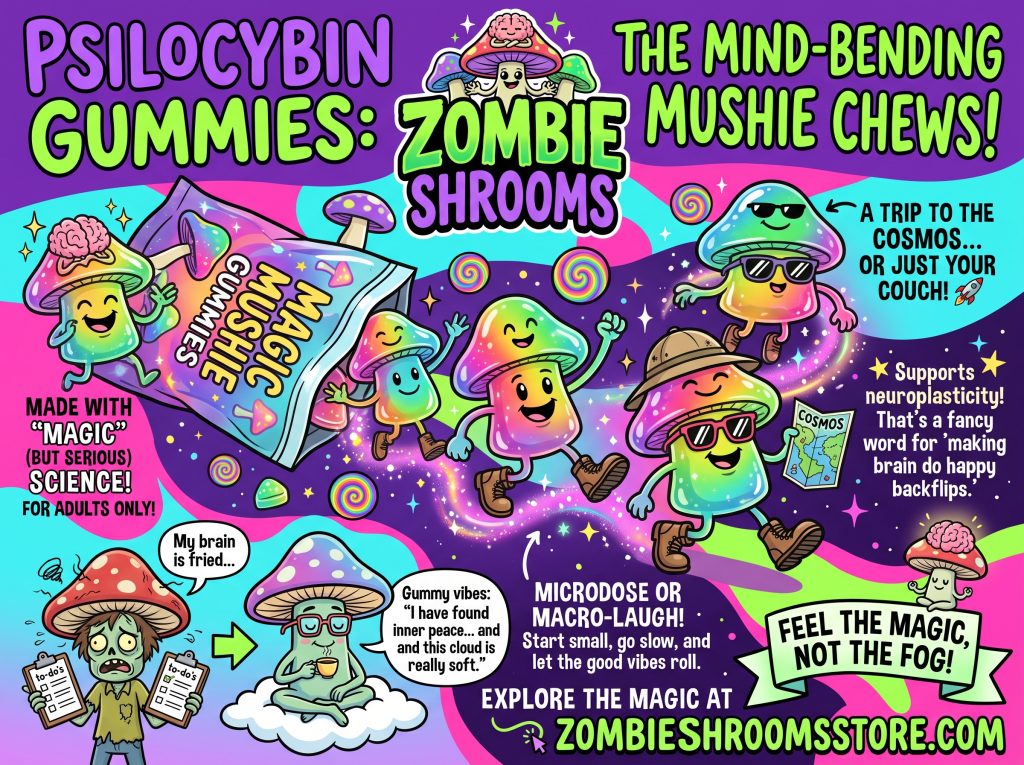
Psilocybin gummies are edible products described as containing psilocybin, a psychedelic compound found in certain mushroom species. However, a product name or package claim does not independently establish what a gummy contains. Some mushroom-labelled edibles contain different psychoactive substances, while others contain non-psychedelic mushroom ingredients.
For readers in the United States and Canada, three questions matter: what is actually present, what risks are involved, and which laws apply? These questions cannot be answered reliably by a colourful package, customer review, or claim that a product is “legal.”
This article explains the terminology, examines ingredient research, and distinguishes regulated access from ordinary retail availability. It provides education rather than recommendations for purchasing or using psychoactive edibles.
What Are Psilocybin Gummies?
The phrase usually refers to gummies represented as containing psilocybin or psilocybin-containing mushroom material.
After ingestion, the body converts psilocybin into psilocin, which contributes to changes in perception and consciousness. Potential experiences include altered sensory perception, emotional changes, and a distorted sense of time. Unwanted effects can include anxiety, confusion, and nausea. Canada.ca
A gummy is a delivery format, rather than a distinct psychedelic substance. Its taste, colour, and shape cannot establish its contents or predict an individual’s response.
What Does “Psilocybe Gummies” Mean?
Psilocybe is a fungal genus that includes psilocybin-containing species. “Psilocybe gummies” is informal product language, not a standardised scientific formulation.
Likewise, “psilocybin mushroom gummies” does not explain whether a product contains mushroom material, an extract, an isolated compound, or something else.
Reliable identification requires stronger evidence than a name. Even a familiar mushroom variety on the packaging does not establish a finished product’s chemical composition.
Mushroom Gummies Are Not One Product Category
Several different products appear under overlapping descriptions. Separating them helps prevent misleading comparisons.
Psilocybin-Containing Edibles
These are products containing psilocybin, potentially alongside psilocin and other constituents. Their legal status depends on the jurisdiction and relevant authorisation.
Amanita-Based Products
Amanita muscaria is different from psilocybin-containing mushrooms. Its discussed psychoactive constituents include muscimol and ibotenic acid.
The FDA states that Amanita muscaria, its extracts, and certain constituents are not authorised ingredients in conventional food. It recommends avoiding foods containing them because of safety concerns. Removing psilocybin from a product description therefore does not establish that the alternative is safe or lawfully marketed. FDA
Non-Psychedelic Mushroom Supplements
Other gummies contain ingredients from mushrooms such as lion’s mane or reishi. These should not be assumed to produce psilocybin-related effects.
A “mushroom blend” needs a specific ingredient explanation. The shared word mushroom does not make these categories chemically or medically interchangeable.
What Research Says About Gummy Ingredients
A central concern with unregulated psychedelic mushroom gummies is the possible difference between advertised and measured contents.
A study published in 2025 examined recreational psychoactive mushroom gummies obtained in Portland, Oregon. Its findings included a product described as psilocybin-free that tested positive for psilocybin. Two products claiming Amanita muscaria extracts did not contain the targeted Amanita constituents muscimol or ibotenic acid.
The authors concluded that labelling in the sampled products was generally inaccurate. Readers can examine the PubMed study on psychoactive mushroom gummy composition. PubMed
What This Study Does and Does Not Prove
The findings concern the products tested. They do not establish the composition of every brand or every batch.
Nevertheless, they demonstrate why packaging cannot be treated as independent chemical verification. They also show that “psilocybin-free” wording may not always match laboratory findings.
Why a Testing Claim Needs Context
A statement that something is “lab tested” leaves several questions unanswered.
Which batch was tested? What substances did the laboratory look for? Does the report match the finished product, or only an ingredient supplied earlier?
A report is useful only within its scope. Chemical testing also cannot establish that a product is an approved treatment or predict how a particular person will respond.
Psilocybin Gummies and Health Risks
Psilocybin can affect perception, judgment, emotions, and physical functioning. A sweet edible does not remove those effects.
Reported risks include frightening experiences, panic, nausea, and impaired judgment. People with certain psychiatric or cardiac conditions may face additional concerns. Combining psychoactive substances can increase the risk of adverse events. Canada.ca
Unknown composition adds another problem: symptoms may reflect substances different from those expected.
Candy-Like Appearance and Accidental Exposure
Gummies can resemble ordinary sweets, creating particular concerns for children.
A CDC report described illness in adults following mushroom gummy ingestion and an accidental exposure involving a three-year-old child who developed sleepiness and vomiting and was hospitalised.
The same investigation identified undisclosed controlled substances in some mushroom-labelled products. This illustrates why neither presentation nor marketing category reliably establishes what an edible contains. MMWR
Severe Reactions Need Medical Attention
Public-health investigations involving mushroom-based edibles have reported serious symptoms, including seizures, pronounced sedation, abnormal heart rates, and uncontrolled movements.
These findings concern particular products and exposures; they should not all be attributed to psilocybin alone.
If someone develops seizures, breathing difficulty, loss of consciousness, or severe confusion after an edible, seek emergency medical help. Preserve the packaging for clinicians if available. cdc.gov
Are Legal Mushroom Gummies Actually Legal?
“Legal mushroom gummies” is a marketing phrase that needs a specific explanation.
Legality depends on the ingredients, location, activity, and applicable authorisation. Possession, manufacture, sale, importation, and supervised administration are separate questions.
A product being offered online does not demonstrate compliance with those rules. Nor does a seller’s willingness to ship it establish that receiving or possessing it is lawful.
Legal Status Is Different From Safety
A substance’s controlled-drug classification and its suitability as a food ingredient involve different regulatory questions.
Something described as outside a particular drug schedule may still face food-law restrictions. Conversely, an authorised research activity does not create general permission for retail sales.
Clear educational writing should identify the rule being discussed instead of using “legal” as an unrestricted label.
Psilocybin Gummies in the United States
Psilocybin remains a Schedule I controlled substance under US federal law. State and local policies may differ, but those differences should not be presented as blanket federal permission. dea.gov
Oregon’s Supervised Services Model
Oregon provides a regulated psilocybin services framework for eligible adults aged 21 and older.
Participants undergo preparation, and administration takes place at a licensed service centre with a licensed facilitator. Oregon states that products cannot be purchased and taken off-site.
The Oregon Health Authority’s explanation of psilocybin services also clarifies that a prescription or medical referral is not required. This is a specific state framework, distinct from an ordinary retail gummy market. oregon.gov
Decriminalisation Is a Separate Concept
Decriminalisation and reduced enforcement do not necessarily authorise commercial manufacturing or sales.
A local policy concerning possession cannot automatically be extended to shipping, product approval, or activity elsewhere. Articles discussing these issues should specify the jurisdiction and check current official rules.
Psilocybin Edibles in Canada
Psilocybin and psilocin are controlled substances in Canada. Activities involving them generally require authorisation.
Health Canada’s psilocybin guidance states that no psilocybin-containing therapeutic product is approved for sale as a medicine in Canada.
It describes restricted pathways that can include clinical trials, the Special Access Program, and individual exemptions in applicable circumstances. These routes have requirements and do not create a general recreational retail market. Canada.ca
A healthcare practitioner’s involvement is not blanket permission to obtain any gummy. A particular authorisation, its scope, and the product involved still matter.
Hallucinogenic Drugs That Are Legal: Why the Question Needs Context
The search “hallucinogenic drugs that are legal” combines several issues that require separate answers.
A substance may be available only through a specific research authorisation or supervised programme. Another may have different restrictions depending on the activity or location.
This makes a simple list potentially misleading. The useful question is whether a particular substance, formulation, and activity is authorised under the applicable rules.
Medical research, restricted access, local enforcement policy, and commercial approval are different categories. None should be substituted for another when describing psilocybin edibles.
Reading a Magic Mushroom Gummies Review
A magic mushroom gummies review may describe flavour, packaging, or a person’s impressions. It cannot reliably establish chemical identity, safety, legality, or therapeutic effectiveness.
A reviewer usually cannot verify which substance produced an experience. They may also have used other products or have expectations that influence their account.
Watch for unsupported statements such as “guaranteed safe,” “legal everywhere,” or “clinically proven” without a relevant study.
A credible educational review explains what was independently verified, what remains uncertain, and whether commercial incentives could influence the presentation.
Clinical Research Versus Retail Shroom Edibles
Research into psilocybin’s therapeutic potential does not establish that retail shroom edibles provide the same intervention.
Clinical studies use defined protocols, participant selection, characterised preparations, monitoring, and outcome assessment. Those controls help researchers understand both potential benefits and harms.
An unfamiliar gummy may differ in composition and lacks the same research framework. Findings from a clinical trial therefore should not be turned into a treatment claim for an untested edible.
Anyone seeking help for a health condition should discuss appropriate care and legitimate research options with a qualified healthcare professional.
Frequently Asked Questions
1. Are psilocybin gummies approved medicines?
A gummy label does not establish medical approval. Health Canada states that no psilocybin-containing therapeutic product is approved for sale as a medicine in Canada.
2. Do all psychedelic mushroom gummies contain psilocybin?
No. Products may claim different ingredients, and laboratory studies have found discrepancies between some labels and measured contents.
3. Are Amanita gummies the same as psilocybin mushroom gummies?
No. Amanita and psilocybin-containing mushrooms have different constituents. The FDA has raised specific safety and food-law concerns about Amanita ingredients.
4. Does a positive review prove a gummy is safe?
No. Personal experience cannot establish chemical composition, identify uncommon risks, or demonstrate legality.
5. Does Oregon’s programme allow take-home psilocybin products?
No. Oregon’s supervised services framework requires administration at a licensed centre and does not permit participants to take purchased products off-site.
Where to Explore Further
For background on psilocybin-containing species and variety names, read Golden Teacher Mushrooms: Origins, Traits and Cultural History.
For a separate discussion of culinary mushrooms and nutritional evidence, explore Are Mushrooms Healthy? Nutrition, Benefits and Limits.