
Psychedelics Education
Psilocybin Exemptions in Canada Explained: Who Qualifies, How to Apply, and What the Law Really Allows
Oct
Canada has one of the most closely watched psilocybin regulatory frameworks in the world, yet few topics cause more confusion than psilocybin exemptions in Canada. Headlines about legal therapy, court challenges, and dispensaries make it sound as though access is broad. In reality, the legal pathways are narrow, specific, and tightly controlled by Health Canada.
This guide explains what a psilocybin exemption actually is, who can qualify, how the application process works, and where the boundaries sit. It is written for Canadian readers who want a factual, no-hype understanding of the law — whether you are a patient exploring therapeutic options, a student of drug policy, or simply curious about how psychedelics are regulated in this country.
If you are new to the subject, it helps to start with the basics of is psilocybin legal before diving into exemptions, because the exemption system only makes sense against the backdrop of prohibition.
What Is a Psilocybin Exemption in Canada?
Psilocybin and psilocin are listed in Schedule III of the Controlled Drugs and Substances Act (CDSA). That means activities such as possession, production, sale, and import are illegal unless a person is authorized under the regulations or granted an exemption by the Minister of Health.
An exemption is a legal instrument that lifts specific prohibitions for a specific person, purpose, and time period. It does not legalize psilocybin generally. It does not create a retail market. It does not allow a patient to buy mushrooms from a storefront or website. Instead, it creates a narrow permission — usually for medical or scientific purposes — under defined conditions.
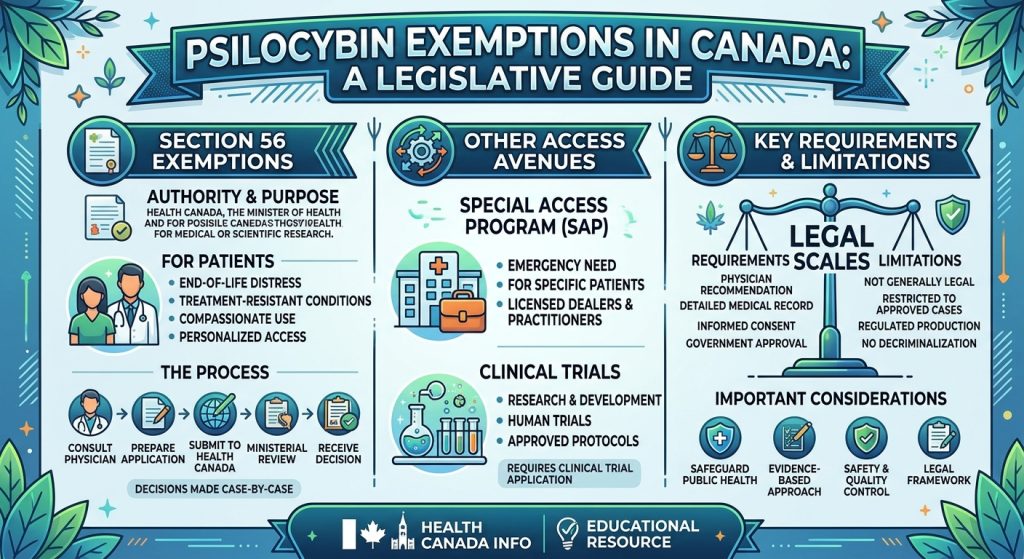
There are three main legal routes in Canada:
- Section 56(1) exemptions under the CDSA, granted to individuals or organizations for a defined purpose.
- The Special Access Program (SAP), which allows authorized health professionals to request access to restricted drugs for patients with serious or life-threatening conditions.
- Clinical trial authorizations, where researchers receive permission to study psilocybin under strict protocols.
Each route has different eligibility criteria, paperwork, and oversight. None of them is a shortcut to casual access.
Section 56 Exemptions: The Original Legal Pathway
How Section 56 works
Section 56(1) of the CDSA allows the Minister of Health to exempt a person or class of persons from the application of the Act if the exemption is considered necessary for a medical or scientific purpose, or otherwise in the public interest. Historically, this power was used for things like supervised consumption sites and, more recently, for psilocybin and psilocin.
In 2020, Health Canada began granting Section 56 exemptions to certain patients for end-of-life or serious psychological distress, following court decisions that recognized the Charter rights of individuals facing terminal illness. These exemptions were landmark moments, but they were also individual and purpose-specific.
Who has received them
Recipients have typically included patients with diagnoses such as cancer-related anxiety, treatment-resistant depression, and severe PTSD, often in the context of palliative care. Some exemptions have also been granted to therapists and organizations supporting those patients, and to researchers studying psilocybin-assisted therapy.
Importantly, a Section 56 exemption is not a prescription. It does not come with a product supply. Patients granted an exemption may be permitted to possess psilocybin for personal medical use, or to produce a limited amount for themselves, but the exemption does not authorize commercial sale or distribution.
Why they are hard to get
Health Canada reviews each application on its merits. Applicants generally need supporting documentation from a regulated health professional, a clear description of the medical condition, evidence that conventional treatments have been tried or are unsuitable, and a detailed plan for how the psilocybin will be used and monitored. Approval is discretionary, and the volume of applications far exceeds the number granted.
The Special Access Program: Canada’s Medical Route
What the SAP is
The Special Access Program is a long-standing Health Canada mechanism that allows practitioners to request access to drugs that are not marketed in Canada for patients with serious or life-threatening conditions when conventional treatments have failed, are unsuitable, or are unavailable. In January 2022, the program was expanded to include psychedelic substances, including psilocybin and psilocin.
This was a significant shift. For the first time, authorized health professionals could request psilocybin for patients outside of clinical trials, provided the criteria were met.
Who can apply
The application must come from a licensed practitioner — typically a physician or nurse practitioner — not from the patient directly. The practitioner must demonstrate that:
- The patient has a serious or life-threatening condition.
- Conventional therapies have been tried and failed, are unsuitable, or are unavailable in Canada.
- The benefits of psilocybin are expected to outweigh the risks.
- There is sufficient evidence to support the use of psilocybin for that condition.
Health Canada reviews each request and may approve, deny, or ask for more information. Approvals are patient-specific and time-limited.
What the SAP does not do
The SAP does not create a general right to psilocybin. It does not authorize recreational use. It does not permit a patient to purchase psilocybin from an unlicensed source. And it does not obligate any practitioner to apply on a patient’s behalf.
For a deeper look at how the program operates in practice, see this breakdown of psilocybin Canada Health Canada rules and exemptions.
Clinical Trials: The Research Pathway
Clinical trials are the third major legal route. Researchers must obtain authorization from Health Canada and approval from a research ethics board before administering psilocybin to participants. Trials typically focus on conditions such as treatment-resistant depression, anxiety in advanced illness, PTSD, and substance use disorders.
Participants generally do not pay for the drug, and they are closely monitored by clinical staff. Eligibility is determined by the study protocol, not by patient preference. If you are interested in this route, our guide to psilocybin clinical trials Canada explains how studies are structured and who tends to qualify.
Clinical trials remain the most rigorously studied pathway, and they are also the source of most of the evidence that regulators rely on when evaluating exemption requests.
What About Possession Without an Exemption?
Outside of an exemption, SAP approval, or clinical trial, possession of psilocybin remains illegal in Canada. That includes dried mushrooms, capsules, chocolates, gummies, teas, and any other product containing psilocybin or psilocin.
Enforcement varies by province and by circumstance. Some police services have deprioritized simple possession, while others continue to lay charges. A few municipalities have passed non-enforcement policies for personal possession, but municipal policy does not change federal law. Retail dispensaries operating openly in cities such as Vancouver have been raided and charged, and the legal status of those storefronts has not been resolved in their favour.
This is why understanding the difference between are magic mushrooms legal in Canada in theory and how enforcement works in practice matters. The law on the books and the law on the street are not the same thing.
Common Myths About Psilocybin Exemptions
Myth: A doctor’s note makes psilocybin legal
A note from a physician is not an exemption. Only Health Canada can grant an exemption or approve a SAP request. A recommendation or referral may support an application, but it does not change the legal status of the substance.
Myth: Exemptions allow you to buy from any source
Exemptions are purpose-specific and often source-specific. A patient approved for personal possession is not automatically authorized to purchase from a dispensary, website, or unlicensed producer. The exemption document defines what is permitted.
Myth: Once approved, the exemption lasts forever
Most exemptions and SAP approvals are time-limited and may include conditions such as dosage limits, supervision requirements, or reporting obligations. Renewal usually requires a new application or updated documentation.
Myth: Canada has legalized psilocybin
Canada has not legalized psilocybin. It has created narrow legal pathways for specific medical and research purposes. The default legal status remains prohibited.
Practical Steps If You Are Considering an Exemption
If you believe you may qualify for a legal pathway, the process generally looks like this:
- Speak with a regulated health professional. A physician or nurse practitioner who understands psychedelic medicine is essential, especially for SAP requests.
- Document your medical history. Include diagnoses, treatments tried, and reasons conventional options have not worked.
- Discuss the evidence. Be realistic about what psilocybin research does and does not show for your condition.
- Submit through the appropriate channel. Section 56 applications and SAP requests are submitted by the practitioner or applicant, depending on the route.
- Wait for a decision. Timelines vary, and requests for additional information are common.
- Follow the conditions exactly. Exemptions can be revoked if conditions are not met.
It is also worth reading about psilocybin laws in Canada explained so you understand the broader legal context before starting an application.
Frequently Asked Questions
Is psilocybin a controlled substance in Canada?
Yes. Psilocybin and psilocin are listed in Schedule III of the Controlled Drugs and Substances Act. Possession, production, sale, and import are illegal unless authorized by regulation or exemption.
Can I get a psilocybin exemption for anxiety or depression?
Possibly, but it depends on the severity of the condition, whether conventional treatments have been tried, and whether a regulated health professional is willing to support the application. Health Canada assesses each case individually.
Does the Special Access Program cover psilocybin?
Yes. Since January 2022, authorized practitioners have been able to request psilocybin and psilocin through the SAP for eligible patients with serious or life-threatening conditions.
Can I legally buy shroom gummies in Canada with an exemption?
No. An exemption for personal medical use does not authorize purchasing psilocybin products from unlicensed retailers. Product source and possession must comply with the specific terms of the exemption.
Are psilocybin exemptions the same as legalization?
No. Exemptions are narrow, individual, and purpose-specific. They do not create a legal market or general permission to use psilocybin.
What happens if I possess psilocybin without an exemption?
You may face criminal charges under the CDSA. Enforcement varies, but the legal risk is real and should not be underestimated.
The Bottom Line
Psilocybin exemptions in Canada are real, but they are exceptions to a prohibition, not a form of legalization. The Section 56 route, the Special Access Program, and clinical trials each serve a specific purpose and come with strict conditions. For most Canadians, the legal status of psilocybin remains unchanged: possession outside an authorized pathway is a criminal offence.
If you are exploring psilocybin for medical reasons, the most responsible first step is a conversation with a regulated health professional who can assess your situation and explain the evidence. If you are simply learning about the topic, keep following the regulatory updates — Canada’s framework continues to evolve, and the details matter.