
Psychedelics Education
Psilocybin Clinical Trials in Canada: How Research Works, Who Qualifies, and What the Law Allows
Oct
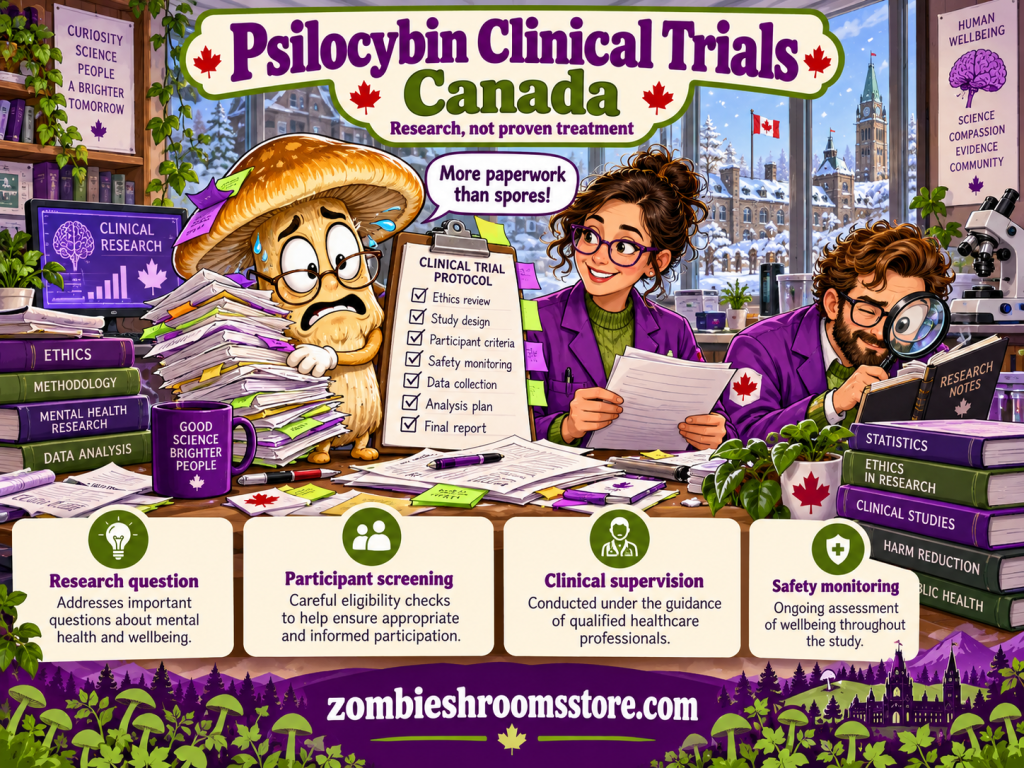
Psilocybin Clinical Trials in Canada: What They Are and Why They Matter
Psilocybin clinical trials in Canada have shifted from a niche academic curiosity to one of the most closely watched areas of psychiatric research. Over the past several years, Canadian universities, hospitals, and life-science companies have launched studies examining whether psilocybin-assisted therapy can help people living with treatment-resistant depression, end-of-life anxiety, substance-use disorders, and other conditions that have not responded well to conventional care.
For Canadians who search for information about magic mushrooms, the topic raises practical questions: How does a trial actually work? Who is allowed to join? What does the law permit, and what remains illegal? This guide walks through the research landscape in plain language, without hype and without downplaying the risks.
What Is Psilocybin, and Why Is It Studied?
Psilocybin is a naturally occurring compound found in more than 180 species of mushrooms, most famously those in the genus Psilocybe. When ingested, the body converts psilocybin into psilocin, the molecule primarily responsible for the perceptual, emotional, and cognitive changes associated with a psychedelic experience.
Researchers are interested in psilocybin because of how it interacts with serotonin receptors, particularly the 5-HT2A receptor. This interaction appears to temporarily alter activity in brain networks involved in self-referential thinking and rumination — the same patterns that tend to be overactive in depression and anxiety disorders. The hypothesis is that a carefully supported psilocybin session may help “reset” rigid thought patterns when combined with psychotherapy.
If you want a deeper foundation on the compound itself, our overview of how mushrooms interact with the human brain covers the pharmacology in more detail.
How Psilocybin Clinical Trials Work in Canada
A clinical trial is not the same as recreational use, and the differences are significant. Trials follow a structured, regulated pathway designed to protect participants and produce reliable data.
Phase 1: Safety and Dosage
Phase 1 studies typically involve a small number of healthy volunteers or participants with a specific condition. The goal is to establish safety, tolerability, and appropriate dosing. Researchers monitor heart rate, blood pressure, psychological responses, and adverse events closely.
Phase 2: Does It Work?
Phase 2 trials expand to a larger group and begin measuring efficacy — whether symptoms actually improve. Many Canadian psilocybin studies are currently at this stage, focusing on depression, anxiety, and existential distress in patients with serious illness.
Phase 3: Confirming Results at Scale
Phase 3 trials are larger, often multi-site, and designed to confirm findings across diverse populations. They are the final step before a treatment can be considered for regulatory approval. Psilocybin has not yet completed this pathway for any indication in Canada, which is why it remains a controlled substance rather than a prescription medicine.
What a Trial Session Actually Looks Like
Most modern protocols involve preparation sessions, one or two dosing sessions, and integration sessions afterward. During dosing, participants are supervised by trained therapists or clinicians in a calm, controlled environment. Blindfolds, curated music, and comfortable furnishings are common. The session can last six to eight hours, and participants are monitored throughout.
Health Canada’s Role in Psilocybin Research
Health Canada regulates psilocybin under the Controlled Drugs and Substances Act (CDSA). Psilocybin and psilocin are listed in Schedule III, which means possession, production, and distribution are illegal unless authorized.
To run a clinical trial, researchers must obtain several layers of approval:
- A clinical trial application (CTA) reviewed by Health Canada, including preclinical data, protocol design, and safety monitoring plans.
- A research exemption under Section 56 of the CDSA, or another authorized pathway, allowing legal possession and handling of the substance.
- Research ethics board (REB) approval from the sponsoring institution, which scrutinizes participant consent, risk management, and study design.
This layered system is why Canadian psilocybin research tends to move deliberately. It is also why the number of approved trials, while growing, remains modest compared with jurisdictions that have rescheduled the drug.
Health Canada’s Special Access Program and Psilocybin
The Special Access Program (SAP) allows healthcare practitioners to request access to drugs that are not marketed in Canada for patients with serious or life-threatening conditions when conventional therapies have failed, are unsuitable, or are unavailable.
In 2022, Health Canada clarified that psilocybin and psilocin could be requested through the SAP under specific conditions. This was a meaningful shift: it created a legal, medically supervised route for a small number of patients — typically those with severe, treatment-resistant depression or end-of-life distress — to access psilocybin-assisted therapy outside a formal clinical trial.
Important caveats apply:
- The request must come from a licensed healthcare practitioner, not the patient directly.
- Approval is granted case by case and is not guaranteed.
- The treatment must take place under supervised clinical conditions.
- The SAP does not legalize recreational possession or personal use.
For a broader look at where the law currently stands, see our explainer on whether psilocybin is legal in different contexts.
What Recent Research Suggests
The evidence base is still developing, but several themes have emerged from peer-reviewed studies and early trial results.
Depression and Treatment-Resistant Depression
Multiple small trials have reported rapid reductions in depressive symptoms after a single supervised psilocybin session, with some participants sustaining benefits for weeks or months. However, sample sizes are often small, blinding is difficult, and long-term durability remains uncertain. Researchers consistently caution against interpreting early results as proof of a cure.
Anxiety and Existential Distress
Studies involving patients with cancer diagnoses have examined whether psilocybin can reduce anxiety, depression, and fear of death. Results have generally been encouraging but modest in scale, and the therapy component — not just the drug — appears to play a substantial role in outcomes.
Suicidal Thoughts
Recent analyses have explored whether psilocybin may ease suicidal ideation in people with severe mood disorders. Early findings suggest possible short-term reductions, but researchers emphasize that these studies are preliminary and that psilocybin is not a crisis intervention. Anyone experiencing suicidal thoughts should contact emergency services or a crisis line immediately.
Substance-Use Disorders
Canadian and international teams have also investigated psilocybin for alcohol and tobacco dependence. Some trials show promising abstinence rates, though relapse and long-term follow-up remain active areas of study.
Who Can Participate in a Psilocybin Clinical Trial?
Eligibility varies by study, but common criteria include:
- A confirmed diagnosis of the condition under investigation
- Failure to respond to, or intolerance of, standard treatments
- Age 18 or older (some studies require 21+)
- No personal or family history of psychosis, bipolar I disorder, or certain cardiovascular conditions
- Willingness to attend preparation and integration sessions
- Ability to provide informed consent and comply with follow-up requirements
Participants are not paid to take psilocybin in most Canadian studies, though some trials offer compensation for time and travel. Enrollment is typically handled through the sponsoring institution, not through online vendors or unregulated sources.
Legal vs. Recreational Use: A Clear Distinction
This is where confusion is most common. A clinical trial or SAP approval is a tightly controlled medical pathway. Outside those pathways, psilocybin remains a controlled substance in Canada.
Possession, production, and distribution of magic mushrooms without authorization can lead to criminal charges. Selling psilocybin products to the public is not legal under federal law, regardless of how a product is packaged or marketed. Some municipalities and provinces have debated decriminalization, but as of now, no Canadian jurisdiction has legalized recreational psilocybin in the way cannabis was legalized.
If you are researching mushroom varieties out of general interest, our dried magic mushrooms category provides educational product information, but it does not change the legal reality described above.
Risks and Limitations of Psilocybin Research
Psilocybin is not risk-free, and responsible research acknowledges this openly.
- Psychological distress: Challenging experiences, sometimes called “bad trips,” can involve intense fear, confusion, or panic.
- Cardiovascular effects: Increased heart rate and blood pressure can be problematic for people with heart conditions.
- Psychosis risk: Individuals with a personal or family history of psychotic disorders may be at elevated risk.
- HPPD: A small number of users report persistent perceptual disturbances after psychedelic use.
- Interaction risks: Combining psilocybin with certain medications, including SSRIs and lithium, can produce unpredictable effects.
These risks are why clinical trials exclude many participants and why unsupervised use carries meaningful danger.
The Future of Psilocybin Research in Canada
Canada is positioned as a significant contributor to global psychedelic research. Several companies and academic centres are running or planning trials, and regulatory pathways continue to evolve. Possible developments include larger Phase 3 studies, expanded SAP access, and clearer frameworks for therapist training and oversight.
What is unlikely to change quickly is the fundamental distinction between supervised medical research and unregulated personal use. For now, the most reliable way to access psilocybin legally in Canada is through an approved trial or a physician-initiated SAP request.
Frequently Asked Questions
Are psilocybin clinical trials free to join?
Most trials do not charge participants. Some provide compensation for time and travel. However, access is limited by eligibility criteria and study capacity.
Can my doctor prescribe psilocybin in Canada?
Not through a standard prescription. Psilocybin is not an approved marketed drug. A physician can, however, submit a Special Access Program request for a patient who meets specific criteria.
Is microdosing part of clinical research?
Some studies examine microdosing, but most therapeutic trials focus on full or moderate doses combined with psychotherapy. Evidence for microdosing remains limited and mixed.
How do I find a psilocybin trial in Canada?
Start with ClinicalTrials.gov and Health Canada’s clinical trial database, then contact the sponsoring institution directly. Your family doctor or psychiatrist may also be able to refer you.
Does a trial approval make psilocybin legal for everyone?
No. Approval applies only to the specific study, its participants, and its authorized sites. It does not legalize possession or use outside that framework.
Key Takeaways
Psilocybin clinical trials in Canada represent a serious, regulated effort to understand whether psychedelic-assisted therapy can help people with hard-to-treat mental health conditions. The research is promising but preliminary, the legal pathways are narrow, and the risks are real. Canadians interested in this area should rely on peer-reviewed evidence, consult qualified healthcare professionals, and understand that medical research and recreational use are governed by entirely different rules.
Authoritative sources
Legal status of psilocybin mushrooms · Psilocybin