Psychedelics Education
Are Magic Mushrooms Legal in Canada? Psilocybin Laws, Possession, and Health Canada Explained
Oct
Few topics generate as much confusion among Canadian readers as the legal status of magic mushrooms. Search results often contradict each other: some pages claim psilocybin is fully illegal, others suggest it is effectively decriminalized, and a growing number of storefronts and websites sell shroom products as though no restrictions exist at all. The truth sits somewhere in the middle, and understanding it requires looking at three separate layers of Canadian law: the federal Controlled Drugs and Substances Act (CDSA), Health Canada’s exemption powers, and municipal enforcement priorities.
This guide explains what psilocybin is under Canadian law, what possession actually means, how Health Canada exemptions work, and what Canadians should realistically understand before assuming anything about legality. It is educational information, not legal advice, and laws can change.
What Is Psilocybin Under Canadian Law?
Psilocybin is the naturally occurring compound found in more than 180 species of mushrooms, most famously those in the Psilocybe genus. When a person consumes magic mushrooms, the body converts psilocybin into psilocin, the molecule primarily responsible for the psychedelic experience. You can read a deeper breakdown of that conversion in our guide to psilocybin vs psilocin.
Under Canadian federal law, both psilocybin and psilocin are listed in Schedule III of the CDSA. That classification matters. Schedule III substances carry serious penalties for possession, trafficking, and production, though they are treated as less severe than Schedule I drugs like heroin or cocaine. Psilocybin is also regulated under the Food and Drug Regulations, which restricts its sale, importation, and distribution.
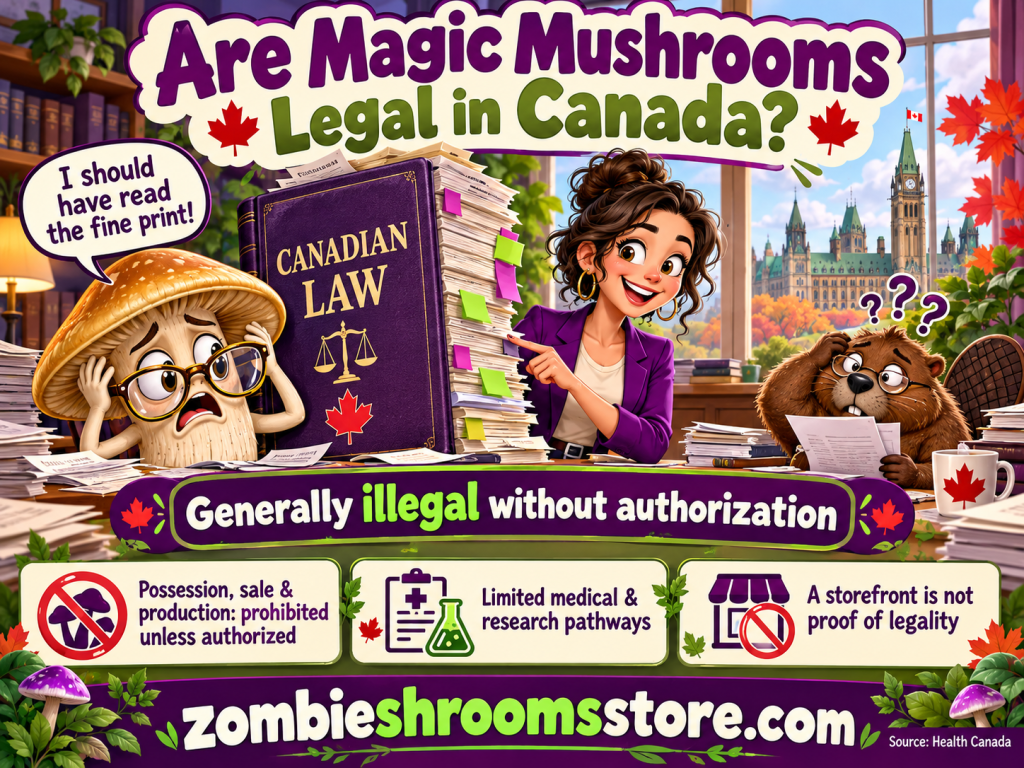
In plain terms: psilocybin is a controlled substance in Canada. It is not legal for recreational use, sale, or possession outside of specific authorized contexts.
Is Possession of Magic Mushrooms Illegal in Canada?
Yes, possession of psilocybin or psilocin without legal authorization is a criminal offence under Section 4 of the CDSA. Penalties depend on the circumstances and whether the Crown proceeds by summary conviction or indictment.
- Summary conviction: typically a fine, probation, or in some cases up to 18 months in jail for a first offence.
- Indictment: more serious charges can carry up to 10 years imprisonment, particularly where trafficking or large quantities are involved.
In practice, simple possession charges for small amounts are relatively uncommon in some urban centres, where police have deprioritized enforcement. Vancouver, for example, has seen several unlicensed mushroom dispensaries operate with limited police intervention. However, deprioritized enforcement is not the same as legalization. A product being sold openly does not mean buying or possessing it is lawful.
This distinction is important for anyone researching mushroom gummies or similar products online. The format of a product does not change its legal classification. If it contains psilocybin or psilocin, it falls under the same federal rules as dried mushrooms.
Health Canada Psilocybin Regulations and Exemptions
Health Canada administers the Special Access Program (SAP) and can grant exemptions under Section 56 of the CDSA. These are the primary legal pathways through which Canadians can access psilocybin.
Section 56 Exemptions
A Section 56 exemption allows an individual or organization to possess, produce, or distribute psilocybin for a specified purpose, usually medical or scientific. Since 2020, Health Canada has granted a growing number of exemptions, most notably to patients with serious or treatment-resistant conditions such as end-of-life anxiety, severe depression, and PTSD.
These exemptions are granted case by case. They are not a blanket permission, and they do not legalize psilocybin for the general public.
The Special Access Program
In January 2022, Health Canada expanded the SAP to include psilocybin and MDMA for certain serious or life-threatening conditions where conventional treatments have failed. Access requires a physician or nurse practitioner to submit a request on the patient’s behalf. The program is narrow, and approval is not guaranteed.
Clinical Trials and Research
Health Canada also authorizes clinical trials involving psilocybin. Canadian researchers are studying psilocybin-assisted therapy for depression, anxiety, substance use disorders, and other conditions. Our overview of psilocybin clinical trials in Canada covers how these studies are structured and who may qualify.
What About Dispensaries and Online Sellers?
Canada has seen a wave of unlicensed psychedelic dispensaries open in cities like Vancouver, Toronto, and Victoria. These shops sell dried mushrooms, chocolates, capsules, and gummies openly. Some operate as advocacy businesses, arguing that psilocybin should be decriminalized or regulated like cannabis.
Legally, these businesses are operating outside federal law. Health Canada has stated repeatedly that selling psilocybin products without authorization is illegal, regardless of how the products are packaged or marketed. Enforcement varies by region and by political climate.
For consumers, the practical takeaway is that buying from an unlicensed seller carries legal risk, and product quality and dosing are not guaranteed. If you are researching products for educational purposes, our product catalogue provides detailed information on formats, strains, and specifications.
Municipal Decriminalization Efforts
Several Canadian cities have passed non-binding motions calling for the decriminalization of personal possession of psychedelics. These motions do not change federal law. They signal local political priorities and may influence police discretion, but they do not create a legal right to possess psilocybin.
This is a common source of confusion. A city council resolution is not the same as a federal exemption or a change to the CDSA. Until Parliament amends the law, psilocybin remains controlled at the federal level.
How Does Canada Compare to Other Countries?
Canada’s approach sits between strict prohibition and full legalization. In the United States, psilocybin remains federally illegal but has been legalized or decriminalized in states like Oregon, Colorado, and several cities. In the Netherlands, psilocybin truffles are legally sold. In Portugal, personal possession of all drugs was decriminalized in 2001, though supply remains illegal.
Canada has not followed Portugal’s model. Instead, it has expanded medical and research access through exemptions while keeping recreational use illegal. Whether that changes in the coming years is an open question, and several advocacy groups are pushing for reform.
What Are the Penalties for Selling Psilocybin in Canada?
Trafficking, production, and possession for the purpose of trafficking carry significantly heavier penalties than simple possession. Under the CDSA, trafficking a Schedule III substance can result in up to 10 years imprisonment if the Crown proceeds by indictment.
Importation and exportation are treated even more seriously. Selling psilocybin products online, shipping them across provincial or national borders, or operating an unlicensed dispensary all fall into this category.
Frequently Asked Questions
Are magic mushrooms legal in Canada for recreational use?
No. Psilocybin and psilocin are Schedule III controlled substances. Recreational possession, sale, and production are illegal under federal law.
Can I get psilocybin legally in Canada?
In limited cases, yes. Health Canada can grant Section 56 exemptions or authorize access through the Special Access Program for serious medical conditions. Clinical trials are another legal pathway.
Is psilocybin a controlled substance in Canada?
Yes. Psilocybin and psilocin are listed in Schedule III of the Controlled Drugs and Substances Act.
Are mushroom gummies legal in Canada?
If they contain psilocybin or psilocin, they are subject to the same federal restrictions as dried mushrooms. The gummy format does not change the legal classification.
Will magic mushrooms become legal in Canada?
There is no confirmed timeline. Advocacy groups and some municipalities are pushing for decriminalization or regulation, but federal law has not changed. Any reform would require amendments to the CDSA or new regulations.
Key Takeaways for Canadians
Psilocybin remains a controlled substance in Canada. Possession, sale, and production outside of authorized medical, research, or exemption contexts are illegal. Health Canada exemptions and the Special Access Program provide narrow legal pathways, primarily for patients with serious conditions. Municipal decriminalization motions and unlicensed dispensaries do not change federal law.
For anyone researching magic mushrooms in Canada, the most important step is to understand the distinction between enforcement discretion and legal status. They are not the same thing, and treating them as interchangeable can lead to real legal consequences.
If you are exploring psilocybin for educational or research purposes, our home page and blog provide detailed information on strains, effects, and product formats. Always verify the current legal status in your province and consult a legal professional for advice specific to your situation.