
Psychedelics Education
Albino Penis Envy
Oct
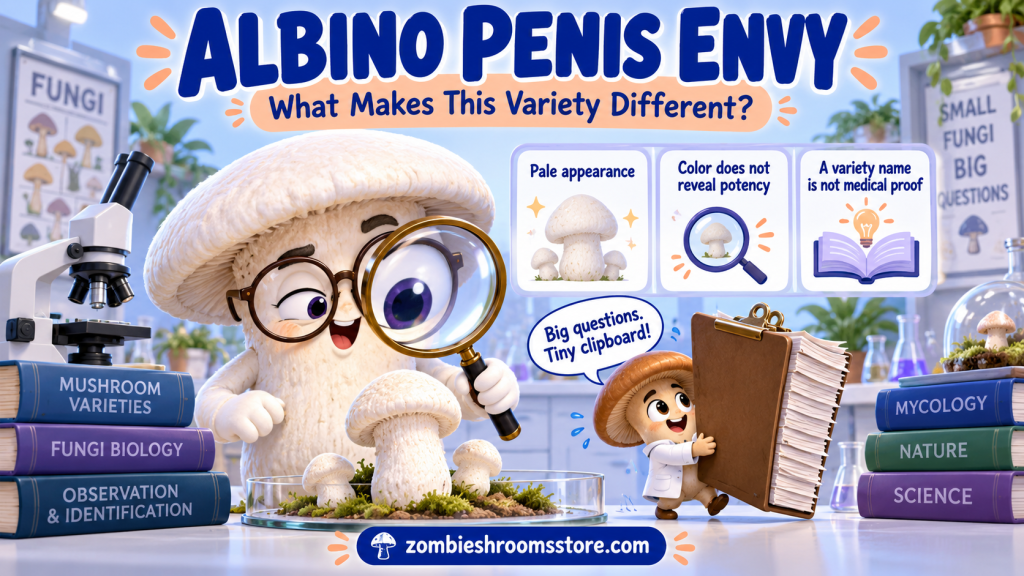
Albino Penis Envy: What Makes This Variety Different?
Albino Penis Envy, often shortened to APE, is a named variety associated with Psilocybe cubensis. Its reputation centers on its pale appearance, distinctive shape, and claims about strength. Understanding those features requires separating visible characteristics from chemical measurements and medical evidence.
A variety name can help organize a discussion, but it cannot establish what every sample contains or predict how someone will respond. Appearance also cannot confirm safety, authenticity, or suitability for treating a health condition.
This guide explains the label, examines the evidence behind potency claims, and addresses common questions about classification. It also distinguishes clinical psilocybin research from claims about tablets, reishi, and herbal supplements.
What Does the Name Identify?
Albino Penis Envy is a variety designation, rather than a separate scientific species. Published research has included material identified as APE within investigations of P. cubensis. PMC
That distinction matters because species identification and variety identification answer different questions. A scientific species name describes a biological classification. A cultivated variety label may refer to a selected line, but the label alone does not verify its pedigree.
Terms such as “strain,” “variety,” and “cultivar” are sometimes used loosely in mushroom discussions. Readers should therefore look for the documentation behind a claim rather than assuming the terminology guarantees consistency.
Background and Uncertain Origin Stories
Detailed origin stories often circulate without accessible original records. A description may name a developer, give an exact year, or claim a specific cross without demonstrating how that information was verified.
Such accounts should be attributed and qualified. Repetition across websites does not make an undocumented story more reliable.
For broader background on the related name, see the Penis Envy history and research article on zombieshroomsstore.com.
A useful educational profile can explain current terminology while acknowledging that parts of a variety’s history remain uncertain.
Appearance and Its Limitations
APE is commonly described as pale or whitish, often with a thick stem and a comparatively compact cap. However, these are general descriptions rather than a dependable identification checklist.
Scientific work examining named P. cubensis lines includes photographs and chemical measurements of material identified as Albino Penis Envy. This shows that the label appears in research, but it does not authenticate every photograph or sample carrying that name. PMC
Color, shape, and size should therefore be interpreted cautiously. Photographs show appearance; they do not establish chemical content.
Likewise, “albino” should not be treated as a synonym for stronger, safer, cleaner, or more therapeutic. A pigmentation description and a medical claim require different evidence.
Is Albino Penis Envy Always Stronger?
The strongest defensible answer is that a name cannot guarantee strength.
A controlled study compared tryptamine profiles across 14 named P. cubensis strains, including APE. It examined differences both between strains and within them. Those findings support a more careful view of potency than a fixed ranking based on reputation. PMC
A laboratory result describes the material tested using that study’s methods. It should not automatically be generalized to every sample circulating under the same designation.
| Common claim | What it actually establishes |
|---|---|
| “Pale appearance” | A reported visual characteristic |
| “Thick stem” | A description of shape |
| “High-potency reputation” | A reason to examine testing, not a verified concentration |
| “Research includes APE” | The named material has been studied for particular questions |
| “Predictable experience” | Requires evidence that a name alone cannot provide |
| “Better medical results” | Requires relevant clinical trials |
The table highlights a central distinction: recognizable features do not replace chemical analysis or clinical evidence.
What Influences the Experience?
A psilocybin experience cannot be predicted from a variety label alone.
NCCIH describes effects that vary with factors including health, mood, expectations, surroundings, and other substances. Experiences may involve altered perception and strong emotions, but they can also include fear or confusion. www.nccih.nih.gov
Personal accounts can describe what someone remembers or felt. They cannot establish that another person will have the same response.
Words such as “spiritual,” “clear,” or “intense” are particularly subjective. They may communicate an individual interpretation without identifying a consistent biological difference.
Nor should an emotionally significant experience automatically be described as successful treatment. Medical improvement requires an appropriate assessment and follow-up.
Are Shrooms Uppers or Downers?
Questions such as “are shrooms uppers or downers?” use an informal classification that does not adequately describe psilocybin.
Psilocybin is generally classified as a classic psychedelic. Its effects involve changes in perception, thought, and mood, rather than fitting neatly into the everyday “upper” or “downer” categories. NCCIH explains that the body converts psilocybin to psilocin, which has psychoactive properties. www.nccih.nih.gov
A person feeling energized does not make the substance equivalent to a stimulant. Feeling sleepy or withdrawn does not make it equivalent to a depressant.
Why the Wording Matters
“Are shrooms an upper or downer?” and “are mushrooms uppers or downers?” also leave the substance unclear.
Ordinary culinary mushrooms are foods. Reishi products belong to a separate supplement discussion. Psilocybin-containing mushrooms involve a different compound and different evidence.
A reliable explanation identifies the actual species or substance before describing its effects. The word “mushroom” alone is too broad to answer a drug-classification question.
What Clinical Research Investigates
Research on psilocybin for depression and anxiety examines particular interventions, participant groups, and outcomes. It does not automatically compare named mushroom varieties.
A 2023 randomized trial investigated psilocybin administered with psychological support for major depressive disorder. The study indexed on PubMed reported improvements compared with its control intervention. pubmed.ncbi.nlm.nih.gov
That finding concerns the intervention studied. It does not establish that Albino Penis Envy produces better outcomes than another variety, or that material outside the trial is equivalent to its preparation.
Depression and Anxiety Are Different Questions
A depression trial should not be presented as proof for every anxiety condition.
A meta-analysis examining psilocybin with behavioral interventions in people with elevated anxiety or depression symptoms tentatively supported further investigation. Its conclusions concerned the included studies, not a preferred mushroom label. pubmed.ncbi.nlm.nih.gov
When assessing a claim, ask which diagnosis was studied, how participants were selected, and what improvement meant. A change on a symptom scale is different from a guarantee of lasting recovery.
Research interest is meaningful, but it should be explained alongside its limitations.
Tablets Do Not Establish Composition
“Shroom tablets” describes a product format, not a verified ingredient list or standardized preparation.
The term alone cannot confirm the species, compounds, concentration, or quality of what is inside. A tablet should not be assumed equivalent to whole fungal material or a preparation used in research.
The same principle applies to capsules, chocolates, and powders. Sharing mushroom-related language does not make products interchangeable.
Before accepting a claim, identify precisely what is being described. A familiar variety name on packaging does not supply missing evidence about composition or medical effectiveness.
Product appearance is also not proof of pharmaceutical regulation.
Ashwagandha and Reishi Belong to Separate Discussions
Searches for “ashwagandha and reishi benefits” can appear alongside psychedelic topics, but these ingredients should not be grouped together as equivalent treatments.
Ashwagandha is an herb, while reishi refers to mushrooms commonly discussed in supplement and traditional-use contexts. Neither should be assumed to produce the same effects as psilocybin.
NCCIH reports that some ashwagandha preparations may help with stress or insomnia, while evidence for anxiety remains unclear. Safety concerns and possible interactions also deserve attention. The NCCIH ashwagandha overview explains these qualifications. NCCIH
Memorial Sloan Kettering maintains a separate evidence and safety review for reishi. Memorial Sloan Kettering Cancer Center
Research about either ingredient cannot establish the benefits of a combined product. It also cannot show that combining supplements with psilocybin is safe.
Evaluating Safety Claims
A pale appearance and recognizable name do not establish personal suitability.
NCCIH describes possible adverse effects including anxiety, nausea, headache, and increases in heart rate or blood pressure. It also identifies particular concerns for people with psychotic conditions or severe forms of bipolar disorder. www.nccih.nih.gov
Those general facts cannot replace an individual assessment of symptoms, medical history, and medications.
If an article describes a variety as universally safe, ask what evidence supports that wording. An explanation should acknowledge uncertainty rather than turning reputation into reassurance.
Treatment decisions belong in a discussion with a qualified healthcare professional.
Reading Comparisons Critically
For another example of how names and research differ, explore the Penis Envy vs Golden Teacher comparison on zombieshroomsstore.com.
Apply the same questions to any comparison: does it distinguish appearance from potency, personal stories from study results, and compound research from variety-specific claims?
An informative Albino Penis Envy profile explains what makes the label recognizable without pretending that every important question has been settled.
Frequently Asked Questions
1. Is APE a separate species?
No. The designation is associated with Psilocybe cubensis. Scientific studies include material identified by this variety name, but that does not authenticate every sample bearing it. PMC
2. Does white coloring indicate greater potency?
Color alone does not establish active-compound concentration. Visual characteristics and chemical measurements answer different questions. Claims about strength require appropriately interpreted testing rather than an inference from pigmentation.
3. Is this variety proven to treat depression?
The clinical evidence discussed here concerns psilocybin administered under defined study conditions. It does not establish APE as a superior or independently validated depression treatment.
4. Are tablets more predictable than whole material?
A format alone cannot establish predictability. Relevant information includes verified composition and quality controls. The words “tablet” or “shroom” do not show that a product matches a studied preparation.
5. Can supplement benefits be applied to psychedelic mushrooms?
No. Ashwagandha, reishi, and psilocybin require separate evidence. Findings about one ingredient should not be transferred to another or used to assume that a combination is effective or safe.