Psychedelics Education
Albino Penis Envy vs Penis Envy
Oct
Albino Penis Envy vs Penis Envy: Key Differences Explained
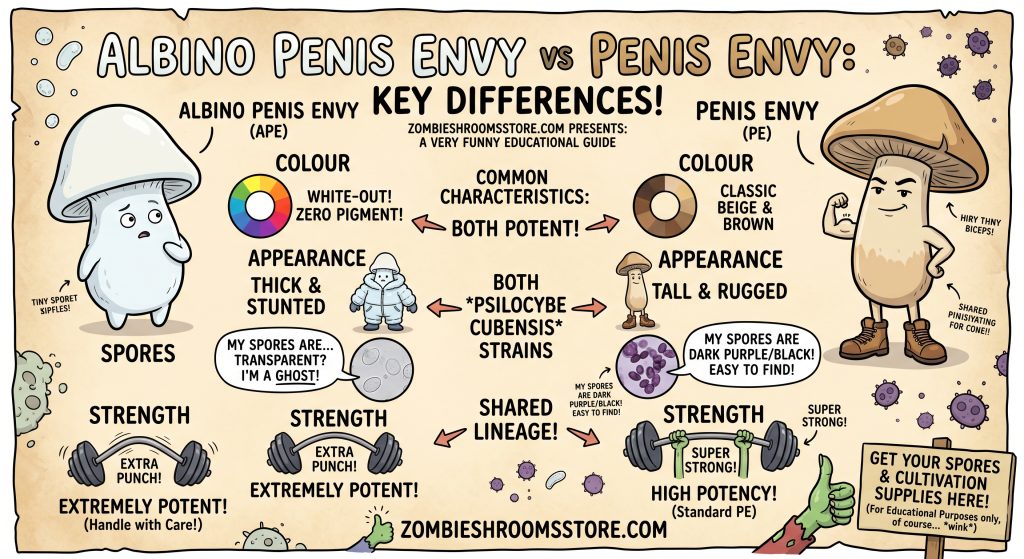
Albino Penis Envy vs Penis Envy is a comparison between two familiar names associated with Psilocybe cubensis, a species of psilocybin-containing mushroom. Their most recognizable reported difference is appearance: Albino Penis Envy, often abbreviated APE, is described as pale, while conventional Penis Envy typically has more visible cap pigmentation.
However, appearance tells only part of the story. Neither name establishes a sample’s chemical composition, predicts someone’s experience, or proves a medical benefit.
The comparison also requires separating psychedelic mushrooms from functional mushroom supplements. Products promoted for concentration, energy, or weight management usually involve different species and different research questions. Evidence about lion’s mane cannot establish benefits for APE or Penis Envy.
This guide explains the main distinctions, examines what laboratory research can show, and addresses common supplement claims without presenting either variety as a treatment recommendation.
Understanding the Two Names
Both names are used for cultivated varieties associated with P. cubensis. They are not separate scientific species.
Terms such as “strain,” “variety,” and “cultivar” appear throughout mushroom discussions, sometimes without consistent definitions. A recognizable name may describe a selected line or reported set of characteristics, but it does not automatically authenticate every specimen carrying that label.
Published research on P. cubensis discusses substantial variation in physical characteristics and psychoactive compounds. This makes documentation important when comparing named varieties. PubMed
Background and Origin Stories
Popular accounts sometimes give precise breeding histories, credit particular individuals, or describe an exact cross. These accounts should be distinguished from independently documented history.
For Albino Penis Envy vs Penis Envy, an educational comparison can explain the names and reported traits without presenting an uncertain pedigree as settled fact.
For additional background, see the website’s Albino Penis Envy overview. Treat general variety descriptions as context rather than proof of any individual sample’s identity.
Albino Penis Envy vs Penis Envy: Appearance
The clearest reported distinction is pigmentation. APE is commonly described as white or cream-colored, while conventional Penis Envy is generally described as having tan or brown cap coloration.
Both are often associated with thick stems and relatively compact caps. These descriptions are tendencies rather than a diagnostic checklist.
| Feature | Albino Penis Envy | Penis Envy |
|---|---|---|
| Common abbreviation | APE | PE |
| Species association | Psilocybe cubensis | Psilocybe cubensis |
| Reported coloration | Predominantly pale or cream | More visible tan or brown pigmentation |
| Reported form | Often thick-stemmed and compact | Often thick-stemmed with a relatively small cap |
| Potency established by appearance? | No | No |
| Medical benefit established by name? | No | No |
Lighting, maturity, handling, and storage can influence how specimens look in photographs. An image cannot establish precise chemical content or confirm that material is safe.
What Does “Albino” Establish?
In everyday mushroom descriptions, “albino” usually communicates a pale appearance. That label alone does not demonstrate the biological mechanism responsible for reduced pigmentation.
Likewise, whiteness does not establish purity, greater strength, or medical suitability. Color describes an observable feature; those other claims require separate evidence.
Potency Claims Need Chemical Measurements
Many online comparisons rank one variety above the other or assign a fixed strength multiplier. These claims can create more certainty than the evidence supports.
A laboratory study indexed in PubMed measured psilocybin and psilocin in multiple P. cubensis strains. Researchers examined individual mushrooms to investigate differences both between strains and within the same strain. PubMed
This distinction matters. A result from one specimen cannot establish a universal potency value for every mushroom sharing its label.
An accurate Albino Penis Envy vs Penis Envy comparison should therefore avoid statements such as “APE is always twice as strong.” A meaningful chemical comparison needs authenticated material, comparable measurements, and enough samples to characterize variation.
Interpreting a Laboratory Result
When reading a potency claim, ask:
- Which compounds were measured?
- Were results reported on a fresh-weight or dry-weight basis?
- How many specimens were tested?
- Was the tested material’s identity documented?
- Does the report actually apply to the sample being discussed?
A photograph, anecdote, or competition result cannot answer all these questions. Laboratory findings are useful when their scope and limitations remain clear.
Experiences Are Not Predictable From a Variety Label
People may describe psychedelic experiences as emotional, visually intense, pleasant, confusing, or frightening. These descriptions do not form a reliable ranking of mushroom varieties.
The National Center for Complementary and Integrative Health’s psilocybin guide explains that effects can vary widely between people and are difficult to predict. It also notes that microdosing’s safety and effectiveness remain unclear. NCCIH
Claims that one named variety reliably produces “clarity” while another produces “relaxation” require stronger evidence than testimonials.
An Albino Penis Envy vs Penis Envy discussion should acknowledge this uncertainty rather than promise a particular mood or experience. A familiar name does not eliminate the possibility of distress or establish suitability for someone with a medical concern.
Psychedelic Mushrooms and Functional Supplements
The word “mushroom” covers biologically different organisms. Sharing that word does not make products interchangeable.
APE and Penis Envy belong in discussions of psilocybin-containing fungi. Lion’s mane, reishi, and other species commonly found in functional supplements belong to different research and product categories.
A powder, capsule, extract, or gummy describes a format. It does not establish which species or active substances the product contains.
This distinction helps explain why searches about the best mushroom powder blends or best mushroom extract do not answer questions about psychedelic varieties. The ingredient list, intended purpose, and evidence must be examined separately.
Evaluating Labels Without Relying on Marketing
A useful supplement label should make its ingredients and amounts understandable. Readers should also examine any testing documentation and whether it matches the product’s batch.
An impressive extraction ratio or a long list of species does not establish that a blend works for ADHD, fatigue, or weight management.
Research on a particular preparation also cannot automatically support every product containing the same species. Composition and formulation matter when interpreting a study.
Do Mushrooms Help With Weight Loss?
The question “do mushrooms help with weight loss” needs clarification. It could refer to ordinary edible mushrooms, a supplement, or a psilocybin-containing variety.
These are different subjects. Using edible mushrooms in meals is a food choice; taking a concentrated extract is a supplement choice. Neither provides evidence that APE or Penis Envy is a weight-loss treatment.
Search phrases such as mushroom for energy and weight loss can combine several claims without showing that the same product addresses either concern.
Likewise, “do mushroom supplements help with weight loss” cannot be answered by pointing to general mushroom nutrition or a laboratory experiment. A persuasive claim would need human evidence involving the actual preparation and a meaningful weight-management outcome.
The research cited in this comparison does not establish either psychedelic variety as a weight-loss intervention. Marketing language should not fill that evidence gap.
ADHD, Concentration, and Brain Fog
Searches for the best mushroom supplements for ADHD or best mushrooms for brain fog often lead to lion’s mane products. These searches reflect interest, but they do not establish an effective treatment.
A small lion’s mane pilot study available through PubMed investigated cognitive performance, stress, and mood in 41 healthy adults. Some results suggested possible benefits, while other findings were null or negative. The authors emphasized the small sample and need for further research. PMC
Importantly, this was not a trial establishing treatment for ADHD.
What “Lions Mane for ADHD” Research Can Show
Evidence from healthy adults should not be presented as proof that lions mane for ADHD works. ADHD requires condition-specific research with appropriate outcomes and safety assessment.
The phrase mushroom supplements for ADHD also encompasses products with different ingredients. Results involving one preparation cannot validate an entire category.
Brain fog is a broad description rather than a single diagnosis. Persistent difficulties with concentration deserve assessment instead of an assumption that a mushroom product will resolve them.
These supplement questions provide useful context, but they do not change the central Albino Penis Envy vs Penis Envy comparison or establish benefits for either variety.
Clinical Research and Legal Context
Psilocybin research has investigated potential applications in mental health. However, a study involving measured psilocybin and structured psychological support is different from evidence about a named mushroom variety.
Clinical findings should be described using the treatment, participants, and setting actually studied. They should not become a claim that APE or Penis Envy is an established medicine.
In the United States, NCCIH identifies psilocybin as federally controlled and notes that state and local policies continue to evolve. Decriminalization or reduced enforcement priority should not be confused with unrestricted legality or approval as a treatment. NCCIH
For a broader example of how informal variety names differ from scientific evidence, read the website’s B+ mushroom background guide.
Frequently Asked Questions
1. What Is the Main Difference Between APE and Penis Envy?
The most recognizable reported difference is pigmentation. APE is generally described as pale, while conventional Penis Envy has more visible cap coloration. Appearance does not establish chemical content or safety.
2. Is APE Always Stronger?
A universal ranking is not justified by a name alone. Chemical measurements can vary between named strains and individual specimens. Claims about relative strength need testing and clearly defined samples. PubMed
3. Are These Separate Species?
Both names are associated with Psilocybe cubensis. They are cultivated variety labels rather than separate scientific species. A label also does not independently authenticate a specimen’s ancestry.
4. Can Either Variety Treat ADHD or Support Weight Loss?
The sources discussed here do not establish either variety as a treatment for ADHD or weight loss. Evidence about lion’s mane or ordinary edible mushrooms cannot be transferred to psilocybin-containing varieties.
5. What Should Readers Remember About Albino Penis Envy vs Penis Envy?
Separate appearance, chemistry, and medical evidence. Reported physical traits provide context, laboratory testing addresses composition, and appropriately designed clinical studies address treatment claims. No variety name answers all three questions.