Psychedelics Education
Blue Meanie Mushrooms
Oct
Blue Meanie Mushrooms: Psilocybin Variety vs Panaeolus Confusion Explained
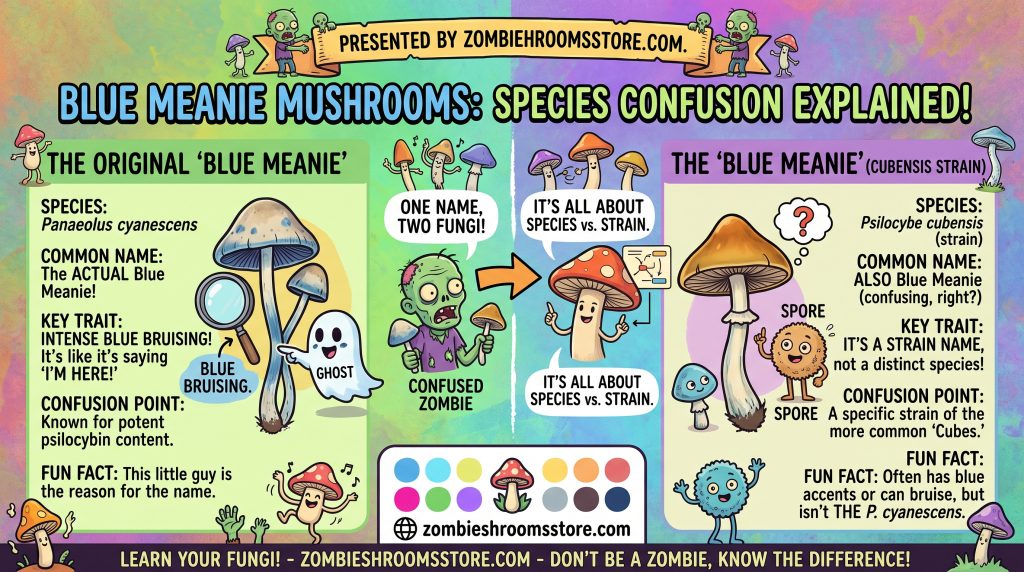
Blue Meanie Mushrooms can refer to two different things: a named variety of Psilocybe cubensis or the separate species Panaeolus cyanescens. That shared nickname creates confusion when readers compare descriptions, research findings, and claims about strength.
The distinction matters because a cultivated variety and a scientific species are different categories. Information about one should not automatically be applied to the other.
A third name, Psilocybe azurescens, frequently appears in the same discussions. It is another distinct species, rather than a scientific synonym for either mushroom called Blue Meanie.
This guide explains the naming problem, clarifies related terminology, and examines why claims about the “strongest” mushroom require more evidence than a familiar nickname.
What Does the Name Actually Mean?
Common names are convenient, but they do not always identify one organism consistently.
“Blue Meanie” appears as a variety name within P. cubensis research. A laboratory study examined material labeled Blue Meanie alongside Creeper, B-Plus, Texas Yellow, and Thai Cubensis. This demonstrates that the name is used for cubensis material in scientific work. PubMed
Separately, “Blue Meanies” is a common nickname for Panaeolus cyanescens. Consequently, a page using the nickname without a scientific name leaves an important question unanswered. en.wikipedia.org
Species and Variety Are Different Categories
A species name identifies a biological classification. A cultivated variety name usually refers to a selected line or set of reported characteristics within a species.
For example:
- Psilocybe cubensis is a species.
- Blue Meanie can be a variety label associated with that species.
- Panaeolus cyanescens is a different species in a different genus.
The phrase magic mushroom varieties often mixes these categories. An educational article should explain whether it is comparing species, cultivated selections, or informal names.
Blue Meanie Mushrooms: The Two Main Meanings
The quickest way to resolve the confusion is to write the full scientific name beside the nickname.
| Name used | What it identifies | Important distinction |
|---|---|---|
| Blue Meanie cubensis | A named variety associated with Psilocybe cubensis | A variety label within a species |
| Blue Meanies or Pan cyans | Common names associated with Panaeolus cyanescens | A separate species in another genus |
| Psilocybe cyanescens | A distinct Psilocybe species | Not Panaeolus cyanescens |
| Psilocybe azurescens | Another distinct Psilocybe species | Not a synonym for Blue Meanie |
This table explains terminology rather than providing an identification guide. A scientific name written on a label does not independently authenticate the material.
Research involving multiple psilocybin-producing fungi has treated Blue Meanies-labeled cubensis material and Panaeolus cyanescens as separate entries, reinforcing the need to distinguish them. PMC
Why “Cyanescens” Causes Another Mix-Up
Panaeolus cyanescens and Psilocybe cyanescens share the second word of their names. However, a scientific species name contains both the genus and the species epithet.
Removing the genus creates ambiguity. Writing only “cyanescens” may leave readers unsure which mushroom is being discussed.
Abbreviations need similar care. “P.” could represent either genus when both appear in the same article. Spell out the complete name before shortening it, and avoid an abbreviation where the context remains unclear.
Older Names and Alternative Terminology
Readers may also encounter Copelandia cyanescens in discussions of the mushroom commonly called Panaeolus cyanescens. Older or alternative taxonomic combinations can make search results look as though they describe additional organisms.
When comparing sources, check whether a name is a synonym, a cultivated variety label, or an entirely different species. Counting every unfamiliar name as a separate mushroom can produce inaccurate comparisons.
Where Does Psilocybe Azurescens Fit?
Psilocybe azurescens belongs to the genus Psilocybe. It is distinct from both P. cubensis and Panaeolus cyanescens.
The abbreviation p azurescens usually means Psilocybe azurescens, although formal writing should include the period and introduce the complete name first.
Likewise, azurescens mushrooms is a shortened description of that species. The search phrase psilocybin azurescens combines the name of a chemical with part of a species name; it is not itself a scientific classification.
Researchers have included P. azurescens in investigations of genetic and chemical differences among Psilocybe species. That research treats it as a distinct organism rather than another name for Blue Meanie. PubMed
For additional discussion of species terminology, read the website’s mushroom spores and species overview.
What Laboratory Research Can Tell Us
Scientific studies can measure compounds in authenticated samples. They can also investigate genetic relationships and differences among the material examined.
However, their conclusions have boundaries. A measurement applies to the samples and methods used, rather than every specimen described by the same common name.
A PubMed-indexed study comparing several cubensis strains analyzed individual mushrooms to examine differences between strains and between mushrooms within a strain. PubMed
This is relevant to Blue Meanie Mushrooms because it shows why a variety label cannot substitute for chemical measurements. Even material grouped under one name needs appropriate sampling before researchers can describe its composition confidently.
Identification Comes Before Comparison
Reliable chemical comparisons also depend on reliable biological identification.
Research examining preserved Psilocybe specimens found misidentifications and inconsistencies in chemical information. Those findings highlight the importance of authentication when interpreting older records or broad claims about a species. PubMed
A study can be carefully conducted yet still answer a narrower question than a headline suggests. Always check which species, specimens, and compounds were actually examined.
Why “Strongest” Rankings Can Mislead
Searches for strong psychedelic mushrooms often produce lists that assign each species or variety a fixed position. These lists may combine measurements from different studies without explaining whether the methods were comparable.
The phrase strongest psilocybin mushroom also leaves “strongest” undefined. It could mean the highest measured psilocybin concentration, combined concentrations of several compounds, or a person’s subjective experience.
Those are different questions.
A meaningful comparison should identify:
- The authenticated species or variety.
- The compounds measured.
- Whether results use fresh or dry weight.
- The number of samples examined.
- The analytical method and reported uncertainty.
Blue Meanie Mushrooms should therefore not receive a universal strength ranking based solely on their nickname. A high result from a particular sample does not establish the composition of every sample bearing that name.
Concentration Is Not a Medical Benefit
A higher measured concentration does not demonstrate a better therapeutic outcome.
Chemical testing establishes composition. Clinical research investigates effects in people under defined conditions. Neither type of evidence should be presented as answering the other’s questions.
Similarly, comparing chemical profiles does not establish that one mushroom is safer, more suitable for a particular person, or more likely to produce a positive experience.
Appearance Cannot Confirm Identity or Safety
The shared name may encourage readers to look for blue coloring as a shortcut. That is not a reliable basis for deciding whether an unfamiliar mushroom is safe.
Photographs cannot establish species identity, chemical composition, or the absence of contaminants. A familiar appearance also cannot authenticate a cultivated variety.
This article is intended to clarify names, not support wild-mushroom identification. Unidentified mushrooms should not be consumed on the strength of an online comparison.
The NCCIH psilocybin information guide notes that poisonous mushrooms can resemble psilocybin-containing mushrooms and that confusion can cause serious poisoning. NCCIH
Health Research and Legal Context
Psilocybin research has investigated potential mental-health applications, but findings involving structured clinical treatment do not establish benefits for a particular common name.
Clinical studies may involve measured substances, participant screening, psychological support, and defined follow-up. A consumer description of Blue Meanie Mushrooms does not provide equivalent evidence.
NCCIH also explains that experiences can be unpredictable and may involve fear, confusion, or panic. A nickname suggesting strength or popularity does not eliminate these risks. NCCIH
In the United States, NCCIH identifies psilocybin as federally controlled while noting evolving state and local policies. Reduced enforcement priority, decriminalization, and regulated access are different arrangements; none should be assumed from a product name. NCCIH
How to Read Mushroom Comparisons More Carefully
Begin by checking whether the article identifies the organism. If it discusses Blue Meanie Mushrooms without distinguishing cubensis from Panaeolus, its comparisons may be unclear from the outset.
Next, separate descriptive claims from measured findings. A statement about reported appearance is different from a laboratory result, and both differ from a clinical treatment claim.
Finally, follow the source. Does it concern the same organism? Does it support the exact conclusion being presented? Are limitations acknowledged?
For another example of how cultivated names fit within species terminology, see the website’s B+ mushroom background guide. Consistent naming makes educational comparisons easier to understand.
Frequently Asked Questions
1. Are Blue Meanie Mushrooms Always Panaeolus Cyanescens?
No. The nickname can refer to Panaeolus cyanescens or to a named Psilocybe cubensis variety. The full scientific name is needed to clarify which meaning applies. en.wikipedia.org
2. Is Panaeolus Cyanescens the Same as Psilocybe Cyanescens?
No. They belong to different genera and are different species. Sharing the word “cyanescens” does not make their scientific names interchangeable.
3. Are Azurescens Mushrooms Another Blue Meanie Variety?
No. Psilocybe azurescens is a distinct species. It should not be treated as a synonym for the cubensis variety or Panaeolus cyanescens. PubMed
4. Can a Name Establish Which Mushroom Is Strongest?
No. A defensible comparison requires authenticated samples, comparable chemical measurements, and a clear definition of strength. A common name cannot establish the concentration in an individual specimen.
5. Does Research Establish Blue Meanie as a Medical Treatment?
The studies discussed here concern identification and chemical composition, not proof that a named variety is an established treatment. Clinical findings about psilocybin should be interpreted according to the actual treatment and setting studied.