Psychedelics Education
B+ mushrooms
Oct
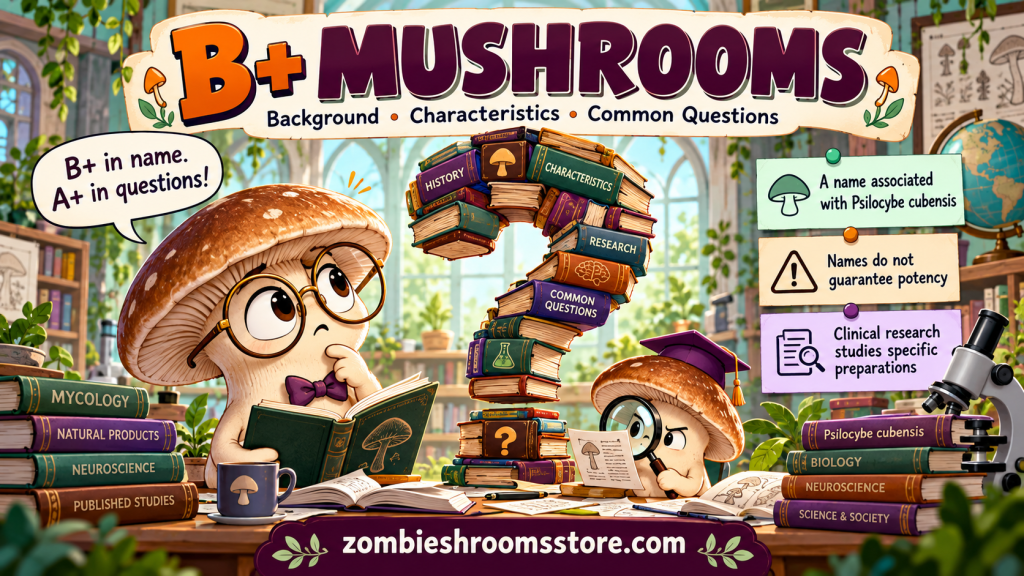
B+ Mushrooms: Background, Characteristics, and Common Questions
B+ mushrooms are a familiar name in contemporary discussions of psilocybin-containing fungi. Commonly associated with Psilocybe cubensis, the label appears in mushroom literature, online conversations, and descriptions of cultivated varieties.
However, familiarity does not establish a standardized biological identity, predictable potency, or a particular medical benefit. Claims that B+ always produces a gentle, positive, or therapeutic experience need stronger evidence than a name or personal testimonial.
Understanding this subject requires separating several questions: what the label means, what researchers know about fungal variation, and what clinical studies actually investigate.
This guide explains those distinctions. It also addresses therapeutic psychedelics, anxiety research, and product terminology without presenting a named mushroom variety as a treatment recommendation.
What Does the Name Mean?
B+ is a variety designation associated with P. cubensis, rather than a separate scientific species. A published review of this species includes B+ among named strains discussed in the scientific literature. PMC
The distinction between a species and a variety label matters. A species name provides a biological classification; an informal designation may identify a cultivated line or selection.
It does not automatically establish that every sample carrying that label has the same ancestry, characteristics, or chemical composition.
Treat the name as a starting point for further questions. Reliable identification, documented provenance, and appropriate testing answer different questions that a label alone cannot resolve.
Background and Origin Stories
Origin stories can make mushroom names memorable, but repetition is not the same as verification.
Accounts may attribute a variety to a particular person, location, or period without presenting original records. Unless those records can be checked, precise claims about who first developed B+ should be treated cautiously.
The same applies to explanations of what the “plus” means. A catchy interpretation should not become a historical fact simply because several websites repeat it.
Educational writing can acknowledge a label’s popularity while being candid about gaps in its documented history.
Common Characteristics and Their Limits
Descriptions often emphasize appearance, size, or other visible features. These observations can be useful, but they should not be presented as fixed rules for every sample.
Research on P. cubensis considers genetic diversity and environmental influences on fungal characteristics and the production of psychoactive compounds. A variety name therefore describes less than readers may initially assume. pubmed.ncbi.nlm.nih.gov
For B+ mushrooms, visible traits should be explained as reported observations rather than a reliable identification checklist.
A photograph cannot establish precise chemical content. Nor can it show whether material is suitable for a medical purpose.
| Claim or description | What readers should understand |
|---|---|
| “B+ variety” | A name associated with P. cubensis, not a separate species |
| “Large specimens” | Size does not independently establish potency |
| “Gentle effects” | A subjective description, not a guaranteed outcome |
| “Therapeutic variety” | Requires direct clinical evidence |
| “Consistent strength” | Needs testing beyond a familiar label |
| “Natural product” | Does not establish safety or medical suitability |
Potency Cannot Be Read From a Label
Strength is one of the most common subjects in mushroom discussions. However, assigning a universal potency category to an informal variety can create false confidence.
A study reporting chemical measurements describes the samples tested under its methods. Those results should not automatically be generalized to everything circulating under the same name.
Processing and storage can also matter. Research has examined the stability of psilocybin and related compounds in P. cubensis material under different conditions. pubmed.ncbi.nlm.nih.gov
Consequently, B+ mushrooms should not be described as consistently mild or predictably strong without appropriately qualified evidence.
Size, color, reputation, and price cannot replace chemical analysis. A reliable educational account makes those limits clear instead of offering an unsupported ranking.
What Shapes a Psilocybin Experience?
A psilocybin experience is not determined solely by a variety name. NCCIH explains that effects can vary with a person’s health, mood, expectations, surroundings, and other substances, among additional factors.
Experiences may involve altered perception, strong emotions, confusion, or fear. A positive account from one person cannot predict another person’s response. www.nccih.nih.gov
This is why terms such as “uplifting” or “beginner-friendly” deserve scrutiny. They can express a personal impression without establishing a general property.
Likewise, an experience that feels significant is not automatically evidence of clinical improvement. Medical research needs defined outcomes and follow-up, rather than relying only on immediate impressions.
What Therapeutic Research Actually Studies
The use of psychedelics in therapy is an active research subject. Studies investigate particular substances, participant groups, treatment settings, and measures of improvement.
Those details form part of the intervention. Psychological support, screening, and follow-up should not disappear when a study is summarized.
A clinical trial investigating psilocybin does not necessarily investigate whole mushrooms. It also does not automatically establish benefits for a commercial variety.
The FDA’s information on psychedelic drug development describes its support for research into potential treatments for serious mental health conditions. Research and development, however, should not be confused with evidence for every product using psychedelic terminology. FDA
A Variety Name Is Not a Treatment Protocol
The phrase “psychedelic mental health treatment” can conceal important differences.
Ask which substance was studied, how participants were selected, what support they received, and what outcomes were measured.
A mushroom label answers none of those questions by itself. Calling B+ mushrooms “therapeutic” would require evidence directly relevant to that claim.
Similarly, research on depression should not automatically be used to advertise benefits for anxiety, trauma, or general wellbeing. Each condition and intervention needs an appropriate evidentiary basis.
Questions About Anxiety
“Which psychedelic is best for anxiety?” is a common search, but it does not have a universal answer supported by this comparison.
Anxiety can refer to a diagnosed disorder, temporary distress, or symptoms associated with another illness. Studies involving one population may not apply to another.
A meta-analysis indexed on PubMed examined psilocybin combined with behavioral interventions in people with elevated anxiety or depression symptoms. Its conclusions tentatively supported further research. It did not establish a preferred mushroom variety. PubMed
A thoughtful interpretation asks more than whether symptoms changed. It considers the comparison group, sample size, duration, adverse effects, and whether the findings have been replicated.
Discussing Treatment Choices
For someone seeking help with anxiety, an online variety description cannot assess the cause of symptoms or determine an appropriate treatment.
A qualified clinician can discuss established options and explain whether a particular research intervention is relevant.
Do not stop prescribed medication or postpone care because a product description promises emotional relief. The NCCIH psilocybin overview specifically advises against delaying medical attention to use psilocybin. www.nccih.nih.gov
Wellness Language Needs Clear Definitions
“Psychedelic wellness” is a broad marketing expression. Without a definition, it does not tell readers what outcome is promised or how that outcome was evaluated.
Does “wellness” mean a personal feeling, a change on a questionnaire, or improvement in a diagnosed condition? Those are different claims.
Terms such as “natural,” “holistic,” and “premium” also do not establish effectiveness. Readers should look for specific ingredients, relevant evidence, and transparent limitations.
For material found on zombieshroomsstore.com, apply the same questions used for any other website: what is documented, what is anecdotal, and what remains uncertain?
Tablets and Other Product Formats
Magic mushroom tablets describe a format, not a verified composition. The words alone cannot establish the ingredients, concentration, quality, or relationship to a studied preparation.
A tablet, powder, chocolate, and whole fungal material should not be assumed equivalent because they share a mushroom-related description.
Likewise, vague search terms such as “shrooms w” provide too little information to identify a substance or assess a health claim.
Clear educational content should name the species or compound being discussed. It should also distinguish label claims from independently established facts.
A professional-looking package is not a substitute for evidence about what it contains.
Safety and Personal Suitability
Possible adverse effects described by NCCIH include anxiety, nausea, headache, increased heart rate, and increased blood pressure. It also identifies particular concerns for people with psychotic conditions or severe forms of bipolar disorder. www.nccih.nih.gov
That information does not establish personal suitability. Medical history, current symptoms, and medications require individual assessment.
A familiar variety name cannot make those considerations disappear.
Responsible education should describe both potential benefits under investigation and possible harms. It should also avoid treating an unpleasant reaction as proof that someone simply needs a different mushroom variety.
Frequently Asked Questions
1. Are B+ mushrooms a separate species?
No. The designation is associated with Psilocybe cubensis. It should not be confused with a separate scientific species name or a standardized medical product. PMC
2. Does the name mean an experience will be positive?
No. A label cannot guarantee mood, perception, or emotional response. Personal descriptions may explain a variety’s reputation, but they do not predict another person’s experience.
3. Are they proven to treat anxiety?
The research discussed here concerns psilocybin-based interventions, not a clinical comparison establishing B+ as an anxiety treatment. Compound research should not be presented as variety-specific proof.
4. Are tablets equivalent to whole mushrooms?
Not necessarily. Format alone does not establish composition or concentration. Evidence about one preparation cannot automatically support claims about a different product.
5. What is the best way to learn about psychedelics?
Begin with authoritative health information and original research. Identify the substance, condition, study design, and reported harms. Keep personal stories separate from evidence of medical effectiveness.
Further Reading
For a related discussion of variety labels, see Golden Teacher vs B+ Mushrooms.
Learning about B+ mushrooms is most useful when the explanation distinguishes names, biological variation, and clinical evidence. Familiarity can help organize the subject, but it should never substitute for verification.