
Psychedelics Education
Huautla vs Golden Teacher
Oct
Huautla vs Golden Teacher: Comparing Two Well-Known Psilocybin Varieties
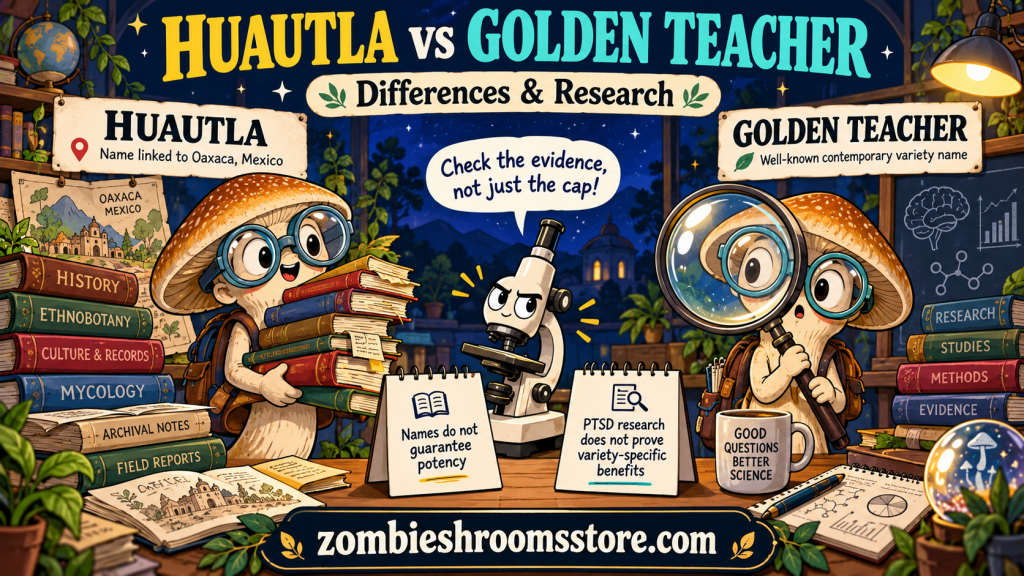
Huautla vs Golden Teacher is a comparison between two familiar names in discussions of psilocybin-containing mushrooms. Both are commonly associated with Psilocybe cubensis, but their names do not establish predictable effects, standardized potency, or proven medical benefits.
Huautla carries an association with Huautla de Jiménez in Oaxaca, Mexico. Golden Teacher is a widely circulated name in contemporary mushroom culture. Understanding those differences requires separating historical context, biological characteristics, personal accounts, and clinical evidence.
That distinction becomes especially important when searches involve magic mushrooms for PTSD or other mental health conditions. Research on psilocybin does not automatically demonstrate that either named variety is an effective treatment.
This guide compares what the labels communicate, explains where uncertainty remains, and examines the evidence without ranking either variety as a medical choice.
What Do the Two Names Mean?
Mushroom descriptions often use “strain,” “variety,” and “cultivar” loosely. These terms can suggest a level of consistency that a label alone cannot verify.
A scientific species name identifies a biological classification. A contemporary variety name may describe a cultivated line, selection, or informal designation. It does not necessarily confirm an independently verified pedigree.
Research reviewing P. cubensis discusses genetic diversity, variation between strains, and environmental influences on the production of its compounds. These interacting factors make simple assumptions about named varieties unreliable. pubmed.ncbi.nlm.nih.gov
For readers, the practical lesson is straightforward: identify what has actually been documented. A memorable name is useful for organizing a conversation, but it is not a laboratory report.
Huautla vs Golden Teacher at a Glance
The most useful comparison concerns context and evidence rather than promises about an experience.
| Feature | Huautla | Golden Teacher |
|---|---|---|
| Common association | Huautla de Jiménez, Oaxaca | Contemporary cultivated mushroom culture |
| Species commonly attached to the name | Psilocybe cubensis | Psilocybe cubensis |
| Historical interpretation | Requires distinction between a regional tradition and a modern label | Origin stories require reliable documentation |
| Potency | Cannot be confirmed from the name alone | Cannot be confirmed from the name alone |
| Experience claims | Personal descriptions are not predictable outcomes | Personal descriptions are not predictable outcomes |
| PTSD treatment evidence | No variety-specific evidence established here | No variety-specific evidence established here |
This table does not establish that all material carrying either name is biologically identical. It also provides no basis for choosing one as a treatment.
The Historical Connection in Oaxaca
Huautla de Jiménez is closely associated with Mazatec traditions and María Sabina, a healer whose work brought international attention to existing ceremonial practices.
CONABIO’s account describes knowledge transmitted through family and community generations, several locally recognized mushrooms, and ceremonies involving chanting. This history is broader than a modern cubensis label. biodiversidad.gob.mx
Consequently, describing a contemporary Huautla variety as an exact representation of Mazatec tradition requires more evidence than a geographic name.
A respectful comparison should preserve that distinction. Indigenous knowledge has cultural meaning beyond the characteristics of a biological sample.
Readers can explore the broader subject through zombieshroomsstore.com, while checking historical claims against Mexican cultural sources rather than relying exclusively on product descriptions.
Understanding Golden Teacher’s Reputation
Golden Teacher is frequently discussed in contemporary mushroom literature. A scientific review of P. cubensis includes it among prominent named strains. pmc.ncbi.nlm.nih.gov
However, recognition does not prove that a variety consistently produces a particular emotional experience. Descriptions such as “gentle,” “wise,” or “ideal for beginners” should not be treated as clinical guarantees.
The word “Teacher” is part of the name. It does not establish that an experience will provide insight, resolve trauma, or improve judgment.
Likewise, an account from one person cannot predict what another person will experience. When comparing reputations, distinguish documented observations from language that expresses expectations or personal interpretation.
Appearance Does Not Establish Potency
Photographs can show visible features, but they cannot reveal a sample’s precise chemical composition or establish its safety.
Even when a description identifies a species correctly, that identification does not provide a measured concentration of active compounds. A review of P. cubensis emphasizes the interaction between genetic variation and environmental factors. pubmed.ncbi.nlm.nih.gov
A useful Huautla vs Golden Teacher comparison therefore avoids unsupported potency rankings.
If an article claims that one is always stronger, ask whether it presents testing from authenticated samples and explains the limits of those results. A finding from one sample cannot automatically describe everything circulating under the same name.
Visual resemblance is also not a substitute for expert identification.
What “Medical Psychedelics” Means
Medical psychedelics is a broad expression used in discussions of clinical research, treatment development, and regulated services. It does not identify one uniform intervention.
A study may investigate a specific compound under defined conditions, with participant screening, psychological support, and follow-up. Those details are part of the intervention being evaluated.
A named mushroom variety is a different kind of description. It does not establish that a sample matches the preparation used in a clinical trial.
When reading medical claims, identify the substance, diagnosis, study design, and treatment setting. Without those details, “research-backed” can become a vague phrase that gives readers more confidence than the evidence supports.
What Research Says About PTSD
Do psychedelics help with PTSD? Researchers are investigating that question, but the answer depends on the substance and the quality of the evidence.
A published psilocybin PTSD study enrolled 22 participants in a nonrandomized, open-label trial. Its primary purpose was to examine safety and tolerability. The investigators also reported findings suggesting symptomatic improvement when psilocybin was administered with psychological support.
The study indexed on PubMed is relevant early evidence, but its design limits conclusions about effectiveness. PubMed
Why the Design Matters
“Open-label” means the intervention was known. Without randomization and a control group, researchers cannot confidently separate its effects from expectations, psychological support, natural symptom changes, or other influences.
The study also recorded adverse events. Reporting possible benefits alongside harms provides a more complete account than describing the findings as a breakthrough cure.
Most importantly for this comparison, the study does not establish that Huautla or Golden Teacher mushrooms are effective PTSD treatments. It investigated a particular research intervention, not a contest between these names.
Microdosing and Its Unanswered Questions
Microdosing for PTSD should not be presented as equivalent to the supported psilocybin intervention studied above.
The National Center for Complementary and Integrative Health states that it remains unclear whether psilocybin microdosing is safe or effective. It also describes potential adverse effects, including sleep problems, anxiety, and worsening mood. NCCIH
Personal reports can explain why people are interested, but they cannot establish effectiveness.
For someone researching psilocybin and PTSD, the useful distinction is between a hypothesis, a testimonial, and evidence from an appropriately designed study. Each deserves a different level of confidence.
Repeated exposure to small amounts is also a separate research question from a single supported intervention.
Mood Disorders Require Separate Assessment
Discussions of psychedelics and mood disorders often combine depression, anxiety, bipolar disorder, and trauma-related conditions. These diagnoses should not be treated as interchangeable.
Evidence relevant to one condition may not apply to another. A participant population selected for a trial may also differ substantially from people seeking help outside research.
NCCIH identifies important safety concerns for people with psychotic conditions and severe forms of bipolar disorder. Its psilocybin health overview explains uncertainty, possible harms, and the importance of discussing care with a qualified professional. NCCIH
An online comparison cannot assess psychiatric history, medication interactions, or individual suitability.
Can Either Be Called the Safest?
The phrase “safest psychedelics” suggests a universal ranking that this comparison cannot support.
Safety depends on more than a variety name. NCCIH describes unpredictable experiences and factors including health, expectations, surroundings, other substances, and the preparation involved. NCCIH
Calling Golden Teacher “beginner-friendly” or Huautla “traditional” does not remove those uncertainties.
The Huautla vs Golden Teacher question therefore has no evidence-based winner for universal safety. Nor does this article establish a preferred option for self-treatment.
Anyone considering a change in mental health care should discuss the actual intervention with a qualified clinician rather than relying on a label’s reputation.
How to Evaluate Online Claims
Searches for psychedelic mushrooms for PTSD can return scientific studies, personal stories, advertisements, and speculative descriptions together.
Check whether an article:
- Identifies the substance and condition studied.
- Links to the original research.
- Explains the comparison group and follow-up.
- Reports adverse effects alongside benefits.
- Distinguishes compound research from variety-specific claims.
Also watch for a historical association being used as medical evidence. Cultural significance deserves recognition, but it answers a different question from clinical effectiveness.
A careful comparison makes these boundaries visible instead of using the word “psychedelic” to connect unrelated findings.
Frequently Asked Questions
1. What is the main difference between the two names?
Huautla has a geographic and cultural association with Oaxaca, while Golden Teacher is widely recognized in contemporary mushroom discussions. Neither name independently confirms potency, lineage, safety, or medical effectiveness.
2. Is Golden Teacher consistently weaker?
This article establishes no reliable universal ranking. Claims about strength need authenticated testing and appropriate qualifications. A sample’s measured composition should not automatically be generalized to every mushroom sharing its label.
3. Does traditional use prove a variety treats trauma?
No. Traditional cultural significance and evidence for a modern psychiatric treatment are different matters. Neither should be simplified to fit the other, and historical associations cannot replace condition-specific clinical research.
4. Are magic mushrooms for PTSD a proven treatment?
Early psilocybin research includes a small open-label trial, but that does not establish routine effectiveness or validate named mushroom varieties. Stronger controlled evidence is needed to assess benefits, risks, and durability. PubMed
5. Which name should someone choose for medical purposes?
A variety name is not an adequate basis for a medical decision. Discuss symptoms and evidence-based care with a qualified professional. Research findings need to match the actual intervention, diagnosis, and setting under consideration.
Further Reading
For related material, use the comparison search on zombieshroomsstore.com. Compare claims with the original studies and health information above.
Huautla vs Golden Teacher is most informative when it explains names, context, and uncertainty. It becomes misleading when reputation is presented as a prescription.