Psychedelics Education
Huautla Mushrooms
Oct
Huautla Mushrooms: History and Traditional Context in Mexico
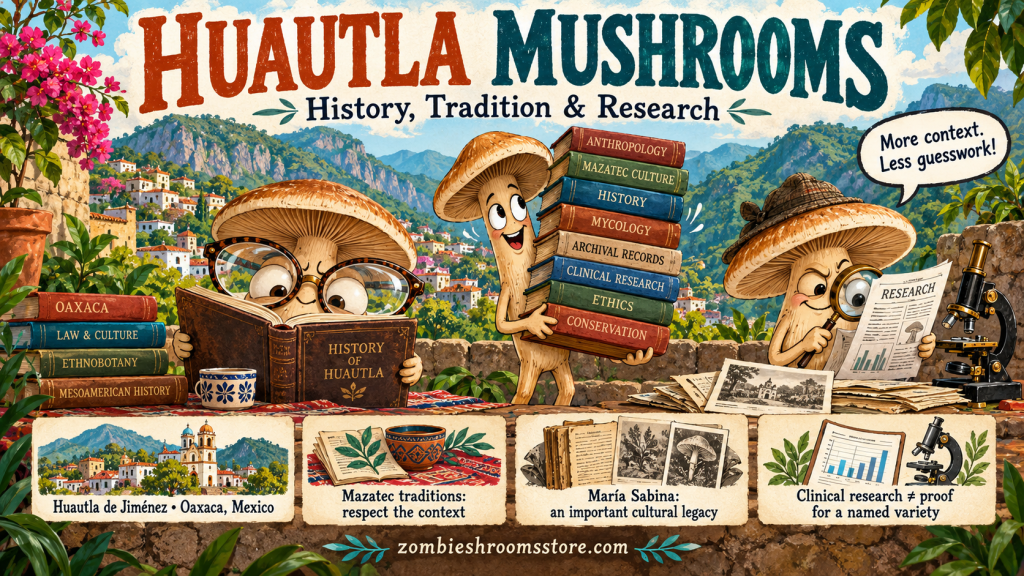
Huautla mushrooms are associated with Huautla de Jiménez, a town in Oaxaca, Mexico, widely recognized for its connection to Mazatec ceremonial traditions. Understanding that association requires looking beyond modern mushroom names to the people, knowledge, and cultural practices behind them.
Today, “Huautla” may appear as a name attached to a cultivated mushroom variety. However, a contemporary label should not be treated as a complete description of Indigenous tradition or evidence of a verified historical lineage.
This guide explores the region’s significance, María Sabina’s legacy, and the difference between traditional healing practices and modern clinical research. It also addresses questions about psychedelics for mental health without presenting a culturally significant mushroom name as a proven medical treatment.
What Does the Name Refer To?
“Huautla” can refer to a place, its broader cultural associations, or a contemporary mushroom label. Those meanings overlap, but they are not interchangeable.
In modern mushroom discussions, the name commonly appears in connection with Psilocybe cubensis. Reporting on the region distinguishes that contemporary naming practice from local traditions involving multiple mushroom species. A commercial variety name does not represent the entire ceremonial history of Huautla de Jiménez. doubleblindmag.com
This distinction matters whenever a description claims that a named variety is “the original ceremonial mushroom” or has a particular traditional effect. Such statements require historical and biological evidence.
A name alone cannot confirm ancestry, chemical composition, potency, or therapeutic value. Readers should therefore separate what is documented from what is repeated in marketing or informal accounts.
The Place Behind Huautla Mushrooms
Huautla de Jiménez lies in Oaxaca’s Sierra Mazateca. Mexico’s tourism authority recognizes the town’s association with María Sabina and traditional healing practices involving herbs and mushrooms. gob.mx
Its significance extends beyond contemporary interest in psychedelics. A responsible account should approach Huautla as a living community, rather than simply as the origin story for a product.
That means asking whose account is being presented. A visitor’s description, a scientific classification, and a community member’s explanation may emphasize different aspects of the same subject.
For educational writing, this is an opportunity to preserve context. Geography explains where a tradition is associated; it does not, by itself, explain what that tradition means to the people who practice it.
María Sabina and Her Legacy
María Sabina was a Mazatec healer whose knowledge developed within family and community traditions. Mexico’s biodiversity commission, CONABIO, describes her connection to ceremonial healing and the use of different locally recognized mushrooms.
Its account also records visits by foreign researchers in 1955 and the publication of a widely influential account in Life magazine in 1957. These events brought substantial outside attention to practices that already existed. Her ceremonial work included inspired chanting as well as mushrooms. Biodiversidad Mexicana
The CONABIO profile of María Sabina provides a useful starting point for learning about her life.
Describing this history as a foreign “discovery” gives outsiders too much credit. A more accurate framing distinguishes international publicity from the knowledge held by local people.
Her legacy should also be approached as a human story. Reducing a healer’s life to an advertising reference leaves out the relationships and responsibilities that give cultural knowledge meaning.
Understanding Traditional Context
Accounts of María Sabina describe healing ceremonies known as veladas. Their significance cannot be reduced to the presence of a psychoactive substance. Language, chanting, the healer’s role, and the purpose of the encounter are also part of the documented context. Biodiversidad Mexicana
For readers, an important distinction follows: learning about a ceremony is different from claiming to reproduce it.
A retreat, online description, or modern experience should not automatically be called an authentic Mazatec practice. Claims of cultural authority deserve careful examination, including who has authorized the description and whose perspective it represents.
Likewise, traditional healing terminology does not translate neatly into modern psychiatric diagnoses. It would be misleading to describe every historical healing encounter as treatment for depression or post-traumatic stress disorder.
Respectful education can acknowledge cultural significance while avoiding unsupported medical interpretations.
Why Modern Labels Need Scrutiny
Descriptions of Huautla mushrooms sometimes combine regional history with claims about predictable experiences. Readers should examine those claims separately.
A historically meaningful name does not establish that every sample bearing it has identical characteristics. It also does not demonstrate that researchers have tested that named variety for a particular condition.
Before accepting a claim, ask:
- Does the source identify the species?
- Is the historical connection documented?
- Does the research concern this variety or a different preparation?
- Is a personal account being presented as a general result?
These questions help prevent a common misunderstanding: assuming that evidence about psilocybin automatically proves a claim about a mushroom label.
What Research Can Tell Us
Interest in the benefits of psychedelic drugs has encouraged clinical investigation. However, researchers study particular substances, conditions, participants, and treatment settings.
The phrase “therapeutic hallucinogens” is broad. It does not identify one standardized treatment, and it should not imply that every substance grouped under that description has the same evidence or risks.
A useful reading habit is to identify the actual intervention. Was it a measured research preparation? Was psychological support included? What comparison did the investigators use?
Research on a compound can help answer scientific questions without validating every historical story or commercial description attached to it. That distinction is especially important when discussing Huautla mushrooms.
Depression and Anxiety
Searches for “psychedelic drugs for depression and anxiety” often bring together research on different diagnoses and populations.
A 2023 randomized clinical trial examined a single administration of psilocybin for major depressive disorder, delivered with psychological support. It reported improvements in depressive symptoms compared with its control intervention. The trial indexed on PubMed is relevant evidence about that studied approach. PubMed
It does not establish a treatment effect for a named Huautla variety. Nor should findings in major depression automatically be applied to every anxiety disorder.
The practical question is more specific than whether participants felt better: which patients benefited, under what conditions, for how long, and with what adverse effects?
Trauma-Related Conditions
The phrases “psilocybin PTSD” and “PTSD and mushrooms” describe public interest, but they do not establish clinical effectiveness.
A registered study is investigating psilocybin and MDMA approaches in veterans with PTSD. A trial registration documents a research plan; it is not proof that the intervention works. ClinicalTrials.gov
Similarly, “acid PTSD” refers informally to questions about LSD and trauma. LSD, psilocybin, and MDMA are different substances. Findings about one cannot simply be transferred to another.
When reading trauma-related claims, look for completed studies, clearly reported outcomes, appropriate comparisons, and follow-up. A headline about psychedelic research may concern a different substance or condition from the one you are researching.
Positive Effects and Possible Harms
Are psychedelics good? That question is too broad for a reliable yes-or-no answer.
Psychedelics can alter perception, mood, and thought. Some experiences are described positively, while others involve distress. NIDA identifies health effects and safety concerns alongside the scientific interest in these substances. Its overview of psychedelic and dissociative drugs offers general background. nida.nih.gov
Claims about psychedelics’ positive effects should therefore include the setting and the evidence behind them.
A personally meaningful experience is not necessarily a clinical improvement. Conversely, a difficult experience should not automatically be dismissed as a necessary step toward healing.
For someone seeking help with depression, anxiety, or trauma, a useful next step is a conversation with a qualified mental health professional. An educational article cannot determine personal suitability or replace an assessment.
Food Classification Is a Separate Question
“Is mushroom a vegetable or protein?” is a nutrition question that belongs to a different category.
Biologically, mushrooms are fungi. In cooking, edible varieties are commonly grouped with vegetables. They contain some protein, but typical servings are not substantial protein replacements. nutritionsource.hsph.harvard.edu
These food facts should not be used to imply that psychoactive mushrooms are appropriate everyday nutritional ingredients. Culinary foods, supplements, and psychoactive products require different explanations.
When browsing zombieshroomsstore.com, identify which category an article discusses before applying its claims to another product.
Reading Cultural and Medical Claims Carefully
Good educational writing makes uncertainty visible.
Historical claims need historical sources. Biological claims need reliable identification. Medical claims need evidence relevant to the substance, condition, and intervention being discussed.
Watch for descriptions that move between these categories without explanation. “Traditionally used,” “studied by scientists,” and “clinically effective” are separate statements requiring separate support.
A balanced account can recognize Indigenous knowledge without turning it into a universal medical endorsement. It can also explain promising research without suggesting that modern clinical methods fully represent a community’s traditions.
Frequently Asked Questions
1. What are Huautla mushrooms?
The term connects mushrooms with Huautla de Jiménez in Oaxaca and may also appear as a contemporary variety label. These uses should be distinguished. A regional name alone does not establish a sample’s ancestry or medical properties.
2. Did María Sabina introduce ceremonial use?
She helped bring existing traditions to wider international attention. The CONABIO account describes knowledge passed through family and community generations, rather than a practice beginning with foreign visitors. Biodiversidad Mexicana
3. Are named varieties proven treatments for depression?
The depression trial discussed here investigated psilocybin with psychological support. It does not establish effectiveness for a particular variety name or for mushrooms obtained outside the research setting. PubMed
4. Does research prove mushrooms treat PTSD?
Interest and ongoing trials do not amount to proof. Evaluate completed results and distinguish psilocybin studies from research involving MDMA, LSD, or other substances. Each intervention needs its own evidence.
5. Does traditional use establish safety or legality?
Traditional significance does not settle either question. Safety requires its own assessment, while legal status depends on the jurisdiction and activity. A cultural history article should not be treated as permission to possess or use a substance.
Further Exploration
Use the Huautla search on zombieshroomsstore.com to look for related material. Compare historical descriptions with Mexican cultural sources and medical claims with the original research.