
Psychedelics Education
Penis Envy Mushrooms
Sep
Penis Envy Mushrooms: History, Characteristics, and What Research Says
Penis Envy mushrooms are a named variety commonly associated with Psilocybe cubensis, a mushroom species that can contain psilocybin and psilocin. Their unusual appearance has made them recognizable in online discussions, while claims about their strength have attracted even more attention. Much of what readers encounter, however, mixes documented findings with stories that are difficult to verify.
Understanding the difference matters. A variety name does not establish the chemical content of an individual mushroom. Likewise, clinical research on psilocybin does not prove that a particular named mushroom variety treats a medical condition. This article examines the history, commonly described characteristics, research, risks, and legal context without treating reputation as scientific evidence.
Readers looking for broader background can explore the informational resources at zombiesshroomsstore.com alongside the independent research and government sources linked throughout this article.
What Are Penis Envy Mushrooms?
“Penis Envy” is a variety name generally used for certain cultivated P. cubensis mushrooms. It is not a separate scientific species name, a measure of potency, or the name of an approved medication.
Three related terms are easy to confuse. Psilocybe cubensis is a species. Penis Envy is a name associated with a cultivated variety within that species. Psilocybin is a compound that the body converts into psilocin, which contributes to psychedelic effects. Knowing which term a claim refers to helps readers judge whether the claim is about biology, a variety’s reputation, or a substance being studied in a clinical trial.
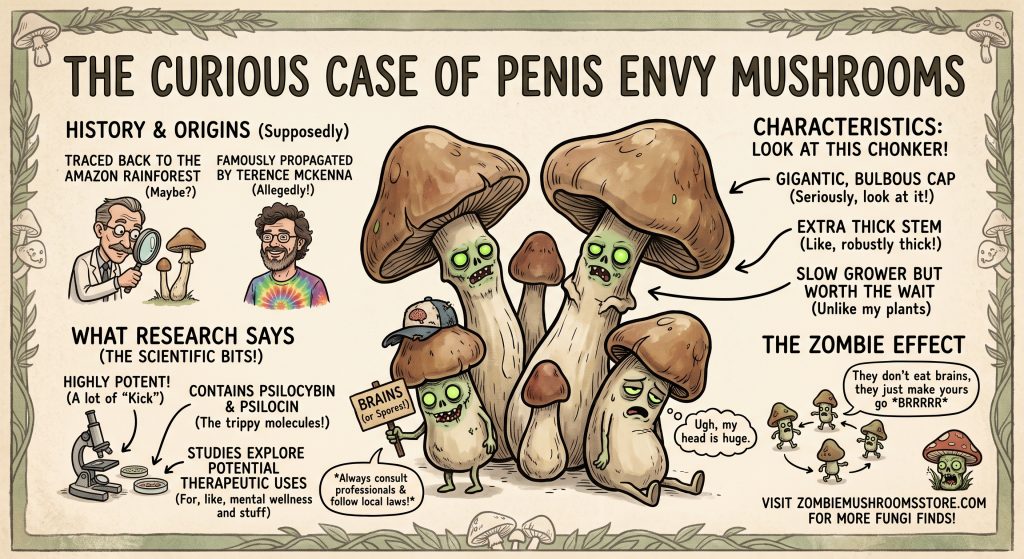
Descriptions of Penis Envy mushrooms often mention thick stems and relatively small caps. Those traits help explain how the variety acquired its name, but they cannot confirm identity by themselves. A photograph also cannot show how much psilocybin or psilocin a specimen contains. Appearance, informal labels, and chemical measurements answer different questions.
That distinction becomes especially important when an online description calls an entire variety “the strongest.” Laboratory results from selected samples cannot establish the contents of every mushroom later sold or discussed under the same name.
Penis Envy Mushrooms: History and Uncertain Origins
The origin story of Penis Envy mushrooms is frequently retold, but accounts differ over who first encountered, selected, developed, and named the variety. Stories often connect it with figures involved in psychedelic mushroom culture during the 1970s and subsequent decades. A clear, independently verifiable record of every step in its development is harder to establish.
For that reason, it is more accurate to describe the variety’s history as partly documented and partly anecdotal. A person may have played a role in sharing an earlier mushroom culture, while another may have selected or circulated mushrooms with the appearance now associated with the name. Those possibilities should not be compressed into a certain account of one discoverer and one date.
The history of this named variety is also distinct from the broader history of psilocybin mushrooms. Scientists studied psychedelic compounds before many modern variety names became widely discussed online. Research involving measured psilocybin has developed through a separate process from the informal naming and circulation of cultivated mushrooms.
This does not make the cultural history uninteresting. It simply means that an engaging story should be identified as a story when the evidence cannot confirm all its details. Readers evaluating an origin claim can ask whether it points to a dated primary record or repeats a later account.
Characteristics, Potency, and Variation
Penis Envy mushrooms are commonly described by their stout stems and smaller caps. Yet specimens associated with a single variety name can differ in appearance. Descriptions of typical traits should therefore be read as general observations, not as an identification guide.
Research on Penis Envy mushrooms is still limited, so claims about a consistent strength should be treated cautiously. A laboratory study indexed by PubMed measured psilocybin and psilocin in multiple P. cubensis strains and found differences between strains and between individual mushrooms within a strain. The practical lesson is that a name alone cannot establish the contents of an untested specimen. pubmed.ncbi.nlm.nih.gov
Chemical variation also makes sweeping comparisons misleading. A statement that one variety is always a particular number of times stronger than another suggests a consistency that a name cannot guarantee. To evaluate a specific potency claim, readers would need to know what was sampled, how it was measured, and whether the comparison applies beyond those samples.
Health Canada similarly notes that concentrations of active ingredients can vary from one mushroom to another. Effects can therefore vary according to the mushroom and the person involved. www.canada.ca
Identification is a separate concern from potency. Poisonous mushrooms may be mistaken for psilocybin-containing species. Neither an online photo nor a familiar-sounding variety name establishes that an unidentified mushroom is safe or contains what someone claims it contains.
What Does Psilocybin Research Say?
Researchers are studying psilocybin for several mental health conditions, including depression. Some trials have reported promising results, but research questions remain about effectiveness, longer-term outcomes, risks, and which patients might benefit. Readers should pay close attention to what was actually studied.
A clinical trial may investigate a measured psilocybin intervention under controlled conditions. Participants may be screened, monitored, and followed after treatment. Such a finding cannot automatically be transferred to whole mushrooms, much less to every mushroom carrying the Penis Envy name.
This is a common source of confusion in online health writing. “Psilocybin is being studied” is a statement about an area of research. “Penis Envy mushrooms are a proven treatment” is a different and much stronger claim. Evidence for the first does not establish the second.
Health Canada says research into possible therapeutic uses is ongoing and that the evidence remains limited. Its public guidance identifies clinical trials as an appropriate way to advance knowledge while protecting participants. It also states that no therapeutic product containing psilocybin has been approved for sale as a medicine in Canada. www.canada.ca
Readers seeking more context should compare any related educational articles on zombiesshroomsstore.com with the original study and public health guidance. Before publishing, confirm that this /blog/ address is the correct URL on your site; it could not be independently verified during drafting.
A useful habit when reading a research headline is to ask: Did the study test a standardized compound, a preparation made from mushrooms, or the named variety itself? What outcome did researchers measure, and for how long? Clear answers prevent promising early findings from turning into unsupported medical claims.
Effects and Health Risks
Psilocybin can affect perception, emotion, and a person’s sense of time. Accounts of visual changes are common, but there is no single experience that a mushroom name can predict. Reactions differ, and an individual’s medical circumstances can matter.
Unwanted effects can include fear, anxiety, confusion, nausea, and impaired judgment. Health Canada also notes potential concerns for people with existing psychiatric conditions or cardiac disease. Mixing substances can increase risks. These possibilities belong in an educational discussion alongside the reasons researchers continue to investigate psilocybin. www.canada.ca
Another risk comes from assuming an unregulated item has the identity or ingredients claimed for it. The US Drug Enforcement Administration’s psilocybin fact sheet describes physical and psychological effects and warns that incorrectly identifying a poisonous mushroom can cause harm. A variety label does not resolve either concern. www.dea.gov
People considering a treatment for a health condition should speak with a qualified healthcare professional about established options and any questions they have about legitimate clinical research. An article about a mushroom variety cannot assess an individual’s health or replace medical care.
How Do Psilocybin Mushrooms Compare With LSD?
Some readers arrive at this topic after searching for acid visuals, acid trip visuals, or LSD visual effects. “Acid” is a common name for LSD. LSD and psilocybin are different substances, although both are commonly classified as psychedelics and both can alter perception.
Descriptions of visual effects should be handled carefully. A person’s account of colors, patterns, or other changes is subjective. It cannot establish what another person would experience, and an LSD account cannot predict the effects of a mushroom. A striking visual description is also not evidence that one substance or variety is medically beneficial.
The comparison is most useful for clearing up terminology. When an article discusses LSD visual effects, it is discussing LSD. When it discusses Penis Envy mushrooms, it is discussing a named mushroom variety associated with psilocybin. Blurring those subjects makes health information less reliable.
What Are the Three Subclasses of Hallucinogens?
Searches for the “3 subclasses of hallucinogens” commonly refer to a broad educational grouping: psychedelics, dissociatives, and deliriants. Psilocybin and LSD are typically discussed as psychedelics. Ketamine is commonly discussed as a dissociative, while certain anticholinergic substances are described as deliriants.
This grouping is a starting point, not a claim that all the substances have identical effects or risks. Scientific and educational sources may organize drugs somewhat differently depending on what they are explaining.
A search for “examples of hallucinogens drugs brainly” may lead to short homework answers, but a named example is more useful when paired with its classification and a credible source. Similarly, “which of the following is not considered a hallucinogen” cannot be answered accurately without seeing the options. A substance should be assessed on its identity and effects, rather than guessed from a phrase in a search result.
For this article, the central point is simple: psilocybin belongs in discussions of psychedelics, while “Penis Envy” names a mushroom variety. A classification term does not determine whether a product is lawful or medically approved.
Legal Context in the United States and Canada
Psilocybin rules depend on the jurisdiction and the activity involved. In the United States, psilocybin remains controlled under federal law. State or local policies may differ, but a local change should not be mistaken for federal approval of a named mushroom variety as a medicine.
In Canada, Health Canada describes specific regulated routes through which psilocybin may be accessed in certain circumstances. They include clinical trials, practitioner requests through the Special Access Program, and individual exemptions where applicable. These pathways have requirements and safeguards; they are not general authorization to obtain or prescribe mushrooms. www.canada.ca
Legal claims can become outdated, so readers should check current government guidance for their location. They should also identify exactly what a claim concerns: possession, research, a practitioner’s request, or an approved medicine. Those categories are not interchangeable.
What Should Readers Take Away?
Penis Envy mushrooms are a recognizable name within discussions of P. cubensis, but recognition is not the same as standardization. Their precise origin is not fully settled by the accounts commonly repeated online. Their appearance cannot confirm identity or chemical content, and research on psilocybin does not prove a medical benefit for this particular variety.
The most dependable approach is to separate four questions: What does the historical record establish? What did a laboratory actually measure? What intervention did a clinical study test? What do current rules permit in a specific location? Keeping those questions distinct makes it easier to learn from research without overstating it.
Frequently Asked Questions
1. Are Penis Envy mushrooms a separate species?
No. Penis Envy is generally used as a cultivated variety name associated with Psilocybe cubensis, rather than as a separate scientific species name.
2. Are Penis Envy mushrooms always more potent than other varieties?
That cannot be established from the name alone. Chemical content can vary between strains and between individual mushrooms within a strain. Testing a particular sample does not establish the contents of every specimen sold under that name. pubmed.ncbi.nlm.nih.gov
3. Has research proven that Penis Envy mushrooms treat depression?
No. Clinical research into psilocybin should not be presented as proof that this named mushroom variety treats depression. Researchers must evaluate the specific intervention and outcome studied.
4. Are psilocybin mushrooms approved prescription medicines in Canada?
Health Canada states that no psilocybin-containing therapeutic product is approved for sale as a medicine in Canada. Certain regulated pathways may permit access in specific circumstances. www.canada.ca
5. Do “acid visuals” and mushroom visual effects mean the same thing?
No. “Acid” refers to LSD, while Penis Envy mushrooms are associated with psilocybin and psilocin. Both can alter perception, but a description of one cannot predict a person’s experience with the other.