Psychedelics Education
Psilocybin Laws in Canada Explained: Possession, Health Canada Regulations, and Exemptions
Oct
Psilocybin Laws in Canada Explained: What Every Canadian Should Understand
If you have searched for clear information about psilocybin laws in Canada, you have probably run into a frustrating mix of headlines, outdated blog posts, and legal jargon. One week it looks like magic mushrooms are practically legal; the next, police are charging people over an illegal storefront. The truth is that Canada’s psilocybin rules sit in a strange middle ground: strictly prohibited on paper, but increasingly flexible in practice through Health Canada exemptions and court-driven nuance.
This guide explains how psilocybin is classified under Canadian law, what possession actually means, how Health Canada regulations work, what exemptions exist, and how to interpret recent enforcement news without panicking or making assumptions. It is educational information, not legal advice, and it is written for adults who want a straight answer.
What Is Psilocybin Under Canadian Law?
Psilocybin is the naturally occurring psychoactive compound found in more than 180 species of mushrooms, most famously those in the Psilocybe genus. In Canada, psilocybin and psilocin (the compound your body converts psilocybin into) are listed in Schedule III of the Controlled Drugs and Substances Act (CDSA). That scheduling matters because it determines penalties, enforcement priorities, and how the law treats possession versus trafficking.
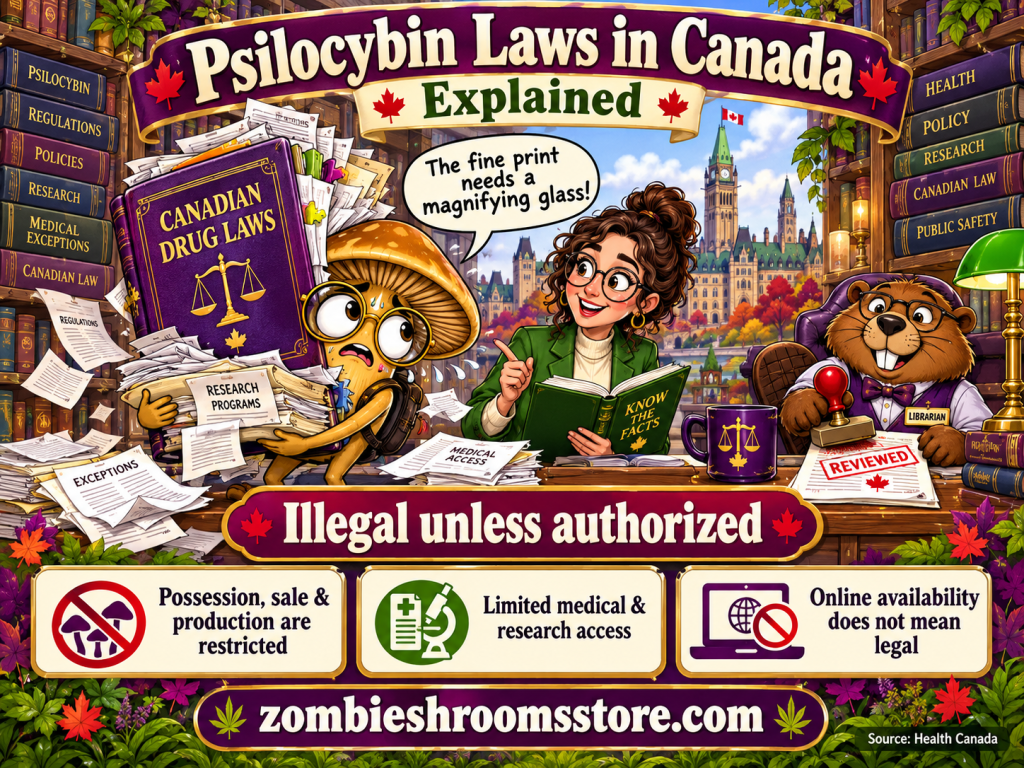
Schedule III is not the harshest tier in Canadian drug law, but it is still a controlled substance. That means producing, possessing, selling, importing, or exporting psilocybin without legal authorization is a criminal offence. There is no federal retail framework for magic mushrooms the way there is for cannabis, and no provincial storefront licensing system exists for psilocybin.
It is also worth separating psilocybin from other compounds that get lumped into the same conversation. Amanita muscaria, for example, is not a psilocybin mushroom and is regulated differently. If you are still sorting out the basics of what these fungi actually are, our overview of the science behind mushrooms and the human brain is a useful starting point before diving into legal questions.
Is Psilocybin a Controlled Substance in Canada?
Yes. Psilocybin is a controlled substance in Canada, and that status has not changed at the federal level. Health Canada continues to treat psilocybin and psilocin as drugs with no approved therapeutic product status outside of research and special access pathways.
What has changed is how the government handles certain requests. Since 2020, Health Canada has granted a growing number of exemptions under Section 56 of the CDSA, primarily for:
- Clinical trials and research institutions
- Palliative and end-of-life patients seeking psilocybin-assisted therapy
- Named patients authorized through the Special Access Program (SAP)
- Certain health professionals seeking to possess psilocybin for training or treatment purposes
These exemptions are individual and specific. They do not legalize psilocybin for the general public, and they do not create a legal market. A person with an exemption can possess psilocybin under defined conditions; a person without one cannot.
Section 56 Exemptions vs. the Special Access Program
These two pathways are often confused, so here is the practical difference:
- Section 56 exemption: A broad or targeted legal permission granted by Health Canada to an individual or organization, allowing activities that would otherwise be illegal under the CDSA.
- Special Access Program: A formal request route where a healthcare practitioner asks Health Canada for access to a non-marketed drug for a specific patient with a serious or life-threatening condition when other treatments have failed or are unsuitable.
SAP requests for psilocybin have increased, but approval is not automatic. Each case is reviewed individually, and the practitioner must justify the request with clinical reasoning.
Canadian Laws on Psilocybin Possession
Possession of psilocybin without authorization is a criminal offence in Canada. In practice, enforcement varies widely by province, city, and circumstance. A small personal amount discovered in a traffic stop is handled very differently from a commercial operation selling dried mushrooms, gummies, or chocolates to walk-in customers.
Penalties for simple possession under Schedule III can include fines, probation, or in more serious cases, jail time, though Crown prosecutors often prioritize trafficking and production cases. Indictable offences involving larger quantities or distribution carry significantly heavier consequences, including prison sentences.
This is why recent headlines about police raiding illegal cannabis or mushroom storefronts matter. When a dispensary-style shop openly sells psilocybin products, authorities tend to treat it as trafficking rather than personal possession. That distinction is central to understanding why some people seem to operate openly while others face charges.
Why Enforcement Looks Inconsistent
Canada does not have a single national police force enforcing drug law uniformly. Municipal police, provincial services, and the RCMP all operate with different priorities and resources. Add municipal bylaws, landlord pressure, and community complaints into the mix, and you get the patchwork enforcement Canadians see in the news.
Some cities have signalled low priority for personal possession. Others have moved aggressively against storefronts. Neither approach changes the federal law itself. It simply reflects how limited enforcement resources get allocated.
Health Canada Psilocybin Regulations: What They Actually Cover
Health Canada regulates psilocybin through the CDSA, the Food and Drug Regulations, and the Narcotic Control Regulations. Its role includes:
- Reviewing and granting research licences for psilocybin studies
- Evaluating Section 56 exemption requests
- Administering the Special Access Program
- Overseeing clinical trial applications involving psychedelic compounds
- Enforcing compliance and investigating unauthorized sales
Health Canada does not license retail mushroom shops. It does not certify gummies, chocolates, or capsules sold online as legal psilocybin products. If a website claims Health Canada approval for a retail psilocybin edible, that claim should be treated with heavy skepticism.
That said, Health Canada has shown willingness to expand research access. Licensed producers, universities, and private research organizations can apply to study psilocybin for conditions such as treatment-resistant depression, anxiety, PTSD, and end-of-life distress. Our deeper look at psilocybin clinical trials in Canada covers how that research pipeline works and who tends to qualify.
Psilocybin Exemptions in Canada Explained
Exemptions are the most misunderstood part of Canadian psilocybin law. An exemption is not a licence to sell. It is a narrow legal permission that allows a named person or organization to do something the CDSA would otherwise prohibit.
Common exemption scenarios include:
- Patients: Individuals granted access through SAP for supervised psilocybin-assisted therapy.
- Therapists and practitioners: Professionals authorized to possess and administer psilocybin in a treatment context.
- Researchers: Institutions running approved clinical trials.
- Religious or ceremonial groups: Organizations that have sought exemptions for traditional use, though these remain rare and case-specific.
An exemption does not transfer. If a patient is authorized to possess psilocybin, that authorization does not extend to friends, family, or anyone selling to them. Sharing or reselling exempted psilocybin can void the exemption and create new legal exposure.
What Exemptions Do Not Do
Exemptions do not create a legal retail market, do not make psilocybin products legal for general sale, and do not protect online vendors from enforcement. They also do not override provincial or municipal rules, which can add their own layers of regulation or restriction.
Are Magic Mushrooms Legal in Canada? The Short Answer
No, not for general recreational use. Psilocybin remains a controlled substance, and unauthorized possession, production, and sale are criminal offences. However, Canada has created limited legal pathways for research, therapy, and special access cases.
This is why the answer feels slippery. Legally, the default is prohibition. Practically, there are narrow exceptions, and enforcement varies. If you want the fuller legal picture, including how cannabis and psilocybin differ, our guide on whether magic mushrooms are legal in Canada walks through the same landscape from a different angle.
How Recent Enforcement News Fits In
When police charge people after searching an illegal cannabis or mushroom storefront, it is a reminder that open retail sale remains outside the law. These cases typically involve trafficking or possession-for-the-purpose-of-trafficking charges, not simple personal possession.
For Canadians trying to understand their risk, the practical takeaways are:
- Federal law has not legalized psilocybin retail.
- Exemptions are individual and narrow.
- Enforcement priorities vary by region and by scale of operation.
- Open commercial sale attracts far more legal attention than personal possession.
None of this is legal advice. If you are facing charges or considering a legal defence, speak with a lawyer licensed in your province.
Frequently Asked Questions About Psilocybin Laws in Canada
Is psilocybin a controlled substance in Canada?
Yes. Psilocybin and psilocin are listed in Schedule III of the Controlled Drugs and Substances Act. Possession, production, and sale without authorization are criminal offences.
Can I legally buy magic mushrooms in Canada?
There is no legal retail framework for psilocybin in Canada. Some online vendors operate openly, but that does not make their products legally authorized. Purchasing from them carries legal risk.
What is a Section 56 exemption?
It is a legal permission granted by Health Canada under the CDSA that allows a specific person or organization to possess or use psilocybin for defined purposes, such as therapy or research.
How does the Special Access Program work for psilocybin?
A healthcare practitioner submits a request to Health Canada on behalf of a patient with a serious or life-threatening condition. If approved, the patient can access psilocybin under supervised conditions.
Are mushroom gummies legal in Canada?
If they contain psilocybin or psilocin, they fall under the same Schedule III restrictions as dried mushrooms. Packaging or marketing them as legal edibles does not change their legal status.
Do provincial laws change psilocybin rules?
Provinces and municipalities can add their own regulations and enforcement priorities, but they cannot legalize psilocybin beyond what federal law permits.
Final Thoughts for Canadian Readers
Psilocybin laws in Canada are best understood as a strict federal prohibition with narrow, case-by-case exceptions. Health Canada regulations focus on research, clinical trials, and special access, not retail sales. Exemptions exist, but they are personal, specific, and do not create a legal market.
If you are exploring psychedelics for educational or wellness reasons, the smartest approach is to understand the law, follow credible research, and avoid assuming that open online sales equal legality. For a broader view of product formats and how they are presented, you can browse the Zombie Shrooms Store collection and read the product details carefully. Knowledge is the best harm-reduction tool available.