
Psychedelics Education
How Psilocybin Affects the Brain: A Canadian Guide to Magic Mushrooms and the Mind
Oct
Magic mushrooms have moved from the margins of Canadian culture into mainstream conversation. You will find them discussed in mental-health research, in provincial policy debates, and in casual chats between friends who are curious about psychedelics. Yet despite all the attention, many people still do not understand the basic neuroscience. How psilocybin affects the brain is the question that sits underneath almost every other question about magic mushrooms, from dosing to legality to therapeutic potential.
This guide walks through what psilocybin actually does inside the brain, in plain language. It is written for Canadian readers who want a clear, evidence-informed explanation rather than hype or fear. It is educational content, not medical advice, and it does not replace guidance from a qualified health professional.
What Psilocybin Is and How It Enters the Brain
Psilocybin is a naturally occurring compound found in more than 180 species of mushrooms, including the well-known Psilocybe cubensis family. When someone consumes dried mushrooms, mushroom tea, or a formulated edible, the psilocybin itself is not the molecule that produces the experience. The body converts it.
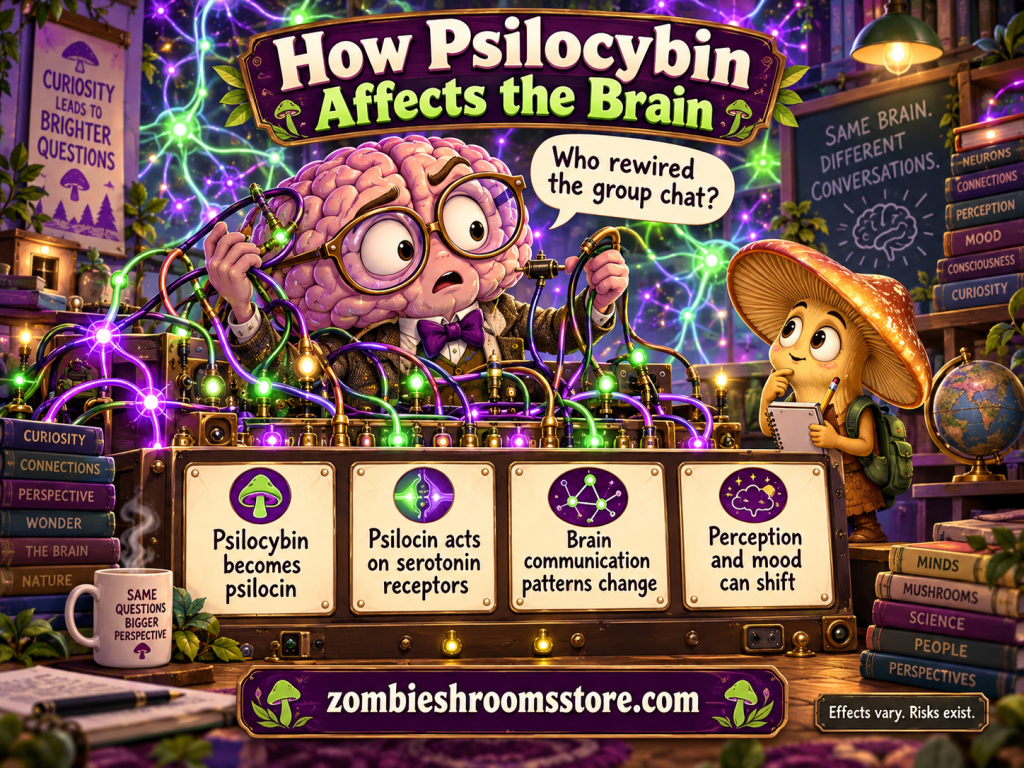
After ingestion, psilocybin is rapidly dephosphorylated into psilocin, the active compound. Psilocin is what crosses the blood-brain barrier and interacts with brain chemistry. This conversion step is one reason the effects of magic mushrooms can feel slower to arrive than some other substances, and it is a key difference between psilocybin and psilocin that beginners often overlook.
Once psilocin reaches the brain, it binds primarily to serotonin 5-HT2A receptors. These receptors are densely concentrated in the cerebral cortex, the outer layer of the brain responsible for perception, thought, and self-awareness. That binding is the starting point for nearly everything that follows.
The Serotonin Connection: Why 5-HT2A Receptors Matter
Serotonin is one of the brain’s most important signalling molecules. It helps regulate mood, sleep, appetite, and perception. Psilocin’s shape is similar enough to serotonin that it can slot into serotonin receptors and activate them, but it does so in a way that is more intense and less predictable than the brain’s own serotonin.
When psilocin activates 5-HT2A receptors across the cortex, it increases communication between brain regions that do not normally talk to each other much. This is often described as increased functional connectivity. In practical terms, it means the brain becomes less rigidly compartmentalised and more broadly interconnected.
That shift helps explain several classic effects:
- Visual changes: colours may appear more vivid, patterns may move, and surfaces may seem to breathe.
- Sensory blending: sounds may take on visual qualities, or music may feel physically present.
- Emotional intensity: feelings can become more vivid, and memories may surface with unusual clarity.
- Altered sense of self: the boundary between “me” and “everything else” can soften.
These effects are not random. They are the downstream result of a specific chemical interaction at a specific receptor family.
How Psilocybin Affects the Default Mode Network
One of the most discussed findings in modern psychedelic neuroscience concerns the default mode network (DMN). The DMN is a set of brain regions that become active when you are not focused on a specific task. It is associated with self-referential thinking, daydreaming, recalling the past, and imagining the future. In many people, it is also linked to rumination and rigid patterns of thought.
Under the influence of psilocybin, activity in the DMN tends to decrease, while communication between the DMN and other networks increases. Researchers describe this as a temporary loosening of the brain’s usual organisational hierarchy. The brain becomes less constrained by its habitual pathways.
This is thought to be one reason psilocybin experiences can feel so personally significant. When the DMN quiets down, people often report a sense of ego dissolution, a feeling of unity, or a fresh perspective on long-standing problems. It is also why some researchers are studying psilocybin for conditions such as depression and anxiety, where rigid thought patterns play a major role.
For a deeper look at the broader relationship between mushrooms and cognition, see our article on the science behind mushrooms and the human brain.
Why the Experience Is So Variable
Two people can take the same amount of the same mushroom variety and have very different experiences. This variability is not a flaw in the science. It is a predictable outcome of how psilocybin interacts with a complex system.
Several factors shape the experience:
1. Dose and Potency
Different mushroom varieties contain different concentrations of psilocybin and psilocin. A gram of one strain is not necessarily equivalent to a gram of another. Formulated products such as mushroom gummies may also deliver a more consistent dose than raw dried mushrooms, though potency still varies by product.
2. Individual Brain Chemistry
Baseline serotonin activity, receptor density, and personal neurochemistry all influence how strongly psilocin binds and how the brain responds.
3. Set and Setting
Psychological state (set) and physical environment (setting) are not just philosophical concepts. They influence stress hormones, attention, and emotional processing, all of which interact with the psychedelic experience.
4. Tolerance and Timing
Psilocybin produces rapid tolerance. Taking it on consecutive days typically weakens the effect, because 5-HT2A receptors become less responsive. This is one reason spacing out experiences matters.
What Psilocybin Does Not Do
There are several persistent myths worth clearing up.
Psilocybin does not cause physical dependence. It does not produce the kind of compulsive craving associated with opioids or nicotine. However, it is not risk-free, and psychological distress during a difficult experience is possible.
Psilocybin does not damage the brain in the way early anti-drug messaging claimed. Modern imaging studies have not found evidence of neurotoxicity at typical doses. That said, psilocybin is a powerful psychoactive substance and should be treated with respect.
Psilocybin is not a treatment you can self-prescribe. Clinical research is promising, but it takes place under controlled conditions with trained facilitators, screening, and follow-up. Recreational use is a different context with different risks.
Microdosing vs Full-Dose Effects on the Brain
Microdosing involves taking a sub-perceptual amount, often 0.1 to 0.3 grams of dried mushrooms, on a schedule such as one day on and two days off. At these levels, users typically do not experience hallucinations or major perceptual shifts. Instead, they report subtle changes in mood, focus, or creativity.
Scientifically, the picture is still developing. Some studies suggest microdosing may influence mood and attention, while others find effects comparable to placebo. What is clear is that microdosing and full-dose experiences engage the brain differently. A full dose produces the dramatic DMN changes and receptor activation described above. A microdose may produce milder, more diffuse effects that are harder to measure.
If you are exploring lower-dose formats, our overview of microdose shrooms explains how these products are typically structured.
The Canadian Context: Research, Law, and Responsibility
In Canada, psilocybin remains a controlled substance under the Controlled Drugs and Substances Act. Possession, production, and distribution are generally illegal outside of specific exemptions. Health Canada has granted limited exemptions for certain medical and research purposes, and clinical trials continue to expand our understanding of therapeutic applications.
This legal reality matters for anyone curious about magic mushrooms. Understanding the neuroscience does not change the law. Canadian readers should be aware of the rules that apply in their province and should not interpret educational content as permission or encouragement to break them.
For a broader look at the products and formats discussed in this article, you can explore the Zombie Shrooms Store shop and review product information carefully before making any decisions.
Frequently Asked Questions
How long does psilocybin stay in your system?
Psilocin is detectable in blood for roughly 6 to 12 hours and in urine for up to 24 hours in many cases. Detection windows vary based on dose, metabolism, and the sensitivity of the test. Psilocybin itself is usually converted quickly and is not the primary target of most tests.
Does psilocybin affect everyone the same way?
No. Genetics, medications, mental health history, dose, and setting all influence the experience. People taking SSRIs or other serotonergic medications may have a blunted response and should consult a healthcare provider about interactions.
Can psilocybin help with depression?
Early clinical research, including trials conducted in Canada and internationally, has shown promising results for treatment-resistant depression and anxiety in controlled settings. However, psilocybin is not an approved standalone treatment, and self-medicating is not recommended.
Is microdosing safe?
Microdosing is generally considered lower-risk than full-dose use, but it is not risk-free. Some people report headaches, anxiety, or sleep disruption. Anyone with a personal or family history of psychosis should avoid psychedelics entirely.
What is the difference between psilocybin and psilocin?
Psilocybin is the compound found in the mushroom. Psilocin is what psilocybin becomes after the body removes a phosphate group. Psilocin is the molecule that actually binds to serotonin receptors and produces the psychoactive effects.
Final Thoughts
Understanding how psilocybin affects the brain replaces mystery with mechanism. Psilocybin becomes psilocin, psilocin activates 5-HT2A receptors, cortical communication increases, and the default mode network quiets down. Those steps help explain why magic mushrooms can produce such profound shifts in perception, emotion, and self-awareness.
That knowledge is useful whether you are a curious beginner, a student of neuroscience, or a Canadian reader trying to make sense of a rapidly changing conversation. It is also a reminder that powerful experiences deserve careful, informed, and lawful consideration.