Psychedelics Education
Psilocybin vs Psilocin Explained: What Canadian Beginners Should Know
Oct
If you have spent any time reading about magic mushrooms in Canada, you have probably seen two similar-looking words used almost interchangeably: psilocybin and psilocin. They sound alike, they come from the same mushrooms, and they are both part of the same experience. But they are not the same compound, and understanding the difference clears up a lot of confusion about how mushrooms work, why effects take time to appear, and why two people can eat from the same batch and have very different experiences.
This guide is written for Canadian readers who want a clear, no-hype explanation. We will cover what each molecule is, how the body converts one into the other, what that means for onset and intensity, how psilocin interacts with the brain, and how this fits into Canada’s current legal landscape. Nothing here is medical advice, and nothing here is a recommendation to break the law. It is education, plain and simple.
What Are Psilocybin and Psilocin?
Both psilocybin and psilocin are tryptamine alkaloids produced naturally by mushrooms in the genus Psilocybe, along with a handful of other genera. They are chemically related to serotonin, which is one of the reasons they interact so strongly with mood, perception, and sensory processing.
The key distinction is simple:
- Psilocybin is the “prodrug.” It is the stable, storage-friendly form of the compound that the mushroom produces. On its own, it does not do much in the human body.
- Psilocin is the active form. It is what actually binds to receptors in the brain and produces the psychedelic experience.
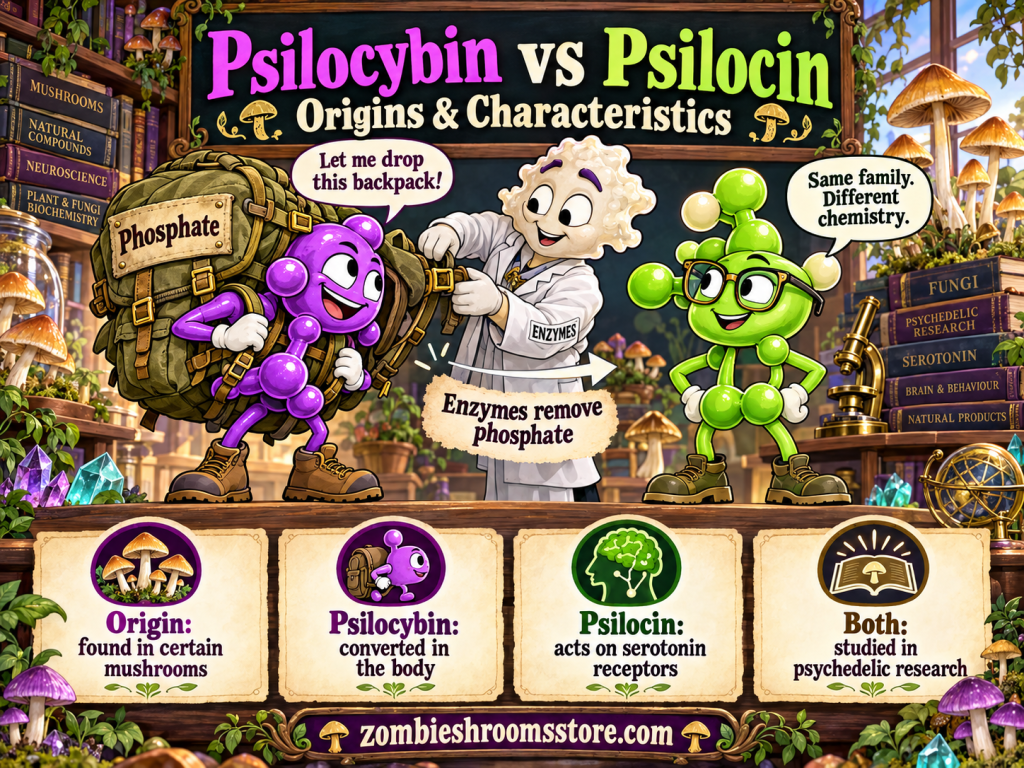
Think of psilocybin as a locked box and psilocin as what is inside. The mushroom ships the box. Your body opens it.
Why Mushrooms Contain Mostly Psilocybin
Psilocin is chemically fragile. It oxidizes quickly, which is part of why bruised mushrooms turn blue, and it degrades with heat, light, and time. Psilocybin is far more stable, so the mushroom stores its psychedelic payload in that form and lets the consumer’s body do the conversion. It is an efficient biological strategy, and it is why dried mushrooms can retain potency for months or years when stored properly.
How Psilocybin Becomes Psilocin in the Body
When you consume magic mushrooms, psilocybin passes through the digestive system largely intact. It is not until it reaches the liver that the important step happens. An enzyme called alkaline phosphatase removes a phosphate group from the psilocybin molecule, converting it into psilocin.
That conversion is the reason mushrooms take 30 to 60 minutes, sometimes longer, to produce noticeable effects. The body has to do chemical work first. It also explains why eating mushrooms on a full stomach can delay onset further, and why some people report a slow, gradual come-up rather than a sudden shift.
Onset, Peak, and Duration at a Glance
While individual responses vary widely based on dose, body weight, metabolism, and whether food was eaten, a typical psilocybin mushroom experience follows a rough arc:
- Onset: 20 to 60 minutes after ingestion
- Come-up: 30 to 90 minutes, often the most physically noticeable phase
- Peak: roughly 2 to 3 hours in
- Come-down: 4 to 6 hours total, sometimes longer at higher doses
Formats matter here. A dried mushroom cap and stem has to be digested and converted. A mushroom gummy or a mushroom tea may hit differently because the material is already broken down or extracted, which can speed absorption. This is one reason beginners are often advised to start low and be patient rather than redosing because “nothing is happening yet.”
How Psilocin Affects the Brain
Once psilocin is in the bloodstream, it crosses into the brain and binds primarily to 5-HT2A serotonin receptors. These receptors are concentrated in areas involved in sensory perception, mood, and self-referential thinking, which is why psilocybin experiences tend to involve visual changes, emotional shifts, and altered sense of self.
Research using brain imaging suggests that psilocin increases communication between brain regions that do not normally talk to each other much. The default mode network, a set of regions associated with rumination and the everyday sense of “me,” appears to become less rigidly organized. Many users describe this as thoughts becoming more fluid, associations becoming looser, and ordinary objects or ideas taking on unusual significance.
This is also why set and setting matter so much. The drug does not create an experience out of nothing. It amplifies and reshapes what is already present in your mind and environment. A calm, familiar, well-prepared setting tends to produce a very different experience than a chaotic one.
Psilocin and Tolerance
One practical detail worth knowing: psilocin produces rapid tolerance. If you take mushrooms two days in a row, the second experience is often noticeably weaker. Most people need about one to two weeks for sensitivity to return to baseline. This is not a moral point, it is a pharmacological one, and it is why spacing out sessions is standard practice among experienced users.
Psilocybin vs Psilocin: A Side-by-Side Comparison
| Feature | Psilocybin | Psilocin |
|---|---|---|
| Role | Prodrug, storage form | Active compound |
| Stability | Relatively stable | Easily oxidized, degrades quickly |
| Activity in the body | Minimal until converted | Binds directly to 5-HT2A receptors |
| Where conversion happens | Converted in the liver | Already active |
| Presence in mushrooms | Dominant | Present in smaller amounts |
| Effect on experience | Determines the delay before effects | Determines the intensity and character |
If you remember only one thing, remember this: psilocybin is the delivery system, psilocin is the experience.
Why This Distinction Matters for Canadian Users
Understanding the psilocybin-to-psilocin conversion has real practical value, especially for beginners.
1. It Explains the Waiting Period
New users often assume mushrooms are not working because nothing happens in the first 20 minutes. In reality, the liver is still doing its job. Knowing this prevents the most common beginner mistake, which is taking more before the first dose has had a chance to convert.
2. It Explains Potency Differences Between Products
Two products can contain the same stated amount of psilocybin and still feel different. Extraction methods, storage conditions, and whether the material is dried, brewed, or infused into a gummy all affect how much psilocybin survives and how quickly it converts. This is why lab-tested products and clear labeling matter, and why comparing a microdose capsule to a full dried mushroom gram-for-gram is not a fair comparison.
3. It Explains Why Storage Counts
Because psilocin degrades quickly, mushrooms are best stored dry, cool, dark, and sealed. Heat and moisture accelerate breakdown. If you are keeping dried mushrooms for a while, proper storage preserves the psilocybin that your body will later convert.
Common Myths About Psilocybin and Psilocin
Myth: Psilocybin and psilocin are the same thing.
They are related but distinct molecules with different roles. Conflating them leads to confusion about dosing and timing.
Myth: Psilocin is only found in trace amounts, so it does not matter.
Psilocin is present in smaller quantities, but it is the compound doing the work. Its low concentration in the mushroom does not reflect its importance in the body.
Myth: Stronger mushrooms contain more psilocin.
Potency is usually driven by psilocybin content, which then converts. A mushroom with high psilocybin can produce a strong experience even if its psilocin content is modest.
Myth: You can speed up the conversion by eating more.
Eating more increases the total amount of psilocybin available, but the conversion rate is limited by your body’s enzymes. More does not mean faster, it means more intense once it arrives.
Psilocybin, Psilocin, and Canadian Law
This is the part where clarity matters more than enthusiasm. In Canada, psilocybin and psilocin are both listed as controlled substances under the Controlled Drugs and Substances Act. Possession, production, and distribution outside of authorized frameworks are illegal, and that includes dried mushrooms, capsules, chocolates, gummies, and teas that contain them.
There are narrow exceptions. Health Canada has granted exemptions under Section 56 in specific cases, most notably for certain patients receiving psilocybin-assisted therapy, and for some clinical trial participants and researchers. These exemptions are individual, time-limited, and heavily regulated. They do not legalize mushrooms for general recreational use, and they do not apply to retail sales.
Several Canadian cities have seen municipal motions to deprioritize enforcement of personal possession, but a municipal policy is not the same as federal legality. If you are trying to understand where you stand, the honest answer is that the legal status depends on the specific exemption, province, and circumstances, and it is worth reading the primary sources rather than relying on headlines.
For a broader look at how these rules are structured, our overview of psilocybin legality walks through the framework in more detail.
Harm Reduction Basics for Beginners
If you are going to explore psilocybin, do it with information rather than guesswork.
- Start low. A low dose lets you learn how your body converts and responds before committing to more.
- Do not mix with other substances, especially alcohol, cannabis, or stimulants, until you understand your baseline.
- Be honest about your mental health history. People with a personal or family history of psychosis or certain mood disorders face higher risk.
- Have a sober, trusted person present for anything beyond a microdose.
- Choose a safe, familiar setting and clear your schedule for the day.
- Never drive during or after a session.
If you take prescription medication, particularly SSRIs, SNRIs, or MAOIs, talk to a healthcare provider before considering psilocybin. Interactions are real and can be unpredictable.
Frequently Asked Questions
Is psilocin stronger than psilocybin?
Psilocin is the active molecule, so in a direct sense it is the one producing effects. Psilocybin is not weaker, it is simply inactive until your body converts it. Comparing the two by weight in a mushroom is not meaningful because they play different roles.
How long does it take for psilocybin to turn into psilocin?
Conversion begins shortly after ingestion and typically produces noticeable effects within 20 to 60 minutes. A heavy meal, individual metabolism, and the format of the product can all extend that window.
Do mushroom gummies contain psilocybin or psilocin?
It depends entirely on the product. Some contain psilocybin extract, some contain psilocin, and some contain neither, relying instead on non-psychedelic ingredients. In Canada, any product containing psilocybin or psilocin falls under the same federal controls as dried mushrooms. Always read labels carefully and understand what you are actually buying.
Can you build a tolerance to psilocin?
Yes. Tolerance develops quickly, often within a day or two of repeated use, and typically resets after one to two weeks of abstinence. This is one reason spacing sessions is standard practice.
Does psilocin affect everyone the same way?
No. Body weight, metabolism, liver enzyme activity, medication use, and individual sensitivity all influence how psilocin affects a given person. Two people can take the same dose and have very different experiences.
Are psilocybin and psilocin legal in Canada?
Both are controlled substances under Canadian federal law. Limited exemptions exist for certain medical, therapeutic, and research contexts, but general possession and sale remain illegal outside those frameworks.
The Bottom Line
Psilocybin and psilocin are two halves of the same process. Psilocybin is the stable compound the mushroom produces and the form your body receives. Psilocin is what your liver creates from it and what actually interacts with your brain. Understanding that sequence explains the delayed onset, the importance of product format, the role of storage, and why dose and setting shape the experience so heavily.
For Canadian readers, the science is fascinating and the legal picture is restrictive. Learn the biology, respect the risks, and stay current on the regulations. If you want to explore the range of formats people ask about, from dried mushrooms to mushroom gummies, start with education before anything else.
Authoritative sources