Psychedelics Education
Amazonian vs B+ Mushrooms
Oct
Amazonian vs B+ Mushrooms: What’s the Difference?
Amazonian vs B+ Mushrooms compares two familiar variety names commonly associated with Psilocybe cubensis, a species of psilocybin-containing fungus. They are not generally presented as separate scientific species. Their labels describe cultivated material, reported histories, and reputations rather than standardised medicines.
The most important difference is therefore less certain than many online comparisons suggest. A name alone cannot establish ancestry, chemical concentration, safety, or a predictable experience. Claims that Amazonian mushrooms are consistently stronger, or that B+ produces a gentler experience, require evidence beyond personal accounts.
This guide explains what the names mean, how to evaluate comparisons, and why questions about onset, peak effects, gummies, and chocolates need separate answers. It focuses on education for readers in the United States and Canada.
What Do Amazonian and B+ Identify?
Both names circulate in discussions of cultivated P. cubensis. However, the word “strain” is often used loosely in mushroom communities.
A scientific strain can refer to particular biological material maintained and documented for research. An informal variety label may be applied more broadly, without consistent records linking every specimen to one authenticated lineage.
Consequently, two sources using the same name may not be describing identical material.
The Amazonian Name
“Amazonian” suggests a geographic connection with the Amazon region. Related descriptions sometimes use “PES Amazonian” or similar wording.
That association does not independently verify where a particular specimen originated. Reliable provenance requires records connected to identifiable material.
The name also does not establish a particular Indigenous tradition. Historical or ceremonial claims need their own supporting evidence.
The B+ Name
B+ is another widely used label associated with P. cubensis. Its familiarity does not make it a separate species or a standardised chemical preparation.
Descriptions frequently attach reassuring qualities to B+, but a reputation for being “beginner friendly” is not a measured safety property.
Amazonian vs B+ Mushrooms at a Glance
| Comparison | Amazonian | B+ |
|---|---|---|
| Common classification | Variety name associated with P. cubensis | Variety name associated with P. cubensis |
| Name association | Suggests an Amazon-region connection | Familiar cultivated-variety designation |
| Verified ancestry | Requires traceable documentation | Requires traceable documentation |
| Appearance | Reported traits overlap with other varieties | Reported traits overlap with other varieties |
| Predictable potency | Cannot be established from the name | Cannot be established from the name |
| Guaranteed effects | No | No |
| Medical claims | Require relevant clinical evidence | Require relevant clinical evidence |
This comparison helps separate descriptive labels from properties that require testing. It should not be used as a mushroom-identification checklist.
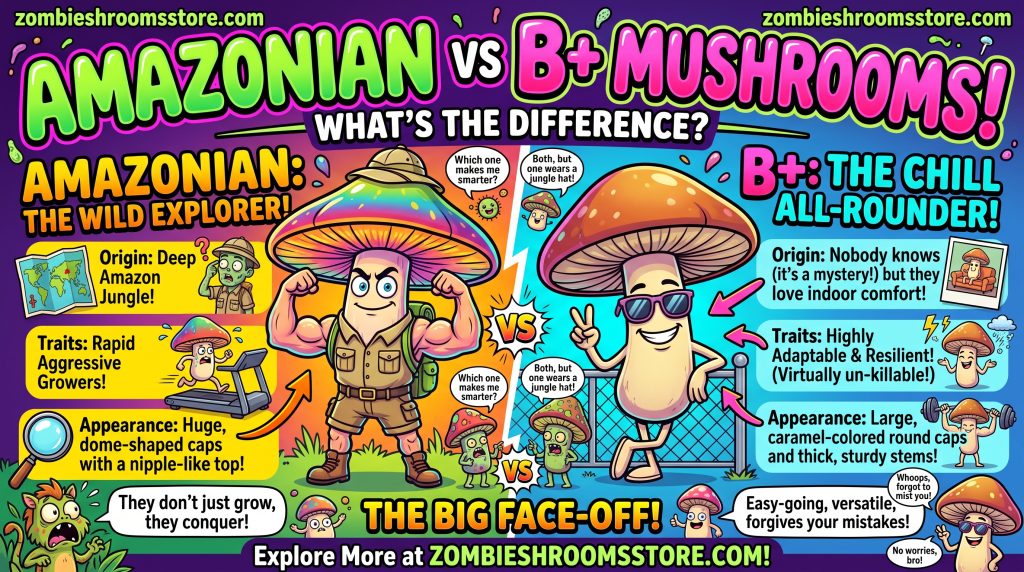
Amazonian vs B+ Mushrooms: Differences in Appearance
Amazonian vs B+ Mushrooms comparisons often focus on visible characteristics such as cap shape, pigmentation, stem thickness, and the size of mature fruiting bodies. These features can help describe particular specimens, but they do not provide a dependable way to distinguish every mushroom carrying either name. Both labels are commonly associated with Psilocybe cubensis, so substantial overlap in appearance is possible. Maturity and environmental conditions can influence physical traits, while lighting, camera settings, and image editing can make photographs appear more distinctive than the specimens themselves. A professional comparison should therefore present appearance as a reported observation rather than definitive proof of identity. Descriptions such as “larger,” “thicker,” or “darker” also reveal nothing reliable about psilocybin concentration or potential medical benefits. Readers should distinguish three separate questions: what a mushroom looks like, whether its identity and provenance have been authenticated, and what chemical analysis shows about the material. Each requires different evidence, and neither a photograph nor a familiar variety name can establish all three.
Why Photographs Have Limits
A photograph may illustrate an article, but it cannot replace authentication or chemical analysis.
This matters especially when someone is comparing unfamiliar mushrooms with pictures found online. Poisonous species can resemble mushrooms people expect to contain psilocybin.
California Poison Control identifies mistaken identification and impaired judgment among the major safety concerns surrounding these mushrooms. California Poison Control System
Amazonian vs B+ Mushrooms: Can Potency Be Compared?
A scientifically meaningful Amazonian vs B+ Mushrooms potency comparison requires authenticated material, appropriate laboratory methods, and enough samples to account for variation. Psilocybin and psilocin concentrations can differ between cultivated lines, individual fruiting bodies, and separate batches carrying the same variety label. Consequently, a measurement from one specimen cannot establish a universal strength rating for every mushroom described as Amazonian or B+. Before accepting a numerical comparison, readers should check which compounds were measured, whether results refer to fresh or dried material, how many specimens were examined, and whether the researchers reported the range of findings alongside an average. Personal accounts cannot resolve these questions because subjective experiences also depend on individual health, expectations, surroundings, and other exposures. Claims that Amazonian is always stronger or that B+ reliably produces milder effects therefore extend beyond what a name alone can demonstrate. Even a documented difference in chemical concentration would not establish greater safety, predictable effects, or superior therapeutic value; those conclusions require separate evidence.
The PubMed study on variation in cubensis tryptamine profiles supports the need for sample-specific chemical measurements. It does not justify turning a variety label into a fixed strength rating. pubmed.ncbi.nlm.nih.gov
What a Meaningful Comparison Needs
A useful comparison identifies the material tested, analytical method, number of samples, and compounds measured.
It also distinguishes fresh from dried material and reports variability instead of only an average. Without those details, a percentage or potency ranking may look more informative than it is.
Even a well-conducted measurement describes the tested samples. It does not establish the composition of unrelated material sold under the same name.
Do These Varieties Produce Different Experiences?
Personal reports sometimes describe Amazonian as intense or B+ as relaxed. These descriptions record subjective impressions rather than guaranteed biological differences.
Experiences can vary with chemical exposure, expectations, health, surroundings, and other substances. A person’s account cannot isolate which factor produced a particular feeling.
A familiar name therefore cannot promise a positive experience or prevent anxiety, confusion, or distress.
Clinical Research Is a Separate Question
A study of a defined psilocybin intervention does not automatically establish a therapeutic benefit for Amazonian or B+ mushrooms.
Clinical findings belong to the preparation, participants, and protocol studied. Neither variety name should be presented as an approved treatment based on research involving a different intervention.
How Long Does It Take for Shrooms to Kick In?
People ask this through several phrases, including “how long do shrooms take to hit” and “how long for shrooms to kick in.”
Health Canada gives a general onset range of approximately 15–45 minutes for magic mushrooms and says effects usually last four to six hours. These are broad descriptions, not reliable predictions for a particular person or unknown product. Canada.ca
Timing does not reveal potency or confirm ingredients. An unfamiliar edible may behave differently from the mushroom material described in general guidance.
Delayed Effects Do Not Establish Safety
A lack of immediate symptoms does not prove that an exposure was harmless.
Uncertainty about the contents makes interpreting a delay particularly difficult. Taking more because effects have not appeared can increase risk.
If the question follows an accidental ingestion or concerning symptoms, seek medical or poison-control advice rather than relying on an online timetable.
When Do Shrooms Peak?
Onset and peak effects are different concepts. Onset describes when changes begin; peak describes the period of greatest intensity.
A clinical review lists a broad peak range of approximately one to three hours for orally administered psilocybin. However, a clinical summary cannot predict the course of an unverified mushroom product or edible. PMC
Neither Amazonian nor B+ has a dependable label-based peak schedule. A clock also cannot determine whether someone is medically safe.
Severe confusion, loss of consciousness, seizures, or breathing difficulty require urgent assessment regardless of elapsed time.
Stages of a Mushroom Trip: What the Terms Mean
Descriptions of the “stages of a mushroom trip” often divide an experience into onset, increasing effects, peak intensity, and declining effects.
These are informal descriptions rather than a universal clinical sequence. Symptoms may overlap, fluctuate, or fail to follow the expected pattern.
| Informal stage | General meaning | Limitation |
|---|---|---|
| Onset | Initial perceived changes | Does not identify the substance |
| Increasing effects | Changes become more noticeable | Progression is not predictable |
| Peak | Period of greatest perceived intensity | Timing and intensity vary |
| Declining effects | Some effects become less pronounced | Does not establish readiness to drive |
| After-effects | Residual physical or emotional changes | Persistent concerns need assessment |
An uncomfortable reaction should not be dismissed as an unavoidable stage. Public-health investigations involving mushroom edibles have documented serious illness requiring medical attention. www.cdc.gov
How Long Do Mushroom Gummies Take to Kick In?
Questions such as “how long do shroom gummies take to kick in” need a product-specific answer that often cannot be established from packaging.
Mushroom gummies may contain psilocybin, different psychoactive constituents, non-psychedelic mushrooms, or mixtures. Published testing has identified discrepancies between some labels and measured contents.
A study of recreational mushroom gummies found inaccurate labelling among sampled products, including psilocybin in a product described as psilocybin-free. pubmed.ncbi.nlm.nih.gov
The general timing associated with psilocybin cannot safely be assigned to every mushroom-labelled gummy. Taste, appearance, and a familiar variety name do not resolve that uncertainty.
How Long Do Shroom Chocolates Take to Kick In?
The same ingredient problem applies to chocolates.
A bar labelled Amazonian, B+, or “mushroom blend” does not independently verify what is present. A clinical timetable for measured psilocybin is therefore not a dependable chocolate-specific forecast.
Research examining unregulated mushroom edibles has raised concerns about product composition. Findings concerning sampled products should not be generalised to every chocolate, but they demonstrate why assumptions are unreliable. pmc.ncbi.nlm.nih.gov
An educational article should explain those limits instead of promising that chocolate always produces faster or slower effects.
Why Growing Golden Teacher Appears in Related Searches
“Growing Golden Teacher” concerns another familiar P. cubensis variety label. It is a separate topic from comparing Amazonian and B+.
The shared species association does not establish identical genetics, appearance, or chemical composition.
Cultivation claims also cannot substitute for chemical measurements or establish that a resulting mushroom is an authorised medicine. Readers should distinguish biological research from instructions or promotional statements about producing controlled substances.
Legal Context in the United States and Canada
In the United States, psilocybin remains federally controlled as a Schedule I substance. State or local policies may differ, but a variety name does not change federal classification.
The DEA’s psilocybin information provides the federal context. Local policy should not be interpreted as blanket permission for commercial sale, shipping, or medical claims. dea.gov
In Canada, activities involving psilocybin generally require authorisation. Health Canada’s magic mushroom guidance explains restricted access pathways and states that no psilocybin-containing therapeutic product is approved for sale as a medicine in Canada. These rules concern the substance and activity, regardless of variety name. www.canada.ca
Frequently Asked Questions
1. Are Amazonian and B+ separate species?
No. Both are commonly discussed as variety names associated with Psilocybe cubensis.
2. Is Amazonian consistently stronger than B+?
A name cannot establish a universal ranking. Composition varies, and meaningful comparisons require measurements of authenticated samples.
3. Does B+ guarantee a gentle experience?
No. “Gentle” and “beginner friendly” describe reputations, not properties that reliably predict safety or individual effects.
4. Do mushroom gummies follow the same timing as whole mushrooms?
Not necessarily. Their ingredients may differ or be inaccurately labelled, making a fixed timetable unreliable.
5. Can appearance confirm identity or potency?
No. Visual resemblance cannot authenticate unfamiliar mushrooms or measure their chemical contents.
Where to Explore Further
Read the Amazonian Mushrooms background guide for more discussion of the name and its reported history.
Explore B+ Mushrooms: Background, Characteristics and Research for a separate examination of that variety label and its limitations.