Psychedelics Education
Cambodian Mushrooms
Oct
Cambodian Mushrooms: Background and Common Characteristics
Cambodian Mushrooms are commonly described as a cultivated variety associated with Psilocybe cubensis, a species of psilocybin-containing fungus. The name suggests a connection with Cambodia, but a geographic label does not independently establish the ancestry or collection location of every specimen carrying it.
Understanding this variety requires separating reported characteristics from verified evidence. Appearance, origin stories, and personal accounts can provide context, but they cannot establish chemical composition, safety, or medical benefits.
Related searches can make the subject more confusing. Names such as Ghost, Blue Ghost, and Blue Meanie may describe other cultivated selections or entirely different species. They should not be treated as interchangeable simply because they appear in discussions of psychedelic mushrooms.
This guide explains the reported background, clarifies those names, and examines what research can reasonably tell readers.
What Does the Cambodian Name Identify?
“Cambodian” is generally used as a variety designation within P. cubensis, rather than the name of a separate scientific species.
That distinction matters. A species name describes a biological classification. A cultivated variety name may describe material maintained or selected for particular characteristics, but its use does not guarantee a documented pedigree.
Published research on P. cubensis discusses variation in physical traits and chemical content, alongside important gaps in genetic documentation. These limitations are relevant when interpreting named varieties. PubMed
A Geographic Label Is Not Authentication
A name associated with a country can sound like a certificate of origin. In practice, it may reflect an account of an original collection, a naming tradition, or a label passed between growers.
To establish provenance, researchers would need supporting records linked to authenticated material. Repeated descriptions on websites are not equivalent to those records.
For Cambodian Mushrooms, an accurate introduction should therefore distinguish the variety’s reported geographic association from independently verified ancestry.
Reported Background and Origin Stories
Popular accounts connect the variety with mushrooms collected in Cambodia. Some versions add a particular collector, landmark, or collection date.
Those details should be attributed to their source rather than presented as settled history. Without accessible original documentation, it is difficult to determine whether different accounts describe the same collection or later retellings.
This uncertainty does not prevent educational discussion. It simply changes the wording: “commonly associated with Cambodia” is more defensible than claiming every labeled specimen comes from a verified Cambodian lineage.
The same care applies to cultural history. A modern cultivated-variety name should not automatically be presented as evidence of a particular community’s traditional practices. Such claims require their own historical or ethnographic sources.
Cambodian Mushrooms: Commonly Reported Traits
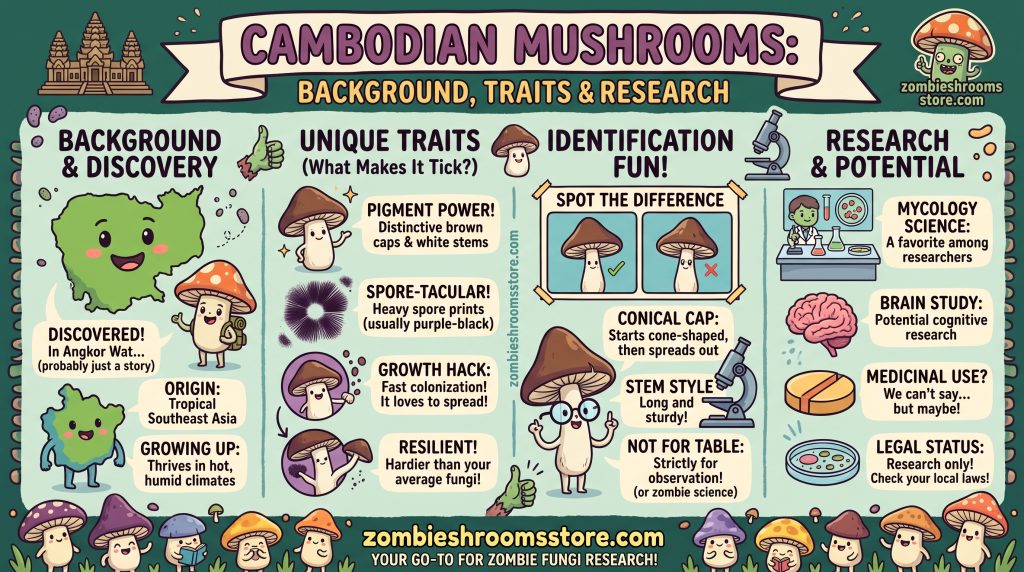
Descriptions commonly associate this variety with the general appearance of P. cubensis: pigmented caps, pale stems, and changing proportions as fruiting bodies mature.
However, these are broad descriptions, not features unique to one variety. A specimen’s appearance can also vary with maturity and environmental conditions.
| Reported characteristic | What it can reasonably tell readers |
|---|---|
| Geographic variety name | Provides naming context, not verified provenance |
| Tan or golden cap descriptions | Describes appearance without proving identity |
| Pale stems | A broad feature that is not unique to this variety |
| Differences in size or shape | May reflect variation and developmental stage |
| Claims of consistent strength | Require chemical measurements |
| Claims of a particular experience | Require more evidence than testimonials |
Photographs cannot establish exact chemical content or reliably distinguish every cultivated selection.
Why Appearance Has Limits
A familiar cap color is not a laboratory result. Likewise, a large fruiting body does not independently establish a high concentration of psychoactive compounds.
Lighting, camera settings, drying, and handling can alter how material looks online. A photograph may illustrate a description while providing little evidence about the sample’s identity.
Cambodian Mushrooms should therefore be described using qualified observations rather than a visual checklist that appears to authenticate them.
What Research Says About Chemical Variation
Psilocybin and psilocin are among the compounds investigated in research on P. cubensis. Their concentrations need measurement; they cannot be established from a variety name.
A PubMed-indexed laboratory study of several cubensis strains examined individual mushrooms to investigate differences between strains and within the same strain. The strains studied included Blue Meanie, Creeper, B-Plus, Texas Yellow, and Thai Cubensis. pubmed.ncbi.nlm.nih.gov
That study should not be presented as a direct measurement of Cambodian material. Its relevance is methodological: it illustrates why comparisons need authenticated samples and appropriate sampling.
Reading a Potency Claim Carefully
Before accepting a numerical claim, check:
- Which material was actually tested.
- Whether its identity was documented.
- Whether results used fresh or dry weight.
- Which compounds were measured.
- How many specimens were examined.
A result describes the samples analyzed. It does not automatically establish a fixed value for all mushrooms carrying a similar label.
For Cambodian Mushrooms, universal claims such as “always mild” or “consistently strong” require evidence beyond a familiar reputation.
Ghost and Blue Ghost: Different Naming Questions
Searches for ghost magic mushroom or blue ghost mushroom introduce additional informal labels. These terms should not be assumed to identify Cambodian material.
The first question is what the writer means by the name. Is it a cultivated selection, a product label, or an informal description? Does the source identify a species and document the material?
The word “Ghost” alone does not establish a specific genetic relationship. Nor does “blue” establish that two labeled varieties are biologically equivalent.
An educational comparison can acknowledge these names without inventing a pedigree or claiming that a pale appearance proves identity. Where documentation is incomplete, uncertainty should remain visible.
Blue Meanie Names Require Extra Care
The term blue meanie mushroom has a particularly important ambiguity. It can refer to a named P. cubensis variety or to the separate species Panaeolus cyanescens.
Similarly, blue meanies shrooms is an informal phrase that does not resolve which meaning applies. The complete scientific name provides essential context.
| Term | Clarification needed |
|---|---|
| Cambodian variety | Generally associated with Psilocybe cubensis |
| Blue Meanie cubensis | A variety label within Psilocybe cubensis |
| Panaeolus cyanescens | A different species in another genus |
| Psilocybe cyanescens | Another distinct species despite the shared second word |
| Ghost or Blue Ghost | Requires a clear source and species designation |
The website’s B+ mushroom background guide offers another example of distinguishing a cultivated name from scientific classification.
What Do “Pan Cyan” and “Pan Cyanescens” Mean?
The phrases pan cyan mushroom and pan cyanescens are commonly used as shortened references to Panaeolus cyanescens.
They should not be confused with Psilocybe cyanescens. Both scientific names contain “cyanescens,” but their genera differ.
When several species appear together, abbreviating every genus to “P.” can make the explanation harder to follow. Writing the complete names avoids an unnecessary source of confusion.
Spores and Mature Mushrooms Are Different Materials
Searches for blue meanie spores and blue meanie mushroom spores combine the naming ambiguity with questions about fungal reproductive structures.
Spores are distinct from the mature fruiting bodies commonly called mushrooms. Information about one material should not automatically be applied to the other.
A label also does not independently verify biological identity or establish legal status. The relevant organism, material, and jurisdiction must be considered separately.
For more terminology, read the website’s mushroom spores overview. Understanding those distinctions makes comparisons involving Cambodian Mushrooms easier to interpret.
Blue Color Is Not Proof of Safety
Phrases such as blue mushroom psychedelic and blue magic mushrooms can imply that color identifies psychoactive fungi. That is an unsafe shortcut.
Color alone does not establish species identity, chemical content, or suitability for consumption. Neither does a photograph accompanied by a confident caption.
Unidentified wild mushrooms should not be consumed based on a blog comparison. The NCCIH psilocybin information guide notes that poisonous mushrooms can resemble psilocybin-containing mushrooms and that confusion can cause serious poisoning. www.nccih.nih.gov
An educational description should clarify terminology without becoming a substitute for qualified identification.
Medical Research Is a Separate Question
Scientific interest in psilocybin does not establish a medical benefit for every named mushroom variety.
Clinical studies examine defined interventions, participants, outcomes, and support arrangements. Their findings cannot simply be transferred to material identified by a geographic nickname.
The PubMed review of cubensis variability and research gaps provides broader scientific context, but it does not establish Cambodian Mushrooms as a treatment for a particular condition. PubMed
Health decisions also require attention to risks. NCCIH describes unpredictable experiences and possible fear, confusion, or panic. A variety’s reputation does not remove these concerns. www.nccih.nih.gov
Frequently Asked Questions
1. Are Cambodian Mushrooms a Separate Species?
The name is generally used for a cultivated variety associated with Psilocybe cubensis. It should not be presented as a separate scientific species or as proof of a specimen’s ancestry.
2. Does the Name Prove the Material Came From Cambodia?
No. It communicates a reported geographic association. Verifying provenance requires records connected to authenticated material, rather than a country name alone.
3. Are They the Same as Blue Meanies?
The names are not interchangeable. Blue Meanie can identify a cubensis variety or refer to Panaeolus cyanescens. A source should specify the organism before comparing characteristics.
4. Can Appearance Establish Potency?
No. Cap color, stem size, and blue discoloration cannot establish precise chemical concentrations. Potency claims require appropriate testing and clearly identified samples.
5. Does Research Establish a Predictable Experience?
No variety label guarantees a particular experience. Chemical composition and individual responses are separate questions, and general psilocybin research should not be presented as proof of a fixed outcome for this variety.