
Psychedelics Education
Are Mushrooms Healthy?
Sep
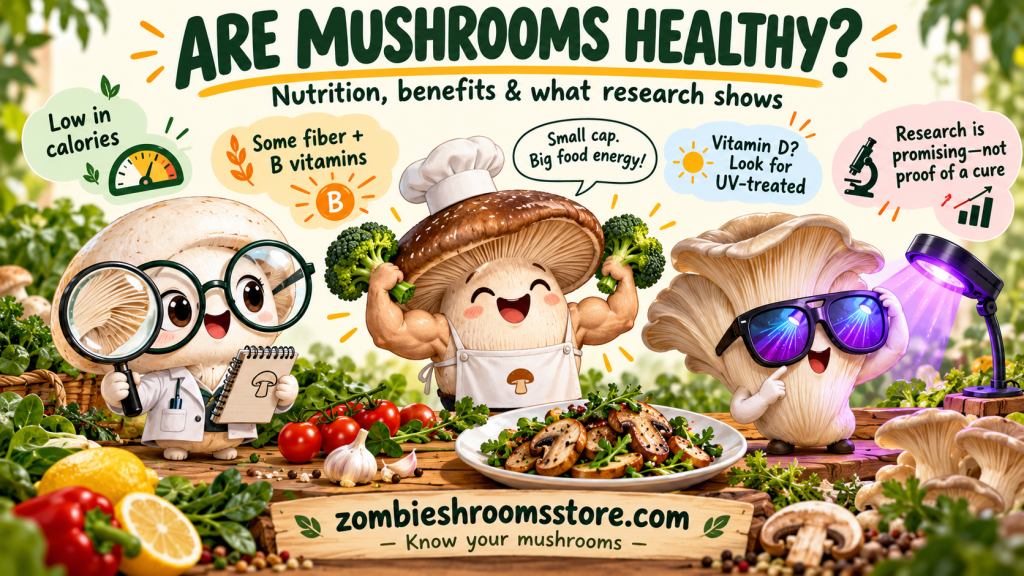
Are Mushrooms Healthy? Nutrition, Benefits, and What Research Shows
Are mushrooms healthy? For most people, familiar edible mushrooms can be a nutritious part of a varied diet. They are generally low in calories and fat, contribute several vitamins and minerals, and add savory flavor to meals. Their nutrient content differs by species and preparation, however, and eating mushrooms has not been proven to prevent or treat a disease.
That distinction matters because the word mushroom covers many unrelated foods and products. White button, cremini, portobello, oyster, and shiitake mushrooms are culinary foods. A concentrated extract is a different product. Psilocybin-containing mushrooms raise separate medical and legal questions. This article focuses on edible culinary mushrooms and the evidence behind their nutritional benefits.
If you have seen broad claims that mushrooms “boost immunity,” “detox the body,” or “fight cancer,” look at what was studied. A nutrient measurement tells us what a food contains. A cell experiment may suggest a research question. Neither, by itself, proves that a serving of mushrooms will produce a particular health outcome in a person.
What Are the Main Benefits of Mushrooms?
The clearest benefits of mushrooms are nutritional and practical. They can add variety, texture, and flavor while contributing relatively few calories. Depending on the species, they supply nutrients such as riboflavin, niacin, copper, selenium, and potassium. Some mushrooms exposed to ultraviolet light can also supply vitamin D₂. The Nutrition Source
Their savory umami taste is useful in cooking. Chopped mushrooms can be mixed with beans, vegetables, grains, or meat to make a meal more flavorful. That can help someone build a satisfying plate without relying entirely on rich sauces. The benefit depends on the whole meal: mushrooms sautéed lightly and served with vegetables are nutritionally different from mushrooms covered in cream, butter, and salt.
They also contribute some fiber, though a typical portion is not a major fiber source compared with beans, whole grains, fruits, or many vegetables. Their value comes from fitting several useful qualities into one food, not from outperforming every other ingredient in every nutrient.
For readers exploring the wider world of fungi, zombieshroomsstore.com offers related informational resources. Keep culinary nutrition claims separate from claims about mushroom supplements or psychedelic varieties.
Are Mushrooms Veg?
People searching “are mushrooms veg” may mean either Are mushrooms vegetables? or Can vegetarians eat them? The answers differ.
Biologically, mushrooms are fungi, not plants. They therefore are not vegetables in the botanical sense. In kitchens and food guidance, people often group edible mushrooms with vegetables because they are prepared and served in similar ways. Harvard’s Nutrition Source describes this distinction: mushrooms are commonly treated as vegetables in meals, while belonging to a separate biological kingdom. The Nutrition Source
Plain edible mushrooms are suitable for vegetarian and vegan diets. A prepared mushroom dish may not be: broth, cheese, butter, or other added ingredients determine whether the finished meal meets someone’s dietary preference.
Mushrooms can provide a satisfying texture in vegetarian meals, but they are not nutritionally identical to meat. Their protein contribution is modest at normal serving sizes. Someone replacing a substantial portion of meat may want to include beans, lentils, tofu, or another protein source alongside them.
What Is the Nutritional Value of Mushrooms?
The nutritional value of mushrooms depends on the variety, portion, and cooking method. White button mushrooms offer one familiar example, but their numbers should not be applied unchanged to shiitake, oyster, or dried mushrooms.
USDA FoodData Central data for raw white mushrooms puts a 100-gram portion at approximately 22 calories, with roughly 3 grams of protein and 1 gram of dietary fiber. A normal serving may weigh less than 100 grams, and cooking oil or other ingredients add calories. The USDA FoodData Central database lets readers compare specific mushroom varieties and preparations rather than relying on one generic figure. fdc.nal.usda.gov
| Nutritional question | Practical answer |
|---|---|
| Are mushrooms low in calories? | Common fresh varieties generally are; added oils and sauces change the meal total. |
| Do they contain protein? | Yes, but typical servings are not a substitute for a major protein food. |
| Do mushrooms have fiber? | Yes, usually a modest amount that varies by species. |
| Are they a vitamin D source? | Some are, especially when exposed to ultraviolet light; many ordinary indoor-grown mushrooms contain little. |
| Do all varieties have identical nutrients? | No. Species, growing conditions, and preparation affect the values. |
A nutrient label on a packaged product is the best starting point for that specific food. Dried mushrooms, for instance, concentrate nutrients per gram because much of their water has been removed. Comparing a small weight of dried mushrooms with the same weight of fresh mushrooms can therefore be misleading.
Do Mushrooms Have Fiber?
Yes. Mushrooms contain dietary fiber and other carbohydrates that are not digested in the same way as sugars. The amount differs among species. USDA researchers examining edible varieties reported differences in fiber content, reinforcing why a single “mushroom” number cannot represent every type. ars.usda.gov
The answer to “do mushrooms have fiber” should include proportion. White button mushrooms contain some fiber, but a serving of lentils or beans generally contributes substantially more. Mushrooms work well with high-fiber foods rather than replacing them. A bowl combining mushrooms, beans, and whole grains offers a broader nutrient mix than mushrooms alone.
Mushroom polysaccharides are also being studied for possible effects on gut microbes. Laboratory and early research can suggest mechanisms, but claims that eating a particular species will treat a gut condition need stronger human evidence. For ordinary meals, the reliable recommendation is to eat a variety of fiber-containing foods.
Preparation matters as well. A mushroom soup with beans and vegetables may add meaningful fiber; a small amount of mushroom flavoring in a processed snack may contribute very little. Read the entire ingredient list before assigning a food the benefits of its most marketable ingredient.
Are Mushrooms a Good Source of Vitamin D?
Sometimes. Mushrooms can produce vitamin D₂ when exposed to ultraviolet light. Many standard supermarket mushrooms grow indoors with limited UV exposure and may contain little vitamin D. UV-treated mushrooms can contain considerably more. The package may say “UV-treated” or specify the vitamin D amount. The Nutrition Source
This is one of the most important qualifications in discussions of mushroom benefits nutrition. It is inaccurate to promise that every mushroom serving will provide a substantial amount of vitamin D. Check the product information or an appropriate food database entry.
Vitamin D is important for normal bone and muscle function, but mushrooms are not a guaranteed solution to a deficiency. A clinician can advise someone concerned about their vitamin D status based on their circumstances. Food choices, supplements when appropriate, and health assessment should be considered separately from promotional claims about a “superfood.”
Mushrooms also supply other micronutrients. Which ones appear in meaningful amounts depends on the species and serving. Eating several kinds of nutritious foods remains a sounder approach than expecting one ingredient to meet every need.
What Does Research Say About Health Benefits?
Research on the health benefits of mushrooms includes nutrient analyses, observational studies, and some interventions. These methods answer different questions.
A PubMed-indexed dietary modeling study estimated how adding an 84-gram serving of mushrooms would affect nutrient intake in US diets. In its modeled scenarios, the serving increased several micronutrients and modestly increased fiber without materially increasing calories. This is evidence about nutrient contribution; it is not a clinical trial showing that mushrooms cure a disease. PubMed
Some observational studies have reported associations between mushroom intake and particular health outcomes. Such studies cannot, by themselves, establish that mushrooms caused the difference. People who eat more mushrooms may differ in their overall diet, activity, healthcare access, or other factors.
The findings are not uniformly positive. A systematic review of cardiometabolic research described the experimental evidence as limited and called for stronger studies. Harvard’s review also notes large prospective studies that did not find significant associations between mushroom intake and some major outcomes. A balanced article should report uncertainty rather than selecting only the most exciting results. PubMed
For everyday eating, the well-supported point is simpler: edible mushrooms can contribute nutrients and help make a varied diet enjoyable. Claims that a specific mushroom prevents cancer, reverses cognitive decline, or replaces treatment go beyond what ordinary food studies establish.
Are There Mushroom Benefits for Women?
Searches for “mushroom benefits for women” often imply that mushrooms have a special effect on hormones, fertility, or weight. The evidence does not support a broad claim that an ordinary serving provides a unique medical benefit for all women.
Women can benefit from mushrooms in the same basic nutritional ways as other adults: variety, low calorie density, modest fiber, and species-dependent vitamins and minerals. UV-exposed mushrooms may contribute vitamin D. The usefulness of any nutrient depends on a person’s diet, health, life stage, and needs.
Pregnancy and medical conditions make sweeping recommendations especially unhelpful. A person who is pregnant, has a serious illness, or is considering a concentrated mushroom supplement should discuss relevant dietary and product questions with a qualified healthcare professional. A whole culinary mushroom and a high-concentration extract are not equivalent.
The strongest answer is therefore practical rather than dramatic. Include well-identified edible mushrooms if you enjoy them, prepare them safely, and build the rest of the meal to provide protein, fiber, and other nutrients you need.
Do Cooking Methods Change the Benefits of Eating Mushrooms?
They can. Fresh mushrooms contain considerable water, so cooking changes their weight and texture. Added oil, cream, cheese, or salt may change a dish’s calorie and sodium totals far more than the mushrooms themselves do. That is why “mushroom calories” and “mushroom dish calories” are not the same question.
Harvard notes that cooking in water may move some water-soluble nutrients into the cooking liquid. In a soup, that liquid remains part of the meal. Quickly sautéing or including mushrooms in a stew are straightforward ways to use their flavor. The Nutrition Source
The benefits of eating mushrooms also depend on what they accompany. Mushrooms added to a vegetable omelet or bean dish can increase variety. Used as part of a meal containing whole grains and other vegetables, they complement a balanced diet. They need not be eaten in large amounts or converted into a supplement to have culinary value.
Buy mushrooms intended for food from a reliable source. Some wild species are poisonous and may resemble edible ones. Identifying a wild mushroom from an online photograph is unsafe, even when a familiar culinary variety appears similar. The Nutrition Source
Are Culinary, Functional, and Psychedelic Mushrooms the Same?
No. A white button mushroom eaten at dinner, an extract marketed as a “functional mushroom” supplement, and a psilocybin-containing mushroom are different subjects. They may be grouped together in search results, but their ingredients, evidence, and applicable rules differ.
The nutrition information in this article concerns edible culinary mushrooms. It should not be used to claim that a psilocybin variety has the same dietary role or that a supplement delivers the benefits measured in whole food. If you are researching those names, our Golden Teacher mushrooms explainer discusses the difference between a named psychedelic variety and a standardized medical intervention.
Similarly, a supplement labelled “mushroom blend” does not tell you the quantity of each ingredient or prove a health outcome. Look for the actual species, form, amount, and evidence behind a claim. A product’s marketing category is not a scientific conclusion.
This distinction protects the central answer to “are mushrooms healthy?” It is reasonable to discuss the nutrients in a serving of edible food. It would be misleading to extend that answer automatically to every product containing the word mushroom.
What Is the Practical Answer?
For most people, common edible mushrooms are a useful food: flavorful, generally low in calories, and capable of contributing fiber and several micronutrients. UV exposure can make some varieties a meaningful source of vitamin D₂. Their exact nutritional contribution depends on the mushroom and the meal.
No single food guarantees better health. Research into disease outcomes remains more qualified than many advertisements suggest. Choose familiar edible varieties, check labels when a specific nutrient matters, and combine mushrooms with a range of vegetables, fruits, whole grains, and protein foods.
Frequently Asked Questions
1. Are mushrooms healthy to eat regularly?
Common edible mushrooms can be included regularly in a varied diet if they suit your health needs. Their nutrients and calorie content depend on the type and preparation; they are not a treatment for a medical condition.
2. Are mushrooms vegetables?
They are fungi, not plants. People often group them with vegetables for cooking and meal planning. Plain edible mushrooms also fit vegetarian and vegan diets. The Nutrition Source
3. Do mushrooms have fiber?
Yes, although the amount is usually modest and varies by species. Pair mushrooms with beans, whole grains, and vegetables if your aim is a higher-fiber meal.
4. How many calories are in mushrooms?
As one example, USDA data puts 100 grams of raw white mushrooms at about 22 calories. Other varieties, portion sizes, and added cooking ingredients change the total. fdc.nal.usda.gov
5. Do mushrooms provide vitamin D?
Some do, especially mushrooms exposed to ultraviolet light. Many mushrooms grown indoors without UV exposure contain little vitamin D, so check the product label if that nutrient matters to you. The Nutrition Source