
Psychedelics Education
Golden Teacher mushrooms
Sep
Golden Teacher Mushrooms: Origins, Characteristics, and Cultural History
Golden Teacher mushrooms are a named cultivated variety commonly associated with Psilocybe cubensis, a species that can contain the psychoactive compounds psilocybin and psilocin. Their familiar name appears in discussions of mushroom history, psychedelic research, and popular culture. It also appears beside claims about predictable strength or a particular kind of experience—claims that deserve closer examination.
The name “Golden Teacher” evokes both an appearance and an idea. Descriptions often mention golden-colored caps, while the word “teacher” reflects how some people have interpreted psychedelic experiences. Neither part of the name is a scientific test. A cap’s color cannot establish chemical content, and a cultural description cannot predict what an individual will experience.
For readers in the United States and Canada, the clearest way to understand Golden Teacher mushrooms is to separate their documented biology, uncertain variety history, and cultural reputation. It is equally important to distinguish psilocybin-containing mushrooms from the unrelated functional mushroom chocolates that sometimes appear in the same search results.
What Are Golden Teacher Mushrooms?
Golden Teacher is an informal variety name, not a separate scientific species. Mushrooms described by that name are generally associated with P. cubensis. Psilocybin is one compound that may occur in this species; after ingestion, the body converts psilocybin to psilocin, which contributes to psychedelic effects.
These distinctions matter when evaluating a claim. A statement about P. cubensis concerns a species. A statement about Golden Teacher concerns a named cultivated variety. A clinical study of measured psilocybin concerns the specific intervention used in that study. Evidence at one level does not automatically establish a claim at another.
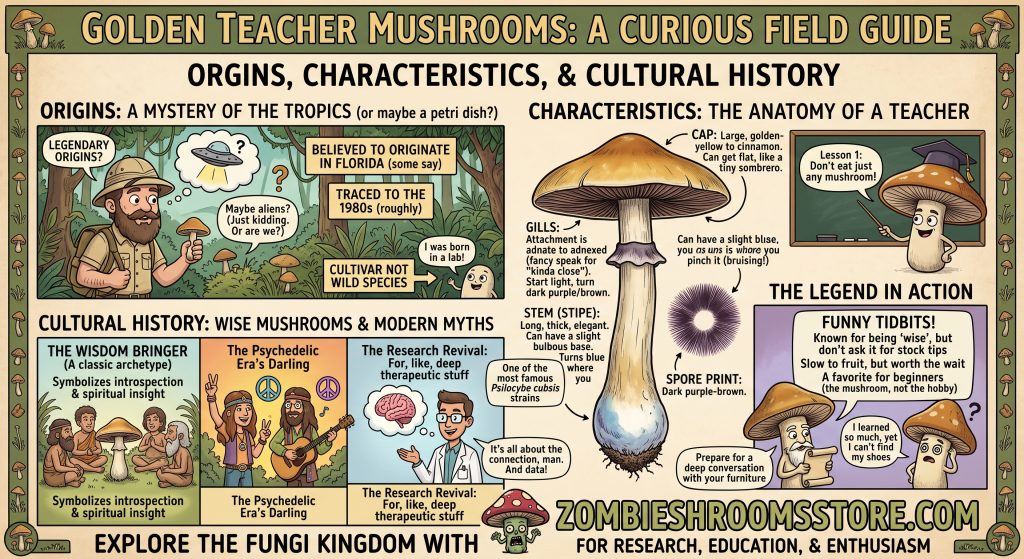
In photographs and descriptions, Golden Teacher mushrooms are often shown with caps that develop a yellow-gold or caramel tone. Their appearance can vary, however. A photograph, a variety label, or a familiar cap color cannot authenticate an unknown mushroom or reveal its chemical contents. Identification and potency require stronger evidence than a visual resemblance.
The name is best understood as a useful subject for cultural and scientific discussion, rather than a promise that every mushroom carrying it has the same ingredients or effects.
Where Did the Golden Teacher Name Come From?
Accounts frequently place Golden Teacher’s emergence in cultivated mushroom circles during the 1980s. More precise stories vary. Different websites attribute its beginnings to different places and people, often without a clear chain of contemporary records establishing a single original specimen.
That uncertainty is a meaningful part of the history. Informal variety names can spread through personal exchanges, catalogs, and later online communities without the kind of documentation used to describe a formally recognized species. A later account may accurately record someone’s experience with a culture while still failing to establish who first collected or named it.
The word “golden” is commonly connected to the cap’s described color. “Teacher” is generally understood as a cultural reference to the insight some people attribute to psychedelic experiences. Those interpretations explain the name’s lasting appeal, but they should not be mistaken for a verified origin story or a claim of therapeutic benefit.
Golden Teacher mushrooms became widely recognizable as conversations about cultivated P. cubensis moved from smaller communities to internet forums and popular media. Their visibility tells us about cultural interest. It does not make the variety a standardized medicine.
What Characteristics Are Commonly Described?
Golden Teacher is often presented as a recognizable example of cultivated P. cubensis: a defined stem, a cap that broadens as it develops, and the warm cap colors that inspired its name. Descriptions like these help readers understand why the variety is discussed. They should not be turned into instructions for identifying unknown or wild mushrooms.
Appearance can differ even among specimens carrying the same name. Conditions under which a mushroom develops can influence visible traits. More importantly, looks do not reveal the amount of psilocybin or psilocin present.
A PubMed-indexed study examining multiple P. cubensis strains measured differences in psilocybin and psilocin both between strains and between individual mushrooms within a strain. Its findings illustrate why a variety name is an unreliable substitute for measurement. They do not establish one fixed strength for every Golden Teacher specimen. PubMed
Misidentification is a separate concern. Resemblance to a photograph of Golden Teacher cannot establish that another mushroom belongs to the same species. Public education should avoid presenting pictures or informal descriptions as a dependable way to assess an unidentified mushroom’s safety.
What Does “Cultural History” Mean Here?
The cultural history of Golden Teacher concerns the stories, meanings, and conversations that have gathered around the name. It is distinct from both the biological history of P. cubensis and the long histories of mushroom use in different communities.
Calling the variety a “teacher” expresses an interpretation of a possible subjective experience. It does not establish that a mushroom reliably provides insight, improves mental health, or produces a beneficial outcome. Personal reports can be valuable accounts of what someone felt, but they cannot substitute for controlled research.
There is also a risk of making the history seem older or more culturally specific than the available evidence supports. Golden Teacher is a modern variety name in cultivated mushroom culture. It should not be presented as the name of a particular traditional Indigenous mushroom or ceremony without evidence. Broader cultural histories deserve their own sources and context rather than being attached to a modern label.
For a related discussion of how variety names acquire reputations, see our Penis Envy mushrooms history article. The same basic question applies to both names: which details can be verified, and which survive mainly through repeated accounts?
Can the Name Predict Potency or Effects?
No. Golden Teacher mushrooms are sometimes described online as producing a particular kind of experience, but a named variety cannot guarantee an emotional or visual response. Chemical variation is one reason. A person’s health, expectations, surroundings, and other substances can also affect an experience.
Health Canada notes that the concentrations of active ingredients may vary from one mushroom to another. It lists possible effects that include altered perception and sense of time, as well as unwanted reactions such as anxiety, panic, confusion, and nausea. Its guidance also describes concerns for people with certain psychiatric or cardiac conditions. Canada.ca
A description such as “gentle,” “spiritual,” or “beginner friendly” is therefore an interpretation, not a measured property that applies to every specimen or person. Likewise, a particularly striking personal account cannot establish that the variety caused an effect unique to Golden Teacher.
Readers assessing a potency claim should ask for the sample, laboratory method, and comparison being used. If an article offers a ranking without those details, it is describing reputation more than reproducible evidence.
What Does Research Say About Medical Use?
Scientists are studying psilocybin for potential therapeutic uses. That research should not be described as proof that Golden Teacher mushrooms treat depression, anxiety, or another condition. A clinical trial may use a measured intervention, participant screening, professional oversight, and structured follow-up. A mushroom identified only by an informal variety name does not automatically meet those standards.
Health Canada says evidence for potential therapeutic uses is still limited and identifies clinical trials as an appropriate route for advancing research. Its public guidance states that no therapeutic product containing psilocybin has been approved for sale as a medicine in Canada. In certain circumstances, regulated access pathways may be available; they have specific requirements and are distinct from general retail availability. Canada.ca
The difference between “a compound is being investigated” and “a named mushroom is an approved treatment” is central to accurate health writing. Anyone considering care for a medical condition should discuss established treatment options and questions about legitimate research with a qualified healthcare professional.
Is There a “Drink That Makes You Hallucinate”?
The search phrase “drink that makes you hallucinate” can refer to very different substances or situations. A drink’s name, flavor, or mushroom imagery cannot tell someone whether it contains psilocybin, another psychoactive ingredient, or no psychedelic compound at all.
The phrase may also lead to discussions of alcohol-related hallucinations. Those are a separate medical issue. Hallucinations can occur with severe alcohol withdrawal, and alcohol-related hallucinosis is a recognized condition. They should not be described as an expected version of a psilocybin experience. Someone experiencing hallucinations in connection with heavy drinking or stopping alcohol needs prompt medical assessment. niaaa.nih.gov
This is why the word hallucination needs context. It describes a possible symptom or experience; it does not identify the substance involved or explain its cause. An educational article about Golden Teacher should not imply that a chocolate, beverage, or alcohol product is comparable merely because a search result uses the same word.
Are Alice Mushroom Chocolates Psychedelic?
Searches for alice mushroom, alice mushroom chocolates, and alice chocolates can appear beside searches about Golden Teacher. The shared word mushroom can create a misleading connection.
Alice markets functional mushroom chocolates. For example, its Happy Ending product page lists cordyceps and other ingredients; it does not list Golden Teacher or psilocybin as ingredients. That is the manufacturer’s published ingredient description, not independent laboratory verification of every product or batch. A functional mushroom chocolate should not be assumed to be a psilocybin product, and the two categories should not be treated as interchangeable. Desire & Intimacy – alice mushrooms
A functional mushroom chocolate is generally marketed around ingredients such as non-psychedelic mushroom species and other food or supplement ingredients. A product advertised as “mushroom chocolate,” however, still deserves a careful reading of its actual ingredient list. The wording alone is too broad to establish what it contains.
That distinction matters beyond one brand. The US Food and Drug Administration has warned about the use of Amanita muscaria and certain constituents in conventional foods sometimes marketed as “psychedelic edibles” or “mushroom edibles.” Amanita is not Golden Teacher, and its principal discussed constituents differ from psilocybin. The FDA’s consumer and industry notice shows why readers should check the specific ingredient rather than grouping all mushroom products together. FDA
How Should Readers Interpret Alice Mushroom Reviews?
Search phrases such as “alice mushrooms reviews” and “alice happy ending mushroom chocolates review” indicate interest in a branded food or supplement product. A customer review may describe taste or a person’s impression. It cannot establish that the product treats a condition, causes a psychedelic experience, or has effects comparable to Golden Teacher mushrooms.
It is also important to identify which Alice product a review concerns. Different products may have different ingredient lists. A comment about one chocolate cannot be applied to the entire brand, and promotional claims should be distinguished from independent clinical evidence.
For readers arriving at this article through those searches, the direct answer is that Alice’s described functional mushroom chocolates and Golden Teacher are different subjects. Compare their stated ingredients before drawing any conclusion. Do not use a review of a chocolate as evidence about a psilocybin-containing mushroom variety.
Legal Context in the United States and Canada
Laws concerning psilocybin vary by jurisdiction and activity. In the United States, psilocybin remains controlled under federal law, although state and local approaches may differ. A local policy does not, by itself, establish federal medical approval of Golden Teacher mushrooms.
In Canada, activities involving psilocybin and psilocybin-containing mushrooms generally require authorization. Health Canada describes pathways that can include clinical trials, the Special Access Program, and exemptions in applicable circumstances. These are regulated routes with requirements, not blanket permission to obtain or prescribe mushrooms. Canada.ca
Readers should check current rules for their location and the exact activity being discussed. Research authorization, a practitioner’s access request, possession, and approved sale are different legal questions. You can also begin with the Zombies Shrooms Store informational home page for related reading, while relying on current government guidance for legal and medical claims.
What Is the Most Reliable Takeaway?
Golden Teacher mushrooms are culturally recognizable, but the name carries less scientific certainty than many descriptions suggest. Their exact origin is difficult to establish from commonly repeated accounts. Typical appearance cannot confirm identity or potency, and personal stories cannot establish predictable effects.
The strongest educational approach is to ask what a source actually demonstrates. An historical account may document circulation of a name. A laboratory test may describe particular samples. A clinical trial may evaluate a measured psilocybin intervention. Each can contribute knowledge without proving the claims made at the other levels.
That same care helps readers distinguish Golden Teacher from functional mushroom chocolates, Amanita products, and alcohol-related hallucinations. They may share a search-results page, but they do not share a single biology, evidence base, or legal status.
Frequently Asked Questions
1. Are Golden Teacher mushrooms a separate species?
No. Golden Teacher is commonly used as a cultivated variety name associated with Psilocybe cubensis. It is not a separate scientific species name.
2. Is the exact origin of Golden Teacher known?
A precise, fully verified account of its original specimen and naming is difficult to establish. Accounts commonly associate its emergence with cultivated mushroom circles in the 1980s, but more detailed origin stories should be treated cautiously.
3. Can a Golden Teacher label tell me how potent a mushroom is?
No. The amounts of active compounds can vary, including between individual mushrooms associated with the same strain. A label is not a chemical measurement. PubMed
4. Are Alice mushroom chocolates the same as Golden Teacher mushrooms?
No. Alice describes products containing functional mushroom ingredients, such as cordyceps in its Happy Ending chocolate. That product description should not be confused with a named P. cubensis variety. Desire & Intimacy – alice mushrooms
5. Are Golden Teacher mushrooms approved prescription medicines?
No. Research into psilocybin does not make a named mushroom variety an approved medicine. Health Canada states that no psilocybin-containing therapeutic product is approved for sale as a medicine in Canada.