Psychedelics Education
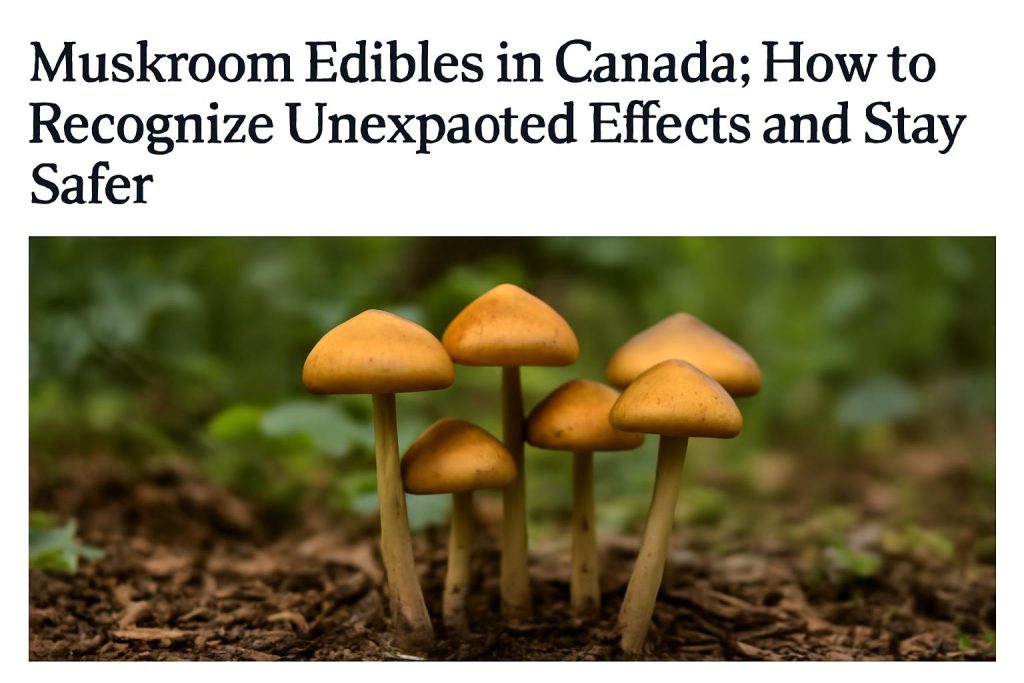
Mushroom Edibles in Canada: How to Recognize Unexpected Effects and Stay Safer
Oct
Editor’s note: This is an evergreen educational guide, not a claim about a current Canadian news trend. Mushroom edibles can produce unpredictable effects, and nothing in this article replaces medical advice or emergency care.
Products described as mushroom gummies, chocolates, capsules, or other psychedelic edibles have become easier to encounter online and through informal retail channels. For Canadians, however, the label on an edible does not always tell the full story. The product may contain psilocybin, another psychoactive compound, a non-psychedelic mushroom ingredient, cannabis, or an undisclosed substance. Potency and serving information may also be incomplete.
That uncertainty is why understanding mushroom edibles Canada safety involves more than knowing what a product claims to contain. It means recognizing delayed effects, avoiding risky combinations, knowing when discomfort may pass, and identifying symptoms that require urgent help.
Why mushroom edibles can feel unpredictable
With dried mushrooms, people often assume that the appearance or strain name provides a reliable indication of strength. With edibles, even that limited information may disappear. Processing can make it difficult to judge the amount of active compound in each piece, while product names may be used for marketing rather than scientific identification.
Labels may not reveal the active ingredient
A package may use terms such as “mushroom blend,” “functional mushrooms,” “magic gummies,” or “psychedelic edible.” These descriptions are not interchangeable. Some products contain culinary or functional mushrooms such as lion’s mane or reishi and are not expected to cause a psychedelic experience. Others may contain a psychoactive ingredient, while some products have been found in different markets to contain undisclosed drugs or synthetic compounds.
A colourful package or a confident potency claim is not proof of laboratory testing. Canadians should be cautious when a product does not clearly identify its ingredients, manufacturer, batch information, or testing documentation.
Onset can be delayed
Edibles generally take longer to produce noticeable effects than inhaled substances. Timing can vary according to the product, stomach contents, metabolism, formulation, and the individual. A person may feel little at first and mistakenly assume that the product is inactive. Taking more during that waiting period can result in unexpectedly intense effects later.
Delayed onset is one of the most common reasons an experience becomes stronger than intended. The safest response to uncertainty is not to keep adding more. If someone has already consumed an edible, staying in a calm environment and allowing time for effects to develop is more prudent than trying to accelerate or intensify the experience.
Possible effects of psychoactive mushroom edibles
If an edible contains psilocybin, the body converts it into psilocin, the compound primarily associated with psychedelic effects. Experiences can vary significantly. Some people report changes in colour, sound, time perception, mood, thought patterns, and self-awareness. Others may experience confusion, fear, nausea, dizziness, restlessness, or an uncomfortable loss of control.
Common short-term effects may include:
- Changes in visual or sensory perception
- Altered sense of time
- Intense emotions or rapidly changing mood
- Unusual thought patterns or difficulty concentrating
- Nausea, stomach discomfort, or vomiting
- Increased heart rate or sweating
- Dizziness, poor coordination, or fatigue
- Anxiety, panic, or paranoia
These effects can be more difficult to manage when a person is alone, unfamiliar with psychedelics, already anxious, sleep-deprived, or using other substances. Cannabis and alcohol can make judgment, coordination, anxiety, and confusion worse. Combining psychoactive substances also makes it harder to determine what is causing a symptom.
What to do if an edible feels too strong
A challenging experience is not automatically a medical emergency, but it should be taken seriously. The immediate goal is to reduce stimulation and prevent injury.
Move to a safer setting
Stay indoors or in another familiar, low-risk location. Reduce bright lights, loud music, crowds, and unnecessary conversation. Do not drive, cycle, swim, climb, or operate machinery. If possible, have a calm, trusted sober adult remain nearby.
Use reassurance rather than confrontation
Speak slowly and use simple, reassuring statements. Remind the person that the effects are temporary and that help is available. Avoid arguing about what they see or hear. Challenging their perceptions can increase fear, while a quiet and non-judgmental presence may help them feel less threatened.
Support basic comfort
Offer small sips of water if the person is alert and able to swallow. A light snack may be appropriate if they want one, but do not force food or drinks. Keep the person comfortably warm and seated or lying on their side if they feel nauseated. Avoid giving additional drugs, alcohol, cannabis, or unverified “counteracting” remedies.
Do not leave someone who is severely confused, panicking, vomiting repeatedly, or unable to care for themselves. If their condition is worsening, contact emergency services.
Warning signs that require urgent medical help
Call 911 in Canada or seek emergency medical care when a person has trouble breathing, chest pain, a seizure, loss of consciousness, severe agitation, extreme overheating, serious injury, or symptoms that suggest a dangerous reaction. Emergency help is also appropriate if the person may have consumed an unknown substance or a very large amount.
Seek urgent assistance if someone:
- Cannot be awakened or does not respond normally
- Is having difficulty breathing or has blue or grey lips
- Has a seizure, collapses, or suffers a head injury
- Is dangerously confused, violent, or attempting to harm themselves or others
- Has persistent vomiting and cannot keep fluids down
- Has a very high temperature, rigid muscles, or severe tremors
- Develops intense chest pain or a rapidly worsening physical symptom
When calling for help, be honest about what was taken, approximately how much, and when. Medical professionals need accurate information to make safe decisions. If packaging is available, keep it nearby for identification. Do not delay emergency care because of concern about judgment or possible legal consequences.
How Canadians can assess an edible before using it
No checklist can make an unregulated psychoactive product risk-free. Still, several questions can reveal avoidable uncertainty.
Is the ingredient list specific?
Be cautious when a label uses a proprietary blend, vague “mushroom extract,” or a broad promise such as “legal highs.” A responsible product description should identify the ingredients and avoid implying that a non-psychoactive mushroom automatically produces a psychedelic effect.
Is there credible batch information?
Look for a manufacturer name, lot or batch number, production date, expiry information, and independent testing details. A QR code alone does not prove that testing is genuine. If a certificate is provided, check whether it identifies the same product, batch, and ingredients rather than displaying a generic document.
Are the claims exaggerated?
Promises of guaranteed euphoria, instant mental-health benefits, effortless microdosing, or zero risk should be treated as marketing rather than evidence. Psychedelic experiences are highly individual, and no edible can guarantee a particular emotional or therapeutic outcome.
Readers exploring general product formats can visit the Zombie Shrooms Store home page, where product categories and descriptions are presented for informational review. The site’s product category directory can also help visitors distinguish between formats such as dried mushrooms, mushroom gummies, teas, and capsules. Always verify the rules that apply to your province and situation before considering any purchase.
Canadian legal considerations
In Canada, psilocybin and psilocin are controlled substances under federal law. Possession, production, trafficking, and importation are generally prohibited unless an authorization or exemption applies. The fact that a product is sold online, described as a gummy, or marketed as a “mushroom” product does not automatically make it legal.
Legal status can also differ from product to product. A food containing an ordinary culinary mushroom is not the same as an edible containing psilocybin. Likewise, a product marketed as a “legal psychedelic” may still contain a controlled or undisclosed substance. Do not rely solely on a seller’s claim that an item is compliant in Canada.
Canadian consumers can review the available product directory for educational comparison of formats, but a website listing is not legal authorization, medical approval, or a guarantee of product composition. Regulations and enforcement practices can change, so current information from Canadian authorities should be checked before making decisions.
Who should be especially cautious?
Psychedelic edibles may carry additional risks for people with a personal or family history of psychosis, mania, or certain severe mental-health conditions. People with cardiovascular problems, seizure disorders, pregnancy, or significant medication interactions should speak with a qualified healthcare professional before considering psychoactive substances.
Extra caution is also appropriate for anyone taking antidepressants, stimulants, mood stabilizers, sedatives, or other prescription medicines. Interactions are not always predictable, and stopping prescribed medication suddenly can create its own risks. A pharmacist or physician can provide individualized guidance.
Young people, people who are alone, and anyone experiencing an acute mental-health crisis should not use psychedelic edibles. If someone is considering an edible because they feel hopeless or unsafe, contact emergency services or a crisis-support service instead of using a psychoactive substance.
Frequently asked questions
How long do mushroom edibles take to work?
Timing varies by formulation, ingredients, stomach contents, and individual metabolism. Effects may be delayed, which is why taking additional servings too soon can lead to an unexpectedly intense experience. A delayed effect should not be interpreted as proof that the product is inactive.
Are mushroom gummies safer than dried mushrooms?
Not automatically. Gummies may be easier to portion, but their contents and potency can be difficult to verify. Some may contain no psilocybin, while others may contain an undisclosed psychoactive ingredient. The format alone does not establish safety.
Can cannabis make a mushroom edible experience stronger?
It can make the experience feel more intense or confusing for some people, while increasing anxiety, dizziness, impaired coordination, or paranoia. Combining substances makes effects less predictable, so avoiding combinations is the lower-risk choice.
What should I do if I do not know what was in the edible?
Keep the packaging, note the time and amount consumed, and monitor the person in a safe setting. Contact a poison centre or emergency services for concerning symptoms. If there is breathing trouble, unconsciousness, seizure, severe agitation, or another emergency warning sign, call 911 immediately.
Is a “microdose” automatically low risk?
No. A microdose label does not confirm the actual amount or ingredient. Individual sensitivity, medication use, product variability, and mental-health history can all affect risk. “Microdose” is a marketing or descriptive term, not a safety guarantee.
The practical takeaway
Mushroom edibles deserve the same careful attention as any psychoactive product. The most important safety principles are to question unclear labels, avoid mixing substances, never drive after consuming an edible, stay with a trusted sober person when possible, and seek help quickly when serious symptoms appear.
For Canadians, legal status is another essential part of the decision. Psilocybin products are not made lawful simply by being sold as gummies, chocolates, capsules, or “mushroom blends.” Education, realistic expectations, and prompt medical support are more valuable than confident packaging or exaggerated promises.