Psychedelics Education
What Are Magic Mushrooms in Canada? A Complete Beginner’s Guide to Psilocybin, Effects, and History
Oct
What Are Magic Mushrooms in Canada? The Short Answer
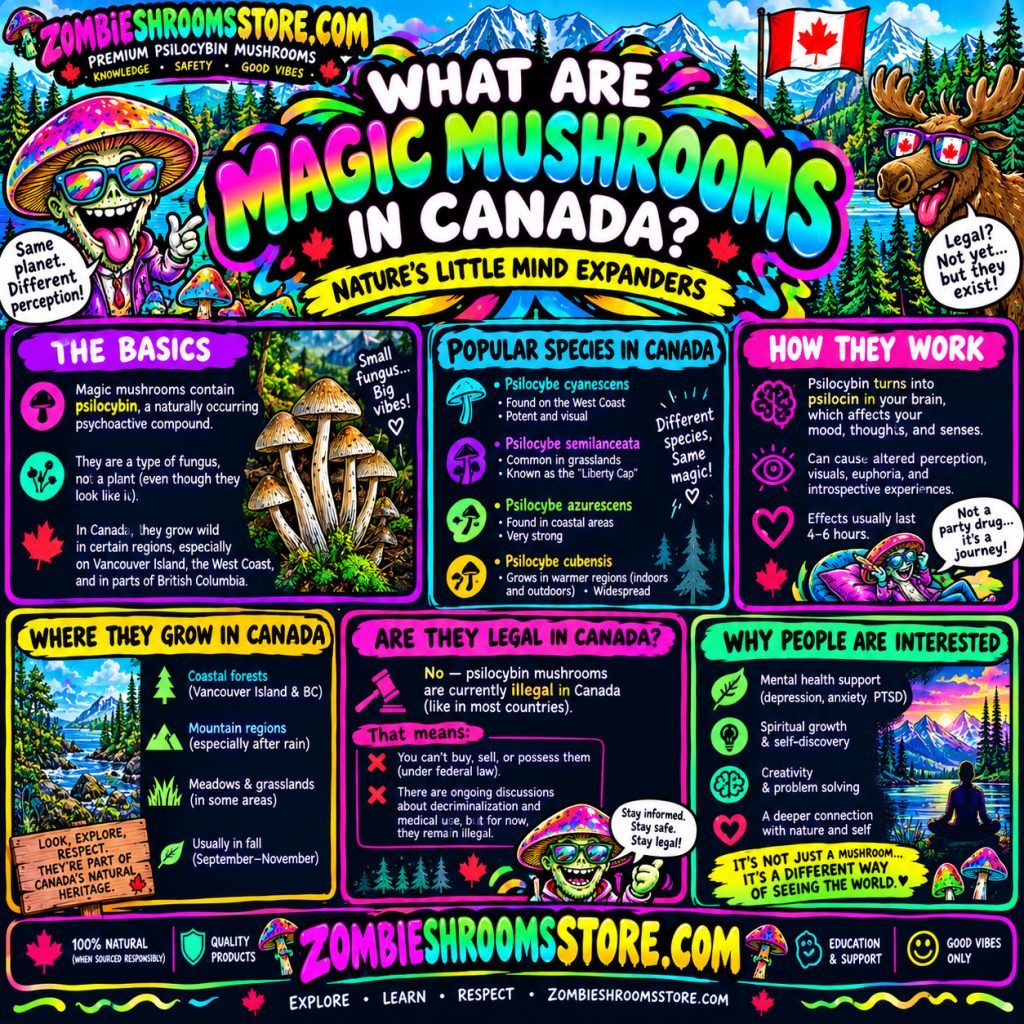
Magic mushrooms — often called shrooms — are fungi that contain naturally occurring psychoactive compounds, most notably psilocybin and psilocin. When ingested, these compounds can alter perception, mood, thought patterns, and sensory experience. In Canada, the term “magic mushrooms” usually refers to dried Psilocybe cubensis and related species, though dozens of psilocybin-containing varieties exist worldwide.
For Canadian readers searching for a clear, no-hype explanation, this guide covers the essentials: what psilocybin actually is, how it interacts with the brain, what a typical experience may involve, the cultural and scientific history of these fungi, and where Canadian law currently stands. It is educational content only — not medical advice and not encouragement to break the law.
Psilocybin vs Psilocin: The Two Compounds Behind Shrooms
Understanding magic mushrooms starts with two closely related molecules.
Psilocybin
Psilocybin is the “prodrug” — a stable compound stored in the mushroom tissue. On its own, psilocybin is not strongly psychoactive. It becomes active after the body converts it, mainly in the liver and gut, into psilocin.
Psilocin
Psilocin is the molecule that actually crosses the blood-brain barrier and produces the psychedelic effect. It closely resembles serotonin, which is why it interacts so readily with serotonin receptors in the brain.
This conversion explains why shrooms typically take 30 to 60 minutes to kick in and why effects can vary based on what you’ve eaten, your metabolism, and the potency of the mushroom. For a deeper dive into this chemistry, see our explainer on the science behind mushrooms and the human brain.
How Psilocybin Affects the Brain
Psilocin’s chemical structure is similar enough to serotonin that it binds to serotonin receptors — particularly the 5-HT2A receptor — throughout the brain. This binding is thought to disrupt normal communication patterns between brain regions, temporarily loosening the brain’s usual “filters” on perception and thought.
Researchers describe this as increased connectivity between networks that don’t normally talk to each other. In practical terms, users may experience:
- Visual distortions, including enhanced colours, moving patterns, or geometric shapes
- Altered sense of time, often feeling that time has slowed or expanded
- Shifts in mood, ranging from euphoria to introspection or, occasionally, anxiety
- Changes in self-perception and a sense of connection to surroundings
- Physical effects such as dilated pupils, mild nausea, or changes in body temperature
These effects are dose-dependent and highly individual. A microdose may produce subtle changes in focus or mood, while a full dose can produce profound perceptual shifts. Set and setting — your mindset and environment — play a major role in shaping the experience.
What a Typical Magic Mushroom Experience Looks Like
Most people describe the arc of a psilocybin experience in phases:
Onset (30–60 minutes)
Early effects may include mild nausea, a sense of anticipation, and the first hints of visual or sensory changes.
Peak (1–3 hours)
This is where perceptual changes are strongest. Colours may seem brighter, patterns may appear in surfaces, and thoughts may feel more fluid or associative. Emotional intensity can rise.
Come-down (3–6 hours)
Effects gradually fade. Many people report feeling calm, reflective, or emotionally open afterward. Some experience lingering fatigue or mild headache.
Total duration is typically 4 to 6 hours for dried Psilocybe cubensis, though stronger species and higher doses can extend this. Beginners are generally advised to start low and go slow, and to avoid mixing with alcohol or other substances.
A Brief History of Magic Mushrooms
Psilocybin-containing mushrooms have been used for centuries, particularly in Mesoamerican cultures where they were incorporated into spiritual and ceremonial practices. Spanish colonial records from the 16th century describe ritual use among Indigenous peoples in what is now Mexico.
Modern Western awareness began in the mid-20th century. In 1957, mycologist R. Gordon Wasson published a Life magazine article describing his experiences with mushrooms in Mexico, introducing psilocybin to a broad audience. Swiss chemist Albert Hofmann — who had earlier synthesized LSD — isolated and named psilocybin and psilocin in 1958, and psilocybin was later synthesized for research.
Early clinical research in the 1950s and 1960s explored psilocybin for anxiety, depression, and end-of-life distress. That research was largely halted when psilocybin was classified as a controlled substance in the United States in 1970 and subsequently restricted internationally. Interest revived in the 2000s, and today Canada is home to active clinical research and a small but growing regulatory framework for psilocybin access.
Types of Psychedelic Mushrooms Found in Canada
Canada’s climate supports a range of psilocybin-containing species, though the most commonly discussed and cultivated is Psilocybe cubensis. Within that species, many named varieties exist — Golden Teacher, Penis Envy, B+, Blue Meanie, Amazonian, and others — each with slightly different characteristics, potency, and cultivation history.
Wild psilocybin species also grow in parts of Canada, including Psilocybe semilanceata (liberty caps) in coastal and temperate regions, and Psilocybe cyanescens in the Pacific Northwest. Foraging carries real risks, including misidentification of toxic lookalikes, so it is not recommended for beginners. If you’re curious about the range of varieties, our guide to dried magic mushrooms outlines common options and their general profiles.
Are Magic Mushrooms Legal in Canada?
This is one of the most common questions Canadians ask, and the answer is nuanced.
Psilocybin and psilocin are listed as controlled substances under Canada’s Controlled Drugs and Substances Act. Outside of specific exemptions, possessing, producing, selling, or importing psilocybin-containing mushrooms is illegal.
However, Canada has developed a limited framework for legal access:
- Health Canada’s Special Access Program (SAP) allows certain healthcare practitioners to request psilocybin for patients with serious or life-threatening conditions where other treatments have failed.
- Section 56 exemptions have been granted to some clinical trial participants and, in limited cases, to individuals for personal medical use.
- Clinical trials at Canadian institutions continue to study psilocybin for depression, anxiety, and other conditions.
Recreational use, sale, and possession remain illegal in most circumstances, though enforcement varies. Some municipalities have passed non-enforcement resolutions, but these do not change federal law. For a detailed breakdown, see our article on whether psilocybin is legal.
Anyone considering psilocybin for health reasons should speak with a licensed healthcare provider and understand the legal boundaries before acting.
Magic Mushroom Facts and Myths
Misinformation about shrooms is common. Here are a few clarifications:
Myth: Magic mushrooms are the same as Amanita muscaria
False. Amanita muscaria contains muscimol and ibotenic acid, not psilocybin. Its effects and risks are different. Psilocybin mushrooms belong primarily to the Psilocybe genus.
Myth: Shrooms are addictive
Psilocybin is not considered physically addictive in the way opioids or nicotine are. However, psychological dependence and risky use patterns are possible, and people with a personal or family history of psychosis should be especially cautious.
Myth: You can’t have a bad experience
Challenging experiences — sometimes called “bad trips” — can happen, particularly with high doses, unfamiliar settings, or unmanaged anxiety. Preparation, dosage control, and a safe environment reduce risk.
Fact: Potency varies widely
Different species and even different batches of the same species can vary significantly in psilocybin content. This is one reason starting with a low dose is widely recommended.
Harm Reduction Basics for Canadian Beginners
If you choose to explore psilocybin, informed caution matters:
- Start with a low dose and wait at least 90 minutes before considering more
- Avoid mixing with alcohol, cannabis, or other substances on a first experience
- Use a calm, familiar setting with a trusted, sober person present
- Avoid use if you have a personal or family history of schizophrenia or bipolar disorder
- Do not drive or operate machinery during or after use
- Purchase only from sources that provide clear product information and dosage guidance
For those interested in lower-dose formats, our overview of microdose shrooms explains how smaller amounts are typically approached.
Frequently Asked Questions
What are magic mushrooms in simple terms?
They are fungi containing psilocybin, a compound that the body converts into psilocin, which alters perception and mood by interacting with serotonin receptors in the brain.
How long do magic mushrooms last?
Dried Psilocybe cubensis typically produces effects lasting 4 to 6 hours, with the strongest phase in the first 1 to 3 hours.
Are magic mushrooms legal in Canada?
Psilocybin is a controlled substance. Limited legal access exists through Health Canada’s Special Access Program, Section 56 exemptions, and clinical trials. Recreational possession and sale remain illegal in most cases.
Can I buy magic mushrooms online in Canada?
Legally, no — recreational sale is not permitted. Some websites operate in a grey area, but purchasing carries legal risk. Always verify the legal status and consult a healthcare provider for medical questions.
What is the difference between psilocybin and psilocin?
Psilocybin is the stable compound in the mushroom; psilocin is the active metabolite produced after ingestion. Psilocin is what directly affects the brain.
Do magic mushrooms show up on drug tests?
Standard drug tests usually do not screen for psilocybin, but specialized tests can detect it for a short window after use.
Final Thoughts
Magic mushrooms are among the most studied psychedelics in modern research, and Canada sits at an interesting crossroads — strict federal law paired with expanding medical and scientific interest. Understanding what psilocybin is, how it works, and what the law allows helps Canadians make informed, safer decisions. This guide is educational only; for medical questions or legal advice, consult a qualified professional.