Psychedelics Education
Types of Psychedelic Mushrooms Found in Canada: A Beginner’s Guide to Species, Effects, and Safety
Oct
Why Canadian Beginners Should Understand Mushroom Types
Canada’s relationship with psychedelic mushrooms is evolving quickly. Across the country, interest in psilocybin has grown thanks to clinical research, shifting public attitudes, and a growing conversation about mental health. For Canadians curious about magic mushrooms, one of the first and most important steps is understanding that “magic mushrooms” is not a single thing. There are many types of psychedelic mushrooms found in Canada, each with its own characteristics, potency, and natural habitat.
Knowing the difference between species and strains matters for safety, education, and informed decision-making. Whether you are reading about psilocybin for the first time or comparing dried mushroom varieties, this guide breaks down the main categories of psychedelic mushrooms in Canada in plain language.
What Makes a Mushroom “Psychedelic”?
Psychedelic mushrooms contain naturally occurring compounds called tryptamines. The two most important are psilocybin and psilocin. Psilocybin is a prodrug: after ingestion, the body converts it into psilocin, which is the compound primarily responsible for the perceptual and emotional effects people associate with a “trip.”
Mushrooms that contain these compounds are commonly called psilocybin mushrooms or “shrooms.” They are different from Amanita muscaria, a separate type of mushroom that contains muscimol and ibotenic acid rather than psilocybin. Understanding this distinction is essential because the effects, risks, and legal treatment of these two categories are not the same.
The Main Types of Psychedelic Mushrooms Found in Canada
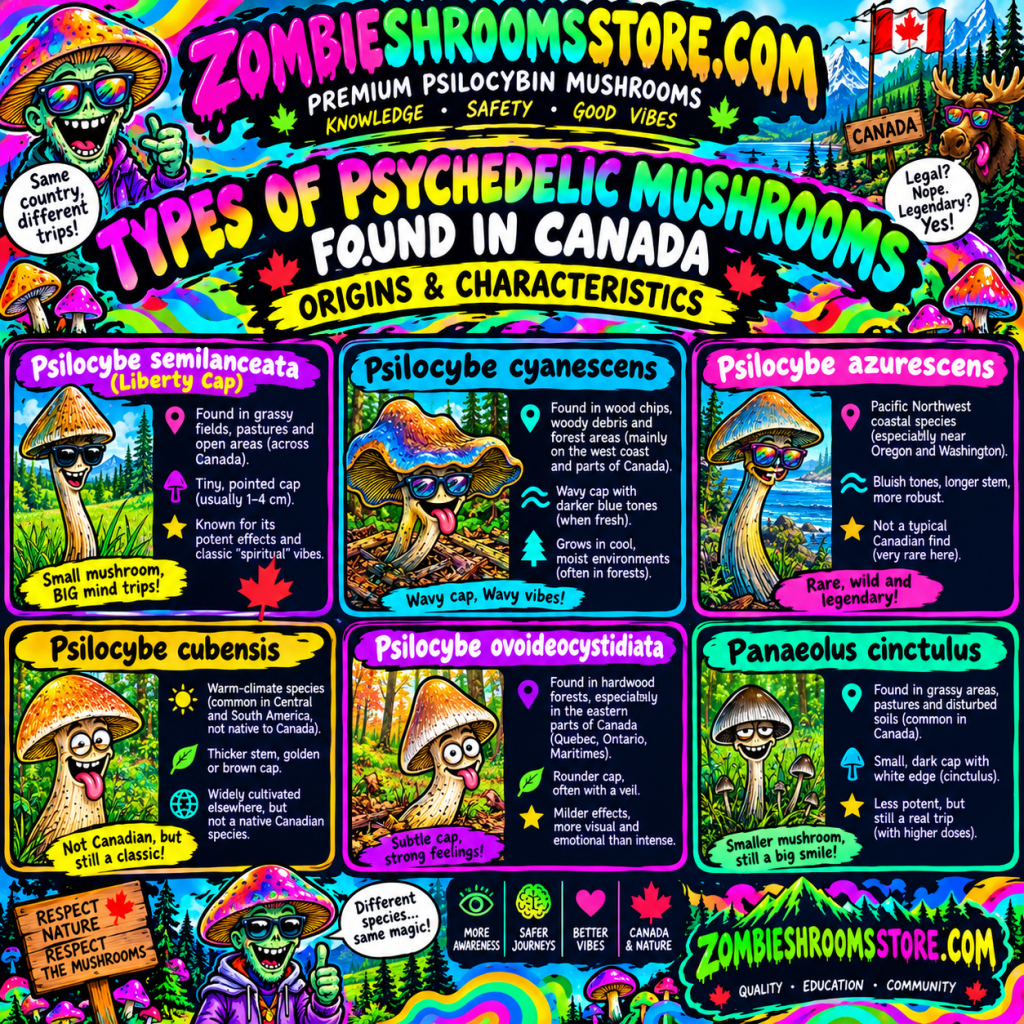
Broadly speaking, psychedelic mushrooms in Canada fall into two groups: native wild species that grow in Canadian climates, and cultivated Psilocybe cubensis varieties that are widely discussed and studied. Here is a closer look at each.
1. Psilocybe cubensis: The Most Familiar Category
Psilocybe cubensis is the most widely cultivated and discussed psilocybin mushroom in the world, and it dominates the Canadian conversation as well. It is a dung-loving species originally associated with tropical and subtropical climates, but it is now grown indoors in controlled environments across Canada.
Within P. cubensis, there are dozens of named varieties, often called strains. These include well-known names such as Golden Teacher, Penis Envy, B+, Amazonian, Cambodian, and Blue Meanie. Each variety may differ slightly in appearance, growth speed, and reported potency, though the fundamental chemistry remains similar.
For a deeper look at how popular varieties compare, our guide to Penis Envy vs Golden Teacher breaks down two of the most frequently discussed strains.
2. Psilocybe semilanceata: The Liberty Cap
Psilocybe semilanceata, commonly called the liberty cap, is one of the most widespread wild psilocybin mushrooms in cool climates. It is found in parts of Europe and North America, including regions of Canada with damp grasslands and pastureland. Liberty caps are small, with a distinctive conical cap and a thin stem, and they are considered relatively potent for their size.
Because they grow in grassy areas that can resemble other small brown mushrooms, accurate identification is critical. Misidentification is a real risk for foragers, and no beginner should consume a wild mushroom based on an online photo alone.
3. Psilocybe cyanescens: The Wavy Cap
Psilocybe cyanescens, often called the wavy cap, is another species that appears in parts of the Pacific Northwest, including coastal British Columbia. It is known for its caramel-coloured cap that develops wavy edges and for bruising blue when handled. Wavy caps are notably potent and tend to grow on wood chips and decaying organic matter.
This species is a good example of why habitat matters. It is not a grassland mushroom like the liberty cap, and confusing the two can lead to serious mistakes.
4. Other Native and Naturalized Species
Canada is also home to other psilocybin-containing species, including Psilocybe baeocystis, Psilocybe strictipes, and various wood-loving species in milder coastal regions. Some of these are uncommon, and their distribution is not fully mapped. For most Canadians, these wild species are of academic interest rather than practical relevance.
It is also worth noting that many mushrooms growing in Canadian forests are toxic lookalikes. The presence of psilocybin species in the wild does not make foraging safe for beginners.
5. Amanita muscaria: A Different Category Entirely
Amanita muscaria, the iconic red-and-white mushroom, is sometimes grouped into psychedelic discussions, but it is not a psilocybin mushroom. It contains muscimol and ibotenic acid, which produce a different type of experience and carry their own risks. Canadian readers should treat Amanita as a separate topic and not assume that guidance about psilocybin mushrooms applies to it.
How Potency Varies Across Mushroom Types
Potency is one of the most misunderstood aspects of psychedelic mushrooms. Even within a single species, psilocybin content can vary significantly based on genetics, growing conditions, harvest timing, and how the mushroom is dried and stored.
This variability is why responsible education emphasizes starting low and going slow. A gram of one variety may not produce the same experience as a gram of another. For Canadians comparing products or reading strain descriptions, it helps to remember that named varieties are not standardized doses.
If you are exploring formats such as edibles, our overview of mushroom gummies explains how potency and serving size can differ from dried mushrooms.
Wild vs Cultivated: What Canadian Beginners Should Know
Most Canadians who encounter psychedelic mushrooms do so through cultivated products rather than wild foraging. Cultivated P. cubensis is grown indoors, which allows for more consistency and easier identification than wild specimens.
Wild mushrooms, by contrast, require expert-level identification skills. Canada has thousands of mushroom species, and many are dangerous. Even experienced foragers use spore prints, habitat notes, and multiple references before making an identification. Beginners should never rely on a single photo or a social media post.
Legal Context for Canadians
Psilocybin and psilocin are controlled substances in Canada under the Controlled Drugs and Substances Act. Possession, production, and sale are generally illegal outside specific exemptions, such as certain Health Canada-approved clinical trials or special access programs. Some municipalities have passed non-enforcement policies, but municipal policy does not change federal law.
This legal landscape is why education matters. Canadians should understand the rules that apply where they live before making any decisions. Our article on whether psilocybin is legal provides a broader overview of the federal framework.
Safety Principles for Exploring Psychedelic Mushrooms
Psychedelic mushrooms are not risk-free. They can produce intense perceptual changes, emotional shifts, and physical effects such as nausea or changes in heart rate. People with a personal or family history of psychosis, bipolar disorder, or certain other mental health conditions may face elevated risks.
Responsible exploration includes researching the substance, understanding local law, avoiding mixing with alcohol or other drugs, and having a trusted person nearby. Set and setting matter: mindset, environment, and expectations all shape the experience.
For a beginner-friendly foundation, our guide to mushrooms and the human brain explains how psilocybin interacts with perception and mood.
Frequently Asked Questions
What are the most common psychedelic mushrooms in Canada?
The most commonly discussed are Psilocybe cubensis varieties, which are widely cultivated, along with wild species such as Psilocybe semilanceata and Psilocybe cyanescens in suitable habitats.
Are wild psychedelic mushrooms legal to pick in Canada?
Psilocybin and psilocin are controlled substances, so possessing wild psilocybin mushrooms is generally illegal outside specific exemptions. Foraging also carries identification risks.
Is Amanita muscaria the same as magic mushrooms?
No. Amanita muscaria contains different compounds and is not a psilocybin mushroom. Its effects and risks should be researched separately.
Do all Psilocybe cubensis strains feel the same?
No. Varieties can differ in potency and reported effects, though individual response and growing conditions also play major roles.
Can beginners identify psychedelic mushrooms safely online?
Online photos are not enough for safe identification. Wild mushroom identification requires expert guidance and multiple verification steps.
Final Thoughts
Canada’s psychedelic mushroom landscape includes both wild native species and a wide range of cultivated P. cubensis varieties. Understanding the types of psychedelic mushrooms found in Canada helps beginners separate fact from hype, recognize the importance of accurate identification, and approach the topic with appropriate caution. Education, legal awareness, and safety should always come before curiosity.