Psychedelics Education
Ecuador Mushrooms: Background and Regional Naming
Oct
Ecuador Mushrooms: Background and Regional Naming
Ecuador mushrooms occupy a distinctive place in the world of mycology. The country’s dramatic geography—coast, high Andes, and Amazon basin—supports an extraordinary range of fungi, many of them edible and several with local names that differ from village to village. For curious foragers, students of ethnobotany, and readers who want to understand what Ecuadorians actually call the mushrooms they eat, the topic offers both cultural depth and practical lessons. This guide covers Ecuador mushroom background, regional naming, the most important edible species, and the identification principles anyone should know before handling wild fungi. For broader coverage of cultivated and functional varieties, see this guide to mushroom products and information.
Ecuador is small in area but ranks among the more mycologically diverse countries in South America. Cloud forests, páramo grasslands, and lowland rainforest each host distinct fungal communities. Indigenous and mestizo communities have named and used many of these species for generations, though formal scientific documentation remains incomplete.
Why Ecuador Is a Mushroom Hotspot
Ecuador sits on the equator and spans roughly 22,000 feet of elevation, from Pacific mangroves to glaciated Andean peaks. That combination produces dozens of microclimates in a compact area. Fungi respond to moisture, temperature, and host plants, so each zone supports its own assemblage of species.
The country’s cloud forests are especially rich. Constant humidity and abundant decaying wood create ideal conditions for wood-rotting fungi, including many bracket fungi and gilled mushrooms. The Amazon lowlands add heat-loving species that rarely appear in the highlands.
A Short History of Ecuadorian Mycology
Scientific study of Ecuadorian fungi lags behind that of Europe or North America. Early twentieth-century botanists collected specimens, and Ecuadorian researchers have expanded the record since the 1970s. Many species remain undescribed or known only from a single collection.
That gap matters for anyone interested in edible wild mushrooms. Lack of documentation does not mean lack of fungi; it means local knowledge often outpaces published science. Travelers and residents should treat any identification with appropriate caution.
Regional Names for Ecuador Mushrooms
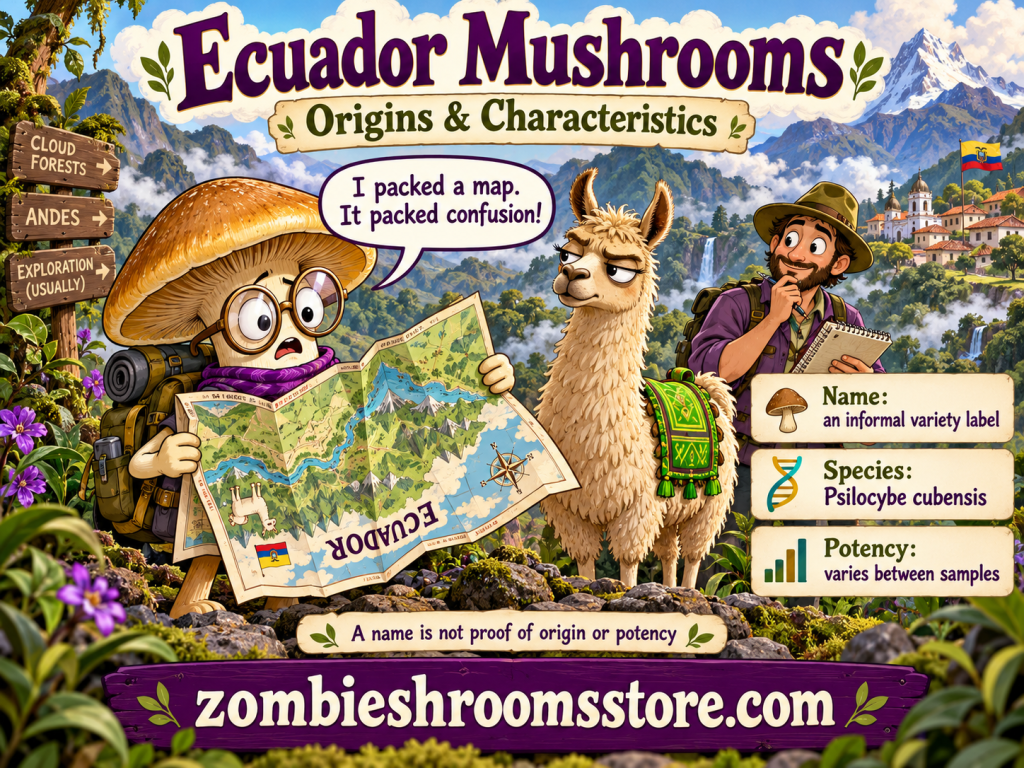
Ecuadorian mushroom names vary by region and even by community. Spanish terms, Kichwa words, and local slang coexist, and the same mushroom may carry different names in different provinces. There is no single national naming standard.
In the Andean highlands, the most recognizable edible species is the champiñón de páramo, a name applied to several grassland mushrooms. In parts of the Sierra, people also use callampa, a term borrowed from Quechua-influenced usage elsewhere in the Andes. Coastal communities may simply say hongo or seta depending on the speaker’s background.
Highland Sierra Naming
Sierra communities tend to name mushrooms by habitat and appearance. Terms often reference the páramo, the pasture, or the tree the fungus grows near. Markets in cities such as Cuenca and Quito sell wild mushrooms seasonally, usually under generic local names rather than precise species labels.
This naming style is practical rather than taxonomic. Two mushrooms that look similar may share a name even if they belong to different species. Buyers should ask vendors about origin and preparation rather than relying on a label.
Amazon and Coastal Variations
In the Amazon basin, Kichwa and Shuar communities maintain their own classification systems, often tied to use rather than morphology. Some species are food; others are medicine, ritual items, or simply ignored. Coastal naming is less documented and draws on both Spanish and Afro-Ecuadorian traditions.
Why Names Are Inconsistent
Regional naming reflects local ecology, language history, and limited scientific standardization. A mushroom called champiñón in one province might not be the same species sold under that name elsewhere. This inconsistency is common worldwide and reinforces a simple rule: local names are not identification.
Notable Edible Mushrooms of Ecuador
Ecuador’s edible fungus diversity includes both wild-harvested species and cultivated varieties. The list below covers the most commonly discussed groups, though precise species identification often requires expert examination.
Páramo and Highland Edibles
Highland grasslands yield several edible species, including mushrooms in the genera Agaricus and Macrolepiota. These are among the types of edible mushrooms most familiar to Sierra communities, appearing after seasonal rains. Their resemblance to well-known Northern Hemisphere species makes them appealing but also demands careful checking for poisonous look-alikes.
Forest and Wood-Decay Species
Cloud forests produce oyster mushrooms (Pleurotus species) and related wood-rotters. Oyster mushrooms are widely cultivated and among the most recognizable edible fungi, which makes them a useful reference point. However, false oyster mushrooms and other look-alikes exist, so identification should never rely on resemblance alone.
Cultivated and Market Varieties
Urban markets increasingly sell cultivated button mushrooms, shiitake, and oyster mushrooms alongside wild harvests. Cultivated varieties are the safest entry point for anyone building a list of edible mushrooms to try. Wild-collected species sold in markets carry more uncertainty because vendors may not distinguish similar-looking species.
How to Tell If a Mushroom Is Edible
This is the question that matters most, and the honest answer is that no single rule guarantees safety. Edible wild mushrooms exist in abundance, but so do toxic species, and some deadly mushrooms resemble edible ones closely. Learning how to tell if a mushroom is edible requires structured study, not shortcuts.
The Limits of Folk Rules
Claims that “all brightly colored mushrooms are poisonous” or that “mushrooms growing on wood are safe” are unreliable. Toxicity does not follow color, habitat, or taste. Many dangerous species taste mild, and some edible ones look alarming. Discard folk rules and rely on species-level identification.
A Practical Identification Framework
Identifying edible wild mushrooms responsibly involves several steps. Confirm the mushroom’s key features: cap shape, gill or pore structure, stem characteristics, spore color, and habitat. Check whether it grows on soil, dead wood, or living trees, and note the surrounding plants.
Then compare against authoritative references and, ideally, a local expert. A spore print helps confirm genus but not species. When any feature is ambiguous, treat the specimen as inedible. This cautious framework applies equally to Ecuador mushrooms and to species in the United States.
Poisonous Look-Alikes to Know
False oyster mushrooms, sometimes called Pleurocybella or similar names, can confuse beginners. Several toxic Amanita species resemble edible Agaricus mushrooms, particularly in the button stage. The deadly Galerina genus shares habitat with edible wood-rotters.
These examples illustrate why mushroom identification demands attention to fine detail. A single misidentified feature can be dangerous, and no online list substitutes for hands-on training.
Ecuador Mushrooms and Global Edible Categories
Readers familiar with North American or European foraging will recognize many of the same categories in Ecuador. The country’s fungi include gilled mushrooms, boletes, bracket fungi, puffballs, and jelly fungi. Each category contains edible and toxic members.
Understanding these broad categories helps when comparing local species to known ones. It also highlights a recurring problem: related species can differ in edibility. A bolete that is safe in one region may have a toxic relative in another. Anyone researching edible fungus across regions should assume that regional variants require separate verification.
Wild Versus Cultivated
Wild-harvested Ecuador mushrooms carry the same risks as wild mushrooms anywhere. Cultivated varieties offer predictability and are the better choice for anyone unsure of identification. Market availability of cultivated mushrooms in Ecuador has grown, giving consumers safer options.
Safety, Sustainability, and Responsible Foraging
Ecuador’s fungal resources face pressure from habitat loss and unregulated harvesting. Cloud forests are among the country’s most threatened ecosystems, and clearing land for agriculture removes fungal habitat along with trees. Sustainable foraging means taking only what you can identify, leaving young specimens, and avoiding damage to substrates.
Legal and Cultural Considerations
Foraging rules vary by location and land ownership, and Ecuadorian regulations on wild harvesting are not always clearly publicized. Asking landowners for permission is both courteous and practical. Respecting local customs around mushroom gathering matters, especially in indigenous territories where traditional knowledge is closely held.
Learning From Local Expertise
The most reliable way to learn Ecuador mushrooms is through local experts who know regional species. Community knowledge, university mycology programs, and guided forays offer grounded instruction. Combine that with reputable field guides and careful practice.
Frequently Asked Questions
1. Are Ecuador mushrooms safe to eat?
Some are, but many wild species are not. Safety depends on correct species identification, which requires expert knowledge. Cultivated mushrooms sold in markets are the safer option.
2. What does champiñón de páramo mean?
It is a local Spanish name for mushrooms gathered in highland grassland, applied loosely to several edible species rather than one scientific taxon.
3. How can you tell if a mushroom is edible?
You cannot rely on simple rules. Confirm cap, gills or pores, stem, spore color, and habitat, then compare with authoritative references and local experts. If any feature is uncertain, do not eat it.
4. What do poisonous look-alikes of edible mushrooms look like?
They often share color, shape, and habitat with edible species. Examples include toxic Amanita species that resemble edible Agaricus mushrooms and Galerina species that grow near edible wood-rotters.
5. Are Ecuador’s wild mushroom names standardized?
No. Names vary by region and community, often describing habitat or appearance rather than species. Local names should never be used as identification.
6. Where can I learn more about mushroom identification?
University mycology departments, regional field guides, and experienced local foragers are the most dependable sources. For product and cultivation background, explore the Zombie’s Shrooms resource collection.
Conclusion
Ecuador mushrooms reflect the country’s remarkable geography and its layered cultural history. Regional naming remains fluid and local, while scientific documentation continues to develop. For anyone interested in edible wild mushrooms, the takeaway is consistent: knowledge, caution, and respect for local expertise matter more than any single list or rule. Approach wild fungi as a subject to study carefully, and consult the mushroom identification and product guides for further reference.