Psychedelics Education
Treasure Coast Mushrooms
Oct
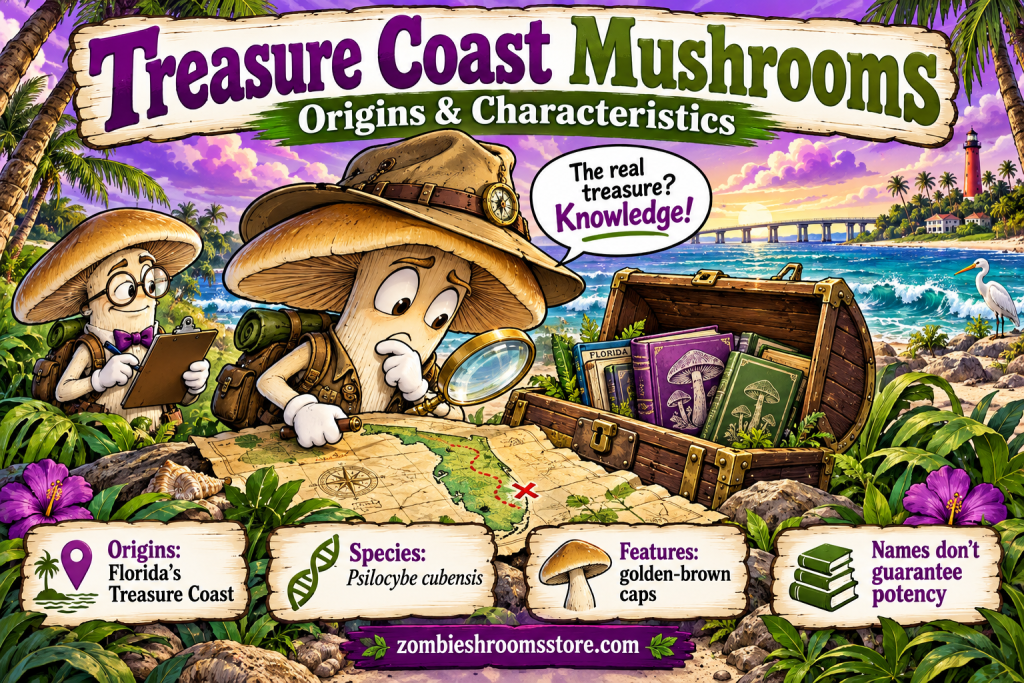
Treasure Coast Mushrooms: Origins and Characteristics
Treasure Coast Mushrooms are commonly discussed as a cultivated variety associated with Psilocybe cubensis, a species of psilocybin-containing fungus. Their name suggests a connection with Florida’s Treasure Coast, but a geographic label is not independent proof of ancestry. Understanding this variety requires separating reported history, observable characteristics, chemical measurements, and claims about effects.
That distinction becomes especially important when mushroom information appears alongside searches about LSD, often called acid. Treasure Coast mushrooms and LSD are different subjects: one concerns a named fungal variety, while the other concerns a particular psychedelic compound. They should not share an assumed identity, timetable, or legal description.
This article examines the variety’s reported origins and characteristics, explains what research can establish, and addresses common LSD questions in an educational context. It does not present either substance as a standard prescription medicine or turn personal accounts into evidence of predictable outcomes.
What Are Treasure Coast Mushrooms?
“Treasure Coast” is an informal variety or lineage name used within discussions of P. cubensis. It is not a separate scientific species. Terms such as strain, cultivar, and variety appear throughout mushroom literature and online communities, but their meaning is not always consistent. A research strain may refer to carefully documented material, while a familiar commercial label may be applied without the same supporting records. Readers should therefore ask what material a source actually describes rather than assume that every specimen bearing the name has identical genetics, appearance, or chemical composition.
The distinction between species and variety also matters when interpreting scientific findings. Research concerning P. cubensis may provide useful biological context, but it does not automatically establish a property unique to Treasure Coast. Similarly, a clinical study involving measured psilocybin cannot be treated as a trial of every mushroom variety containing that compound.
Treasure Coast Mushrooms: Reported Origins
Accounts commonly associate the Treasure Coast name with Florida. However, the sources available for this article do not establish a definitive original collection, collector, and uninterrupted chain of custody for all material now carrying the label. The most accurate wording is therefore “reported Florida association,” rather than a precise origin story presented as settled fact. Geographic names can preserve meaningful historical information, but they require documentation before they can authenticate particular specimens.
A convincing origin record would connect an identifiable collection with preserved material, dated records, and subsequent lineage information. Repetition across websites does not provide that connection. If several descriptions repeat the same claim without identifying their original source, the repetition increases the claim’s visibility rather than its reliability. Treasure Coast Mushrooms should also not be assigned an Indigenous ceremonial history merely because the name refers to a place. Such claims require separate historical and cultural evidence.
What Genetic Research Can Contribute
Genetic research can help clarify relationships among sampled mushrooms, but it cannot resolve every historical question attached to an informal name. A 2023 study examined domestication and genetic diversity in P. cubensis, finding constrained diversity in cultivated material relative to naturalised populations. The PubMed paper on cubensis domestication and genetic diversity provides useful context for understanding cultivated mushroom lineages. Its broader findings should not be interpreted as authentication of every product labelled Treasure Coast. Genetic evidence needs to be connected to the actual material under discussion. pubmed.ncbi.nlm.nih.gov
Characteristics: Appearance and Its Limitations
Descriptions of Treasure Coast Mushrooms often discuss cap pigmentation, stem form, and variation among fruiting bodies. These observations can describe particular material, but they do not establish a unique visual signature that reliably separates the variety from other P. cubensis labels. Developmental stage and environmental conditions can influence appearance, while photographs introduce additional differences through lighting and camera settings. A professional description should make those limitations visible instead of converting a collection of reported traits into an identification checklist.
Appearance is also a poor substitute for chemical analysis. A large specimen is not automatically more concentrated in psychoactive compounds, and a pale or dark cap cannot establish strength. When comparing photographs, readers should distinguish an observation about shape or colour from a claim about identity, ancestry, or potency. Those questions require different evidence, and a photograph cannot answer them all.
Pale Specimens and Pigment Terminology
Online mushroom descriptions sometimes use “albino” and “leucistic” loosely. Both concern pigmentation, but they should not be treated as interchangeable labels based solely on a pale photograph. Lighting, maturity, and variation can affect how a specimen appears. A description should identify whether a pigment characteristic was documented in authenticated material or simply reported by an observer. Even a verified pigmentation difference would not establish a particular psychedelic effect, higher potency, or greater safety.
Treasure Coast Mushrooms and Potency Claims
Claims about strength need measurements of authenticated samples rather than a familiar variety name. Research on P. cubensis has documented differences between cultivated strains and between individual fruiting bodies within strains. A study examining 14 strains under controlled conditions reported substantial chemical variability. This provides a reason to avoid fixed rankings such as “always stronger” or “consistently mild.” A result from one batch cannot establish the composition of unrelated material carrying the same label. pubmed.ncbi.nlm.nih.gov
A meaningful potency comparison identifies the compounds measured, analytical method, number of specimens, and whether results concern fresh or dried material. It should also report variation rather than only an average. Chemical concentration and clinical benefit remain separate questions: a sample containing more of a compound is not thereby safer or more effective as a treatment. Neither Treasure Coast nor another variety name should be used as a substitute for those distinctions.
Are Treasure Coast Mushrooms the Same as Acid?
No. Treasure Coast mushrooms are discussed as biological material associated with a psilocybin-containing species. Acid is a common informal name for LSD. Although both substances appear in discussions of psychedelics, they are chemically distinct and can differ in their effects and duration. Treating “psychedelic” as one uniform category obscures those differences. It also encourages misleading assumptions, such as applying an LSD timetable to mushrooms or assuming that similar subjective descriptions identify the same substance.
The distinction is especially important when reading an account from someone who says they “tripped on acid.” That wording records how the person understood the experience; it does not independently verify the chemical involved. An unknown product can be misrepresented, and effects alone cannot reliably establish its identity.
LSD Meaning: What Does the Name Stand For?
The LSD meaning in drug education is lysergic acid diethylamide. LSD is classified as a hallucinogen, and acid is one of its common informal names. “LSD vs acid” therefore usually compares two names for the same substance rather than two different drugs. However, the word acid has broader meanings outside this context, and an informal label on an unknown product is not chemical confirmation. Educational writing should explain the terminology clearly while preserving that uncertainty.
The question “is LSD a hallucinogen?” has a direct answer: yes. Hallucinogenic effects can involve altered perception, sensory experiences, and a changed sense of reality. However, classification does not mean every exposure produces the same experience. MedlinePlus describes LSD as a hallucinogen and explains that its effects can include both perceptual changes and distressing reactions. LSD: MedlinePlus Medical Encyclopedia
Psilocybin and LSD: A Clear Comparison
| Subject | Psilocybin-containing mushrooms | LSD |
|---|---|---|
| What is being described? | Fungal material containing particular compounds | A specific psychedelic compound |
| Relevant terminology | Species and informal variety names | Lysergic acid diethylamide; “acid” |
| Does appearance verify contents? | No | No |
| Can effects establish identity? | No | No |
| Is duration interchangeable? | No | No |
| Do research findings apply to every product? | No | No |
This comparison separates terminology rather than offering a choice between substances. A shared description such as “visual” or “intense” does not establish equivalent exposure, safety, or medical value. Likewise, findings from a study involving one compound should not be transferred to another without relevant evidence.
How Long Does It Take for Acid to Kick In?
Health Canada describes LSD effects as developing gradually, generally within 30–60 minutes, reaching their greatest intensity around two to four hours, and fading over a period of approximately 10–12 hours. These are general descriptions, not a guaranteed schedule for an individual or an unidentified product. The Health Canada LSD information page provides the public-health context behind those figures. A variety label such as Treasure Coast has no bearing on LSD timing. Canada.ca
How Long Can It Take for Acid to Kick In?
There is no dependable maximum waiting time that can establish an unknown product’s identity or safety. The question may involve actual LSD, another substance, or uncertain exposure. A delayed response does not prove that a product is inactive, and taking more to compensate for an apparent delay can increase risk. Timing estimates should therefore remain educational descriptions rather than instructions for managing consumption. If the question follows accidental ingestion or concerning symptoms, medical or poison-control advice is more appropriate than trying to interpret a clock.
What Does “Tripped on Acid” Describe?
“Tripped on acid” is informal language for an experience attributed to LSD. It does not specify the substance’s verified identity, the person’s health, other exposures, or the conditions surrounding the event. Personal accounts can help describe how someone felt, but they cannot establish predictable effects for other people. Reports of insight, fear, euphoria, or confusion should therefore be understood as subjective experiences rather than fixed properties of a product.
A distressing account also should not be dismissed because other people describe positive experiences. MedlinePlus notes that LSD can produce frightening reactions and impaired perception. Someone experiencing severe confusion, unsafe behaviour, or other concerning symptoms needs appropriate assessment rather than reassurance based solely on another person’s story. LSD: MedlinePlus Medical Encyclopedia
Questions About How People Take Acid
Searches such as “how to take acid drug,” “how do you take acid,” and “how to do acid” can reflect curiosity, uncertainty about an exposure, or interest in consumption. In an educational article, the useful response is to explain the substance and its risks without presenting a method, quantity, or procedure. There is no consumption technique that can make an unidentified substance predictable or turn an unregulated product into an approved medicine. A method described online also cannot resolve uncertainty about ingredients.
If someone is asking because another person may have taken a substance, focus on their condition rather than the name used. Tell medical professionals what is known about the product, timing, symptoms, and other possible exposures. Preserve relevant packaging if available. Do not delay help while trying to decide whether the symptoms “match” an expected psychedelic experience.
Is Acid Illegal in the United States and Canada?
In the United States, LSD is federally controlled as a Schedule I substance. The DEA’s LSD fact sheet explains that classification. Scientific interest and authorised research do not create general permission for possession, sale, or distribution. A statement that psychedelics are being studied therefore should not be interpreted as a statement that retail acid products have been approved. dea.gov
In Canada, LSD is controlled under Schedule III of the Controlled Drugs and Substances Act. Authorised research is distinct from ordinary consumer activity, and legal questions depend on the substance, conduct, and applicable authorisation. Psilocybin-containing mushrooms are subject to their own controls. The phrase “is acid illegal” deserves a jurisdiction-specific answer rather than a global yes-or-no statement that overlooks regulated exceptions. CAMH
Research Interest Does Not Establish Medical Approval
Scientists are studying psychedelics for potential therapeutic applications, but that work does not establish a medical benefit unique to Treasure Coast Mushrooms. Clinical research concerns a defined intervention, selected participants, measured outcomes, and professional oversight. A named mushroom variety cannot stand in for those details. Similarly, research involving LSD cannot demonstrate the effectiveness of a psilocybin-containing mushroom.
The National Center for Complementary and Integrative Health explains that psilocybin experiences can be unpredictable and that safety concerns remain important. Readers should distinguish an emerging research question from an approved indication or an established treatment recommendation. Anyone seeking help for a health condition should discuss appropriate care and legitimate research options with a qualified healthcare professional. nccih.nih.gov
Frequently Asked Questions
1. Are Treasure Coast Mushrooms a separate species?
No. Treasure Coast is commonly used as a variety or lineage name associated with Psilocybe cubensis. It should not be presented as a separate scientific species or a standardised medicine.
2. Is the Florida origin completely verified?
The name is commonly associated with Florida, but the sources checked here do not establish a definitive lineage history for all material carrying it. Precise origin claims need traceable records.
3. Is LSD the same as acid?
In drug-related conversation, acid usually means LSD. However, an informal label cannot independently verify the chemical contents of an unfamiliar product.
4. Do Treasure Coast mushrooms and LSD follow the same timetable?
No. They involve different compounds, and general timing descriptions should not be transferred between them. Unknown product contents create additional uncertainty.
5. Can a variety name predict strength or effects?
No. A name cannot establish chemical concentration, individual response, safety, or therapeutic benefit. Those questions require different forms of evidence.
Where to Explore Further
For another example of evaluating a geographic variety name, read Amazonian Mushrooms: History, Characteristics and Common Questions.
For further discussion of cultivated labels and research limitations, explore B+ Mushrooms: Background, Characteristics and Research.