Psychedelics Education
Amazonian Mushrooms
Oct
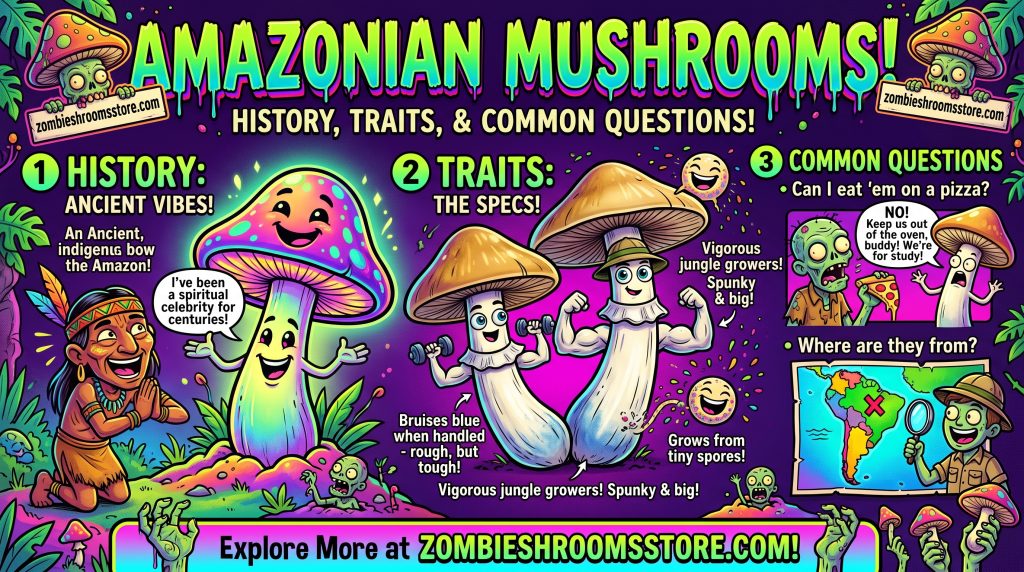
Amazonian Mushrooms: History, Characteristics, and Common Questions
Amazonian Mushrooms are a named variety associated with Psilocybe cubensis, a species of psilocybin-containing fungus. Their name suggests an Amazon-region connection, but a geographic label does not independently verify the ancestry or collection location of every specimen carrying it.
Published literature has included material described as an Amazonian strain. That establishes the name’s use in research, rather than proving that all similarly labeled material has identical characteristics or chemical composition. PMC
Understanding this topic also requires separating psychedelic varieties from ordinary edible mushrooms. Questions about fiber, potassium, calories, and dietary benefits generally concern foods such as button, oyster, and shiitake mushrooms.
This guide examines the reported background, explains what physical descriptions can establish, and answers common nutrition questions without transferring culinary benefits to a psilocybin-containing variety.
What Does the Amazonian Name Identify?
“Amazonian” is used as a cultivated variety or lineage label within P. cubensis. It is not the name of a separate scientific species.
A species name provides a biological classification. A variety label may describe a selected line, reported origin, or familiar set of characteristics. The label alone does not authenticate its pedigree.
Terms such as “strain,” “variety,” and “cultivar” are sometimes used loosely in mushroom discussions. Readers should therefore examine the supporting documentation rather than assume that the terminology guarantees consistency.
Geographic Names Need Supporting Records
A geographic association can be useful historical context. However, reliable provenance requires records connected to identifiable material.
Those records might include collection details, preserved specimens, culture histories, or genetic information. Repetition across websites cannot substitute for that documentation.
For Amazonian Mushrooms, careful wording distinguishes a reported connection with the Amazon region from verified ancestry. It also avoids assuming that every product bearing the name represents the same cultivated line.
History: What Is Documented and What Remains Uncertain?
The Amazonian designation appears in historical mushroom literature and later scientific discussions. Accounts of its background commonly connect it with South America, while some commercial descriptions use names such as PES Amazon or PES Amazonian.
These overlapping names should not automatically be treated as proof of one uniform lineage. Sources may use them differently or repeat accounts without presenting original records.
A modern scientific review includes previously reported chemical measurements for material labeled as an Amazonian strain. Such references show that the designation has a research history, but they do not resolve every question about its origin. PMC
The geographic name also does not establish a particular Indigenous tradition. Claims about ceremonial use or community practices require their own historical and ethnographic evidence.
Amazonian Mushrooms: Commonly Reported Characteristics
Descriptions often emphasize substantial fruiting bodies, pale stems, and pigmented caps. Historical cultivation literature has described Amazonian material as producing medium-to-large mushrooms with thick whitish stems. en.psilosophy.info
These are reported observations, not unique identifying features. Other cultivated P. cubensis varieties can share similar traits.
Maturity and environmental conditions can also affect appearance. Photographs may introduce further differences through lighting, editing, and camera settings.
| Description or claim | What readers should understand |
|---|---|
| Amazonian variety | A label associated with P. cubensis |
| Geographic origin | Requires traceable records |
| Large fruiting bodies | Does not independently establish potency |
| Thick stems | A reported trait, not reliable authentication |
| Consistent strength | Requires appropriate chemical measurements |
| Predictable experience | Cannot be established by the name alone |
A visual description should explain reported characteristics without becoming a checklist for identifying unfamiliar mushrooms.
Chemical Composition Requires Testing
Psilocybin and psilocin are among the compounds investigated in P. cubensis. Their concentrations cannot be established from a variety name, photograph, or specimen size.
The PubMed review of cubensis strains and research gaps discusses genetic diversity, physical variation, and environmental influences on psychoactive compounds. It provides context for why broad claims about named varieties require caution. pubmed.ncbi.nlm.nih.gov
For Amazonian Mushrooms, a meaningful chemical comparison needs authenticated material, a clearly described analytical method, and adequate sampling.
Questions to Ask About Potency Claims
Before accepting a numerical claim, check:
- Which material was examined.
- Whether results used fresh or dry weight.
- Which compounds were measured.
- How many specimens were tested.
- Whether the findings apply to the sample being discussed.
A measurement characterizes tested material. It does not automatically establish a fixed value for every specimen sharing its label.
Likewise, a higher concentration does not demonstrate greater safety or a better medical outcome. Those are separate questions requiring different evidence.
Edible Mushrooms and Psychedelic Varieties Are Different Categories
Nutrition searches often use the word “mushrooms” without specifying a species. That can create misleading connections.
Button mushrooms and other culinary varieties are foods. Amazonian Mushrooms are discussed as psilocybin-containing material. Nutritional information about the former should not be presented as a reason to consume the latter.
| Question | Appropriate subject |
|---|---|
| Do mushrooms have fiber? | Identified edible mushrooms |
| What are button mushroom nutrients? | Culinary Agaricus bisporus |
| How many calories are in a serving? | A specified food and preparation |
| What does Amazonian mean? | A cultivated psilocybin-variety label |
| Does psilocybin have medical applications? | Defined clinical research |
The website’s guide to whether mushrooms are good for you discusses the culinary nutrition category in more detail.
Do Mushrooms Have Fiber and Nutritional Value?
Yes, edible culinary mushrooms contain fiber and nutrients. However, their contribution depends on the species, portion, and preparation.
Harvard’s Nutrition Source describes culinary mushrooms as generally low in calories and fat, with modest amounts of fiber and various nutrients. “Modest” matters: a few slices should not be presented as a concentrated fiber source. The Nutrition Source
The question do mushrooms have nutritional value therefore has a useful answer, but it should remain tied to identified food varieties.
Searches for mushroom benefits nutrition or mushrooms dietary value are best answered by examining the actual food and serving size rather than treating every fungus as nutritionally interchangeable.
Nutrients in Mushrooms
Common culinary varieties can contribute B vitamins and minerals such as potassium, copper, and selenium.
A dietary modeling study examined adding a serving of culinary mushrooms to estimated diets. It projected improvements in several nutrient intakes, including fiber and potassium. Because this was a modeling study, it did not demonstrate that eating mushrooms directly caused better health outcomes. PubMed
The study’s PubMed record explains its methods and findings. Its results concern culinary mushrooms, not Amazonian material.
Button Mushroom Nutrients, Calories, and Potassium
White button mushrooms are familiar culinary ingredients, often used in soups, omelets, pasta, and vegetable dishes.
When researching nutritional value of mushrooms calories, distinguish the plain ingredient from the finished recipe. Added butter, cream, cheese, oil, or sauces change a dish’s nutritional profile.
The same principle applies to button mushroom nutrients. A small garnish contributes less than a larger serving, and fresh and dried weights should not be compared without accounting for their different water content.
Are mushrooms high in potassium? They can contribute potassium, but the amount depends on the variety and portion. “Contains potassium” should not automatically become a “high potassium” claim. Use a reliable food-composition entry or product label for the specific serving.
Benefits of Eating Mushrooms: Keeping Claims Realistic
For culinary mushrooms, practical benefits include variety, savory flavor, and contributions to nutrient intake. They can make meals containing vegetables, beans, and whole grains more appealing.
That helps answer why are mushrooms good for you without promising disease prevention or a dramatic health effect. Their usefulness comes from how they fit into the overall diet.
The benefits of eating mushrooms should also be distinguished from findings involving concentrated extracts. Research on an isolated compound does not establish the same result from an ordinary food serving.
Mushroom Benefits for Women
Searches for mushroom benefits for women do not justify universal claims about fertility, hormone balance, or reproductive health.
Edible mushrooms can contribute to a varied diet for women, as they can for other adults. Specific nutritional needs depend on the individual and life stage.
Neither general food research nor the nutrient content of button mushrooms establishes a women-specific benefit for Amazonian Mushrooms. Keeping that distinction explicit prevents an educational article from implying unsupported medical effects.
Health Research and Safety
Scientific interest in psilocybin does not establish a therapeutic benefit for every cultivated variety.
Clinical research examines defined interventions, participant groups, support arrangements, and outcomes. A familiar mushroom name cannot substitute for those details.
The NCCIH psilocybin information guide explains that experiences can be unpredictable and may involve fear, confusion, or panic. It also warns that poisonous mushrooms can resemble psilocybin-containing mushrooms. www.nccih.nih.gov
For another example of separating variety descriptions from medical claims, read the website’s B+ mushroom background guide.
Frequently Asked Questions
1. Are Amazonian Mushrooms a Separate Species?
No. The name is associated with a variety or lineage within Psilocybe cubensis. It should not be presented as a separate scientific species or proof of a specimen’s ancestry.
2. Does the Name Confirm an Amazon-Region Origin?
Not by itself. A geographic label communicates an association, while verified provenance requires records linked to authenticated material.
3. Does a Large Mushroom Have Greater Potency?
Size alone cannot establish chemical concentration. Potency claims need measurements, clearly identified samples, and an explanation of how results were obtained.
4. Can Culinary Nutrition Facts Be Applied to This Variety?
No. Evidence about fiber, calories, and minerals in button or other edible mushrooms does not establish dietary benefits for a psilocybin-containing variety.
5. What Should Readers Remember About Amazonian Mushrooms?
Separate reported history, physical observations, chemical measurements, and clinical claims. Each requires its own evidence. Ordinary mushroom nutrition belongs in a distinct discussion about identified culinary foods.

Pingback: Treasure Coast Mushrooms: Origins, Traits and Research