
Psychedelics Education
Cambodian vs Golden Teacher Mushrooms
Oct
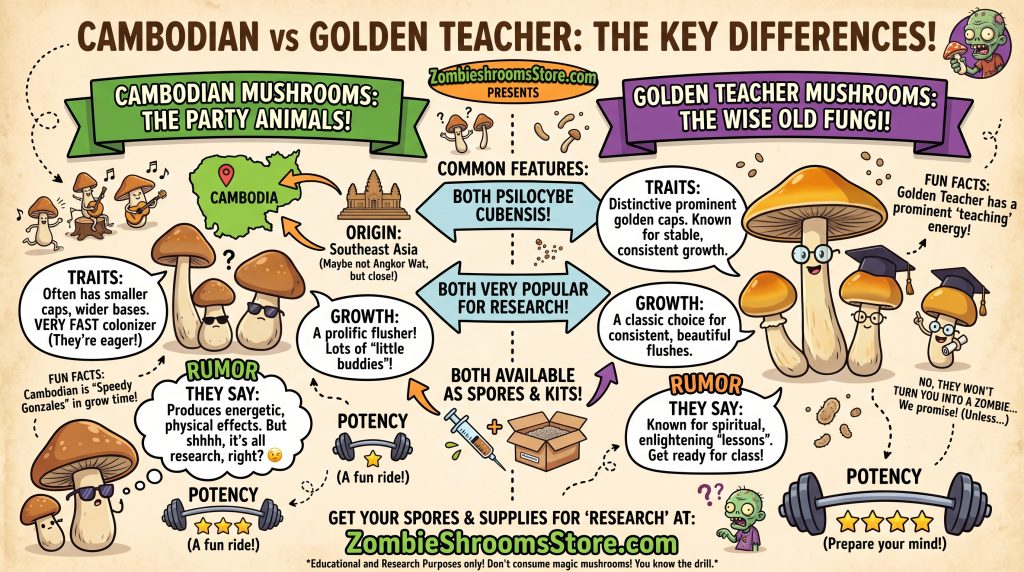
Cambodian vs Golden Teacher Mushrooms: Key Differences Explained
Cambodian vs Golden Teacher Mushrooms is a comparison between two cultivated variety names commonly associated with Psilocybe cubensis. They are generally discussed as selections within the same species, rather than separate scientific species.
Their names suggest different stories. “Cambodian” implies a geographic association, while “Golden Teacher” evokes cap coloration and a reputation for meaningful experiences. Neither name independently verifies ancestry, chemical composition, or a predictable psychological effect.
Descriptions often portray Cambodian material as energetic and Golden Teacher as reflective. These are reported impressions, not established clinical differences. A useful comparison separates observable characteristics, chemical measurements, and personal accounts.
This guide explains those distinctions. It also addresses related searches about Blue Meanies, blue caps, and mushroom bluing without treating color or nicknames as evidence of safety.
What Do These Variety Names Identify?
A scientific species name and a cultivated variety label answer different questions.
Psilocybe cubensis identifies a species. Cambodian and Golden Teacher are names commonly used for cultivated lines or selections associated with that species. Such labels do not necessarily identify a fixed genotype or a consistently documented pedigree. Rose Hill Life Sciences
This matters when interpreting comparisons. Two samples bearing different labels might share many characteristics, while specimens carrying the same label can still vary.
Names Are Starting Points for Questions
A variety name can help organize information, but readers should ask what supports the description.
Is there documented provenance? Has the material been authenticated? Are claims about chemical content based on testing? Does an account describe one specimen or a broader collection?
For Cambodian vs Golden Teacher Mushrooms, these questions provide a stronger foundation than assuming that a familiar name guarantees consistent traits.
Background and Reported Origin Stories
Cambodian material is commonly associated with accounts of mushrooms collected in Cambodia. Precise claims about a collector, location, or collection date need supporting records.
A geographic name alone cannot establish where every currently labeled specimen originated. It may preserve a reported association even when later material lacks traceable documentation.
Golden Teacher also has a widely repeated history, but detailed accounts of its first appearance should be treated carefully when original records are unavailable.
The word “Teacher” is part of the name. It does not establish that the variety reliably produces insight, emotional growth, or a therapeutic outcome.
An educational comparison can acknowledge these narratives while clearly distinguishing them from verified biological and historical evidence.
Cambodian vs Golden Teacher Mushrooms: Reported Appearance
Both varieties are commonly described using features associated with P. cubensis, including pigmented caps and pale stems.
Golden Teacher descriptions often emphasize golden or tan cap coloration. Cambodian descriptions also commonly mention tan-to-golden caps, demonstrating why color alone does not reliably distinguish the two.
Reported differences in cap proportions, stem length, and overall size should be interpreted as observations rather than fixed rules.
| Comparison point | Cambodian | Golden Teacher |
|---|---|---|
| Species association | Psilocybe cubensis | Psilocybe cubensis |
| Naming emphasis | Reported geographic association | Golden coloration and an evocative name |
| Common cap descriptions | Tan or golden | Golden or tan |
| Identification from appearance alone | Not reliable | Not reliable |
| Fixed potency established by label | No | No |
| Predictable experience established by label | No | No |
Maturity, environmental conditions, handling, and photography can all affect appearance. A picture cannot authenticate a cultivated line or establish chemical composition.
What Potency Research Can Establish
A responsible comparison needs measurements rather than assumptions about names.
A PubMed-indexed study of several cubensis strains measured psilocybin and psilocin in individual mushrooms. Its design examined differences between strains and between specimens within a strain. pubmed.ncbi.nlm.nih.gov
That study did not directly compare Cambodian and Golden Teacher material. It should therefore not be cited as proof that either variety is stronger.
Its relevance is methodological: chemical comparisons require authenticated samples, comparable testing, and adequate sampling.
Why Universal Rankings Are Weak
Statements such as “Cambodian is always stronger” or “Golden Teacher is consistently mild” require evidence that extends beyond a few personal accounts.
Before accepting a potency claim, check:
- Which material was tested.
- Whether results used fresh or dry weight.
- Which compounds were measured.
- How many specimens were examined.
- Whether the report applies to the material discussed.
Cambodian vs Golden Teacher Mushrooms cannot be reduced to a dependable strength ranking from their labels alone. A result from one sample does not characterize every specimen sharing its name.
Experiences and Clinical Evidence Are Different
Personal accounts may describe stimulation, relaxation, emotional intensity, or changes in perception. These reports can explain a variety’s reputation, but they do not establish a reproducible difference between varieties.
The NCCIH guide to psilocybin explains that experiences can vary with the person, their health, expectations, surroundings, and other factors. Unpleasant experiences may include fear, confusion, or panic. www.nccih.nih.gov
Clinical treatment studies address another question. They investigate defined interventions and outcomes under particular conditions.
Research involving measured psilocybin and psychological support should not become a claim that Golden Teacher is a treatment or that Cambodian material produces a particular benefit.
A thoughtful Cambodian vs Golden Teacher Mushrooms article keeps these different kinds of evidence separate.
Why Mushroom Tissue Can Turn Blue
Blue discoloration is a chemistry question, not a dependable variety identification method.
Researchers studying P. cubensis identified an injury-triggered sequence involving enzymes and the formation of blue products through oxidation-related reactions. The original bluing study is indexed in PubMed. PubMed
The term bluing psilocybe often refers to this kind of discoloration. It describes a reaction rather than a separate species.
Similarly, blue psilocybin is imprecise wording. The research describes blue reaction products; it does not establish a distinct blue form of psilocybin with special benefits.
Color Is Not a Potency Test
The bluing study explains a biochemical process. It does not provide a validated method for estimating a specimen’s potency by judging its color.
More visible blue staining should not automatically be interpreted as greater strength. Nor does staining establish that an unidentified mushroom is safe.
Blue reactions also occur in other fungi through different chemistry, reinforcing the need to avoid color-based shortcuts. Wiley Online Library
Blue Meanie Names Introduce Another Comparison
Searches for blue meanies strain or blue meanies mushroom strain can refer to a named P. cubensis variety. However, “Blue Meanies” is also used for the separate species Panaeolus cyanescens. pubmed.ncbi.nlm.nih.gov
Consequently, searches about blue meanie mushroom effects need clarification before any comparison is meaningful. Which organism is being discussed? What material was examined? Is the information based on research or testimonials?
Neither Cambodian nor Golden Teacher should be treated as a synonym for either meaning of Blue Meanie.
The phrase blue mini mushroom may be a misspelling or an informal product name. It does not provide enough information to establish a scientific identity.
For further terminology, see the website’s mushroom spores and species overview.
Blue Caps and Online Reference Pages
Search phrases such as blue psilocybin mushrooms and blue cap magic mushrooms describe an appearance or an informal category. They do not reliably identify an organism.
A blue-looking cap in a photograph could reflect discoloration, lighting, editing, or another characteristic. It cannot establish chemical content or suitability for consumption.
Likewise, a search for blue meanies mushrooms wiki may lead to a page discussing Panaeolus cyanescens. That page should not automatically be applied to a cubensis variety sharing the nickname.
Check the scientific name and follow the references before transferring information between pages.
Reading Comparisons Without Overinterpreting Them
Begin by identifying what each statement claims. Does it concern appearance, ancestry, chemical composition, a subjective experience, or a clinical outcome?
Each category needs different evidence. A photograph may illustrate appearance. A laboratory report addresses measured chemistry. A controlled clinical study investigates a defined health outcome.
For Cambodian vs Golden Teacher Mushrooms, avoid sources that move between these categories without explanation.
A description of “beautiful golden caps” does not establish potency. A report of emotional insight does not establish treatment effectiveness. A species name does not independently authenticate an individual sample.
The website’s Albino Penis Envy background guide offers another example of separating reported physical traits from chemical and medical claims.
Health and Legal Considerations
Neither variety name removes the risks associated with psilocybin or unidentified fungi.
NCCIH notes that poisonous mushrooms can resemble psilocybin-containing mushrooms. Online photographs and comparison articles should not replace qualified identification. www.nccih.nih.gov
Legal questions also depend on jurisdiction and the material involved. NCCIH identifies psilocybin as federally controlled in the United States while noting evolving state and local policies. Decriminalization, reduced enforcement priority, and regulated access are different arrangements. www.nccih.nih.gov
A variety’s popularity does not establish legal permission or medical suitability.
Frequently Asked Questions
1. Are Cambodian and Golden Teacher Different Species?
Both names are commonly associated with cultivated Psilocybe cubensis material. They are variety labels rather than separate scientific species. The label alone does not establish a documented pedigree. Rose Hill Life Sciences
2. Is One Reliably Stronger Than the Other?
The evidence discussed here does not establish a universal ranking. A meaningful comparison requires authenticated samples, comparable chemical measurements, and sufficient sampling.
3. Does Golden Teacher Guarantee a Reflective Experience?
No. The name does not establish a predictable psychological outcome. Experiences can vary widely, and personal testimonials should not be presented as clinical evidence. www.nccih.nih.gov
4. Does Blue Staining Prove High Potency?
No. Bluing research explains a chemical reaction, not a validated visual potency test. Color also cannot establish the safety of an unidentified mushroom. PubMed
5. What Is the Main Lesson From Cambodian vs Golden Teacher Mushrooms?
Distinguish names, observations, measurements, and medical claims. Reported traits provide context, chemical testing addresses composition, and clinical studies address specific treatment questions. No variety name answers all of them.